Collaboration vs Cooperation: What Is the Difference? (2026) | The Collaborative Organization
By The Collaborative Organization Team · November 19, 2026 · Last verified November 19, 2026 · 9 min read

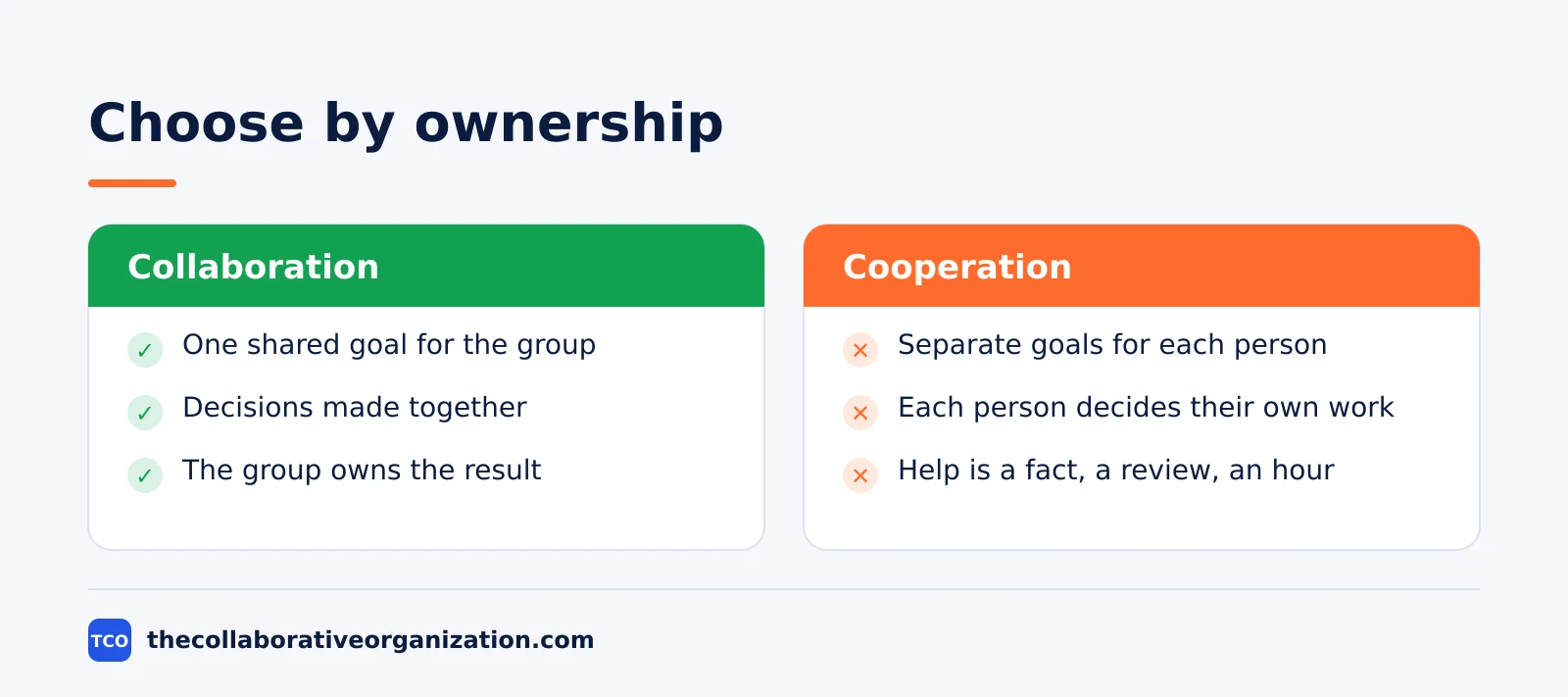
Collaboration means a group shares ownership of one result and shapes it together, while cooperation means people help each other reach their own separate goals. The difference is not how much people talk, but how much ownership they share.
Key takeaways
- Collaboration has one shared goal and shared ownership of the result.
- Cooperation has separate goals, with people helping each other along the way.
- Coordination sits between them: it lines up timing and handoffs for separate work.
- Collaboration needs joint decisions and frequent sharing; cooperation can work with occasional help.
- Pick collaboration for hard shared problems, and cooperation for mostly separate tasks.
What collaboration means
Collaboration is a group of people working together to reach a goal they all share, shaping the work and the result together. Indeed defines it as a group working alongside each other to complete a shared objective, with planning, discussion and the exchange of ideas and materials.
The key word is shared. The goal belongs to the group, the decisions are joint, and the credit belongs to the group too. A product team that builds a launch plan together, with engineering, design and marketing each changing the plan, is collaborating.
Collaboration also creates something new. Nira puts it plainly: collaboration is a process of working with others to create something new, while cooperation is working with others for a common benefit. The output of collaboration is a joint result, not a set of separate pieces.
What cooperation means
Cooperation is people supporting each other and their distinct goals, while each person keeps ownership of their own work. Indeed defines it as individuals supporting each other and their distinct goals, and notes that people who cooperate may not share a common goal at all.
A designer who shares a file with a developer is cooperating. A sales rep who passes a customer note to marketing is cooperating. Each person helps, and each keeps their own task and their own deadline.
Cooperation runs on goodwill and return help. People assist a colleague today and expect support in return later, and the help is usually light: a fact, a review, an introduction, or an hour of time. It does not need a shared plan or a joint decision.
The core difference in one table
The core difference is ownership: collaboration shares it, cooperation keeps it separate. Everything else follows from that one fact, and the table below sets out the contrast.
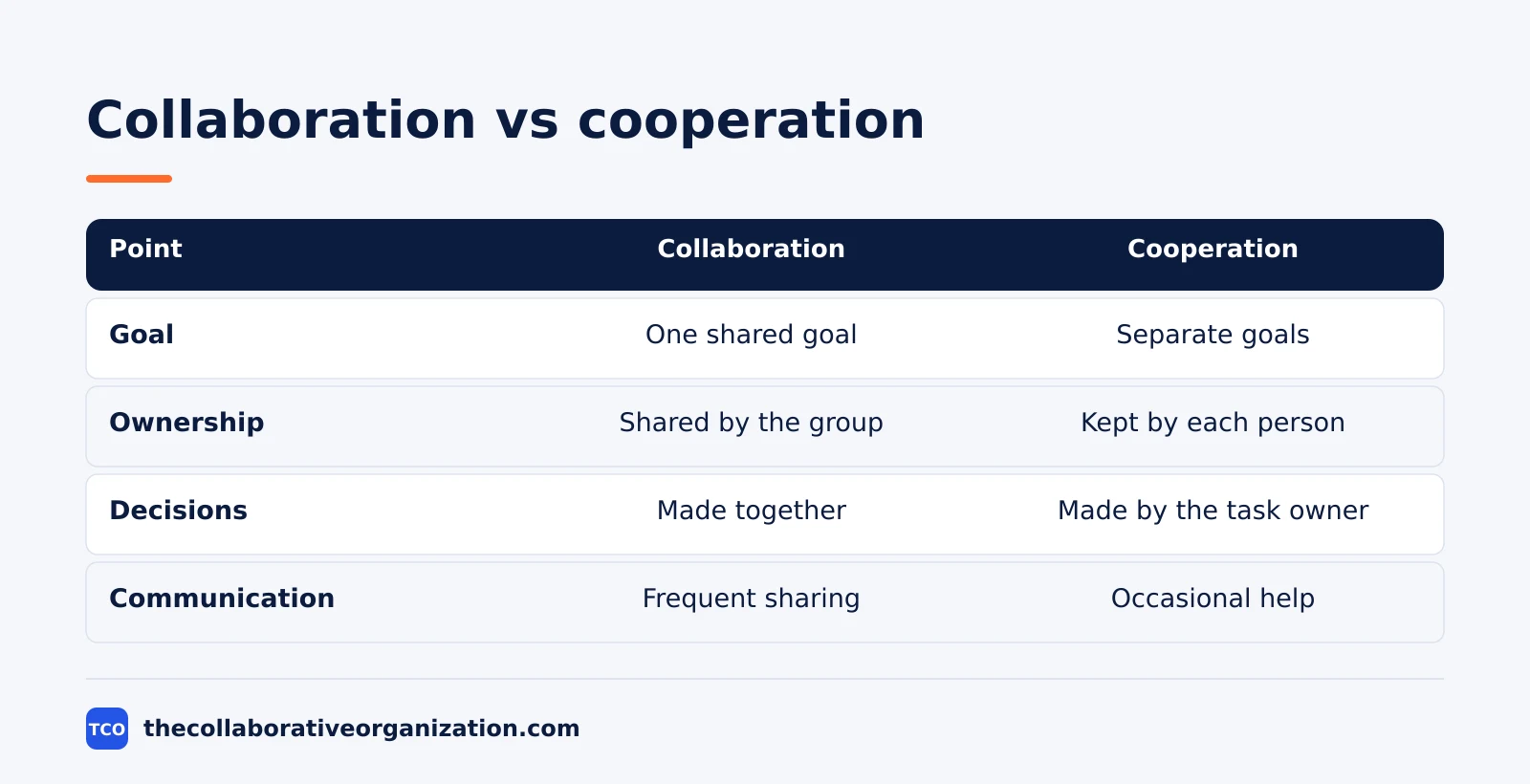
| Point | Collaboration | Cooperation |
|---|---|---|
| Goal | One shared goal for the whole group | Separate goals for each person |
| Ownership | Shared: the group owns the result | Individual: each person owns their work |
| Decisions | Made together by the group | Made by the owner of each task |
| Process | Collective: people depend on each other | Connective: people help and link up |
| Communication | Frequent sharing of facts and resources | Occasional help, facts or reviews |
| Identity | Often named, with a start and end date | Rarely named, part of normal work |
Indeed draws the same line on ownership and process. Collaboration implies shared ownership, while cooperation suggests individual ownership, and collaboration is a collective process where people depend on each other, while cooperation is a connective process of mutual help, according to Indeed.
A useful test comes from the La Crosse Area Community Foundation: cooperation means you handle your part and I handle mine, while collaboration means building something together from the ground up. The Foundation frames cooperation as coordinated actions and shared facts, and collaboration as shared goals, pooled resources, joint decisions and co-ownership of outcomes.
Where coordination fits
Coordination sits between cooperation and collaboration: it lines up timing, order and handoffs so separate work fits together. It does not need shared ownership, but it does need a plan. A designer finishing mockups before a developer starts is coordination, not collaboration.
The Enterprise World sets out the scale in order: cooperation is a helpful hand, coordination is everyone knowing where to stand, and collaboration is building the thing together. Cooperation shares facts or help, coordination organizes activities and timing, and collaboration jointly shapes the work and shares responsibility for the outcome.
The scale helps a team pick the lightest mode that works. A simple update needs cooperation, a clear sequence needs coordination, and a hard problem that needs joint thinking needs collaboration. Picking the heaviest mode for a light task wastes time and adds meetings nobody needs.
Collaboration vs cooperation examples
Examples make the line clear, because the same two people can cooperate on one task and collaborate on the next. The difference is the goal and the ownership, not the people involved.
Cooperation examples include a writer asking an editor to review a draft, a developer sharing a code snippet with a teammate, and a support agent passing a bug report to engineering. Each person keeps their own task, and the help is a favor that speeds the work.
Collaboration examples include a product, design and engineering team building a launch together, a marketing and sales team writing a joint campaign plan, and a cross-team group redesigning a checkout flow. Each group shares the goal, makes decisions together and owns the result together.
Our guide to what a RACI matrix is helps in both modes: it names who does the work and who approves it, so cooperation stays clear and collaboration stays owned.
A team that works in Scrum uses the same clarity in each sprint, with a shared goal and named owners for each item.
When to choose collaboration
Choose collaboration when the problem needs several kinds of knowledge, when no one person can solve it alone, and when the result needs joint decisions. Product launches, process redesigns and hard customer problems fit that shape.
Collaboration pays when the cost of a wrong decision is high, since more views catch risks early. It also pays when the result must feel owned by the whole group, such as a new way of working that every team must adopt. Shared ownership makes adoption easier, because people defend a plan they helped shape.
Harvard Business Review draws a related line, quoted by Slack: cooperation often involves sharing facts or resources, while collaboration involves shared ownership of an outcome. That line appears in Slack and it is the same test used in this article: ask who owns the result.
When to choose cooperation
Choose cooperation when tasks are mostly separate and each person only needs a hand, a fact or a review from someone else. Routine work, expert advice and quick favors all fit cooperation, and forcing them into a joint project adds cost without adding value.
Cooperation is also the right mode when speed matters and one person can decide alone. A writer who needs a fact from sales does not need a joint planning session, and a developer who needs a code review does not need a shared goal. A short request, a clear deadline and a thank-you are enough.
The risk of cooperation is drift: help that never arrives, or help that arrives too late to use. The fix is small and practical: name what you need, name the date you need it, and confirm receipt. That much structure keeps cooperation fast without turning it into a project.
Can you combine collaboration and cooperation?
Yes, and most teams do: they collaborate on the shared result and cooperate on the separate tasks around it. A launch team collaborates on the launch plan, and each member cooperates with people outside the team for facts, reviews and approvals.
The mix works when the team names which mode applies where. The launch plan is collaboration, with joint decisions and shared ownership, while the legal review of the copy is cooperation, with one owner and a clear deadline.
Chaco Canyon notes a related split: collaborations form by intention, have defined identities and start and end dates, while cooperations rarely have names and rarely form by intention. Naming the mode is the first step to running it well.
Tools that fit each mode
Collaboration needs a shared workspace where the group shapes the work together, while cooperation needs a fast way to ask for help and share a fact. One chat tool and one task board cover both modes. Our project management software shortlist compares the task boards side by side.
| Tool | Best for | Free plan | Starting price (as of November 2026) | Notable limit |
|---|---|---|---|---|
| Asana | Joint projects with a named owner per task | Free for 2 people | $10.99 per user per month, billed annually | Free plan covers 2 people |
| monday.com | Visual boards for shared plans and status | Free plan for up to 2 seats | $9 per seat per month (Basic), billed annually | Paid plans need at least 3 seats |
| ClickUp | Docs, tasks and chat in one place | Free Forever plan | $9 per user per month (Core), billed annually | Yearly billing needed for that price |
The Asana price comes from Asana pricing: Starter is $10.99 per user per month when billed annually. On the monday.com pricing page, Basic is $9 per seat per month billed annually. The ClickUp pricing page lists Core at $9 per user per month billed yearly.
A shared board shows the joint work and its owners, which suits collaboration. A chat thread suits cooperation, since a quick question and a quick answer need no board at all. The rule is the same in both modes: one home per job, so nobody has to guess where the latest version lives.
Common collaboration vs cooperation mistakes to avoid
The most common mistake is calling cooperation collaboration, and then wondering why nobody owns the result. The label sets the expectation, so use the right one.
- A review called collaboration. If one person writes the plan and the rest only approve it, that is cooperation, not collaboration.
- A joint project with no shared owner. If nobody owns the result, the group waits for someone else to decide.
- Cooperation treated as a project. A quick favor does not need a kickoff meeting, a shared goal and a weekly review.
- Collaboration treated as a favor. A joint decision does need a meeting, a record and an owner, or it never gets made.
- No record of the mode. When the team never names the mode, each person assumes a different one, and the work stalls.
Ask one question at the start of any joint work: who owns the result, the group or one person? The answer picks the mode, and the mode picks the habits. Our guide on how to choose project management software shows how a shared board keeps that answer visible.
Sources
- Indeed - Collaborate vs. Cooperate: Definitions and Differences (2026)
- La Crosse Area Community Foundation - From Cooperation to Collaboration: What Is the Real Difference? (2025)
- The Enterprise World - Collaboration vs Cooperation in Business: When to Use Each (2026)
- Nira - Collaboration vs Cooperation and Why It Matters (2026)
- Chaco Canyon - Collaborations or Cooperations? (2022)
- Slack - Cross-Functional Collaboration: Why It Is Important (2026)
- Asana - Pricing (2026)
- monday.com - Pricing (2026)
- ClickUp - Pricing (2026)
Frequently asked questions
What is the main difference between collaboration and cooperation?
The main difference is ownership. Collaboration means a group shares ownership of one result and shapes it together. Cooperation means people help each other reach separate goals, while each person keeps ownership of their own work. The work in collaboration is joint; the work in cooperation is parallel.
Is cooperation the same as collaboration?
No. The two words sound alike, but they describe different ways of working. Collaboration needs a shared goal, joint decisions and shared credit for the outcome. Cooperation needs only a willingness to help, such as sharing facts or lending time, while each person keeps their own goal.
Can you cooperate without collaborating?
Yes. A designer can share a file with a developer, or a sales rep can pass a customer note to marketing, without joining a shared project. That help is cooperation. It becomes collaboration only when both people shape the same result together and share responsibility for how it turns out.
When should you choose collaboration over cooperation?
Choose collaboration when the problem needs several kinds of knowledge, when no one person can solve it alone, and when the result needs joint decisions. Choose cooperation when tasks are mostly separate and each person only needs a hand, a fact or a review from someone else.
What is coordination, and where does it fit?
Coordination sits between cooperation and collaboration. It means organizing timing, order and handoffs so separate work lines up, such as a designer finishing mockups before a developer starts. Cooperation is helping, coordination is lining up, and collaboration is building the result together.
Related articles

project management
How to Choose Project Management Software (2026)
Pick project management software in seven steps: define the work, count seats, price the real cost, and run a two-week pilot before you pay.
November 19, 2026 · 10 min read

project management
What Is a RACI Matrix? Definition, Roles and Examples (2026)
A RACI matrix maps who is Responsible, Accountable, Consulted and Informed for each task. Learn the four roles, how to build one, and see a worked example.
November 19, 2026 · 9 min read

project management
Daily Standup Meeting Format That Works (2026)
A daily standup is a 15-minute meeting where Developers inspect progress toward the Sprint Goal and plan the next day. Use this format to run one that ends on time.
November 19, 2026 · 10 min read