How to Get Team Buy-In for New Software (2026) | The Collaborative Organization
By The Collaborative Organization Team · November 19, 2026 · Last verified November 19, 2026 · 9 min read
Team buy-in for new software comes from involving people before the decision, not from announcing it after. Explain the change in the terms of the people who will live with it, let them test the tool before you buy, and show one early result that proves the switch was worth it.
Key takeaways
- People support what they help create, so involve daily users in the choice before you sign a contract.
- Buy-in follows the ADKAR sequence: Awareness, Desire, Knowledge, Ability and Reinforcement, in that order.
- Prosci’s research finds initiatives with excellent change management are six times more likely to meet their objectives.
- Train each role on the screens they will actually use, in short hands-on sessions during normal work hours.
- One visible pilot result convinces more skeptics than any launch email from leadership.
Why teams resist new software
Teams resist new software when they do not know why it is happening, when it makes their day harder, or when they had no say in the choice. Resistance is rarely stubbornness. It is usually a signal that one of those three gaps is still open, and the fix depends on which gap it is.
A lack of Awareness is the greatest source of resistance for both employees and managers, according to Prosci’s benchmarking studies. People cannot support a change they do not understand, so the reason has to come first: what is broken today, and what happens if nothing changes.
Training without that awareness is ineffective and can frustrate people more than it helps. The reason must answer three questions: what is broken, what the new tool fixes, and what the risk of standing still is.
The second gap is personal cost. A tool that saves the company money but adds ten minutes to every task will meet resistance, and rightly so. The pitch has to answer the question each person asks first: what does this do for my day? Company KPIs and management reporting do not answer that.
The third gap is control. When a tool arrives as a finished decision, people defend the old way because it is the only thing they chose. Involving users early closes that gap, because people support what they help create.
Start with the problem, not the product
Buy-in starts with a list of pain points, not with a demo. Speak to staff across departments and build a list of daily challenges: the duplicate data entry, the file nobody can find, the report that takes a Friday afternoon. The new tool only earns support when it answers items on that list.
Solve the problems on the list before you pitch the product. As the list gets shorter, the case for the tool becomes clearer to everyone who contributed to it. The school buy-in guide from iSAMS describes the same order: identify the pain points, solve the problems, then pitch.
Pitch from the bottom upwards. Begin with discussions among colleagues in your department and others, working together on their problems and how the new software could help.
A pitch that reaches leadership after the teams behind it are already convinced lands very differently from one that starts at the top. Our guide on how to choose project management software covers the shortlist step that follows once the problems are clear.
Involve users before you buy
Pick a couple of employees who will use the tool daily and let them test it before you sign anything. Their feedback builds trust, and the testers turn into internal advocates for the tool because they helped choose it. Getting this kind of feedback early is the cheapest buy-in you will ever buy.
Form a champion network from respected employees in different departments and involve them in the selection or the demo. Peer-to-peer advocacy is more powerful than any memo from leadership, because a colleague who says the tool fixed their Friday report is believed in a way a launch email is not.
Map who owns what before the pilot starts. A RACI matrix names one Accountable owner per task and shows who does the work, who gives input and who gets told, so the pilot never stalls while people wait for someone else to decide.
Give skeptics a real job instead of a sales pitch. Pull them into pilot testing, ask for candid feedback, and address their concerns out loud. When the same complaints keep coming back, dig into the root cause: sometimes it is a settings fix, sometimes a messaging gap, sometimes a deeper workflow mismatch.
Use ADKAR to find where buy-in is stuck
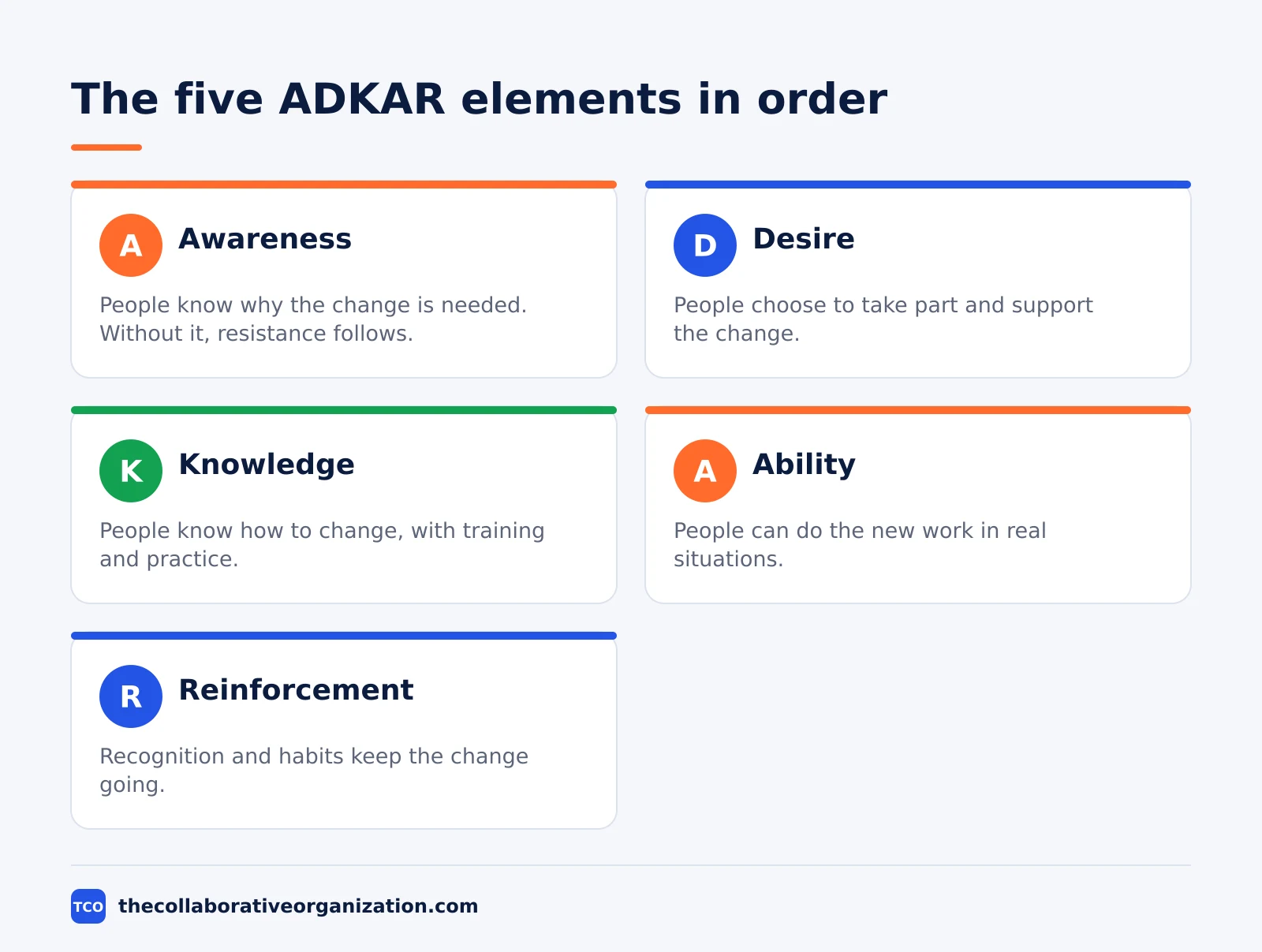
ADKAR turns “they are resisting” into a diagnosis: find the first element a person is missing, and fix that one. The model comes from Prosci, and it names five outcomes each person has to reach, in order: Awareness, Desire, Knowledge, Ability and Reinforcement. It is a model for individual change, not a complete change management methodology.
| Element | What it means | Buy-in signal |
|---|---|---|
| Awareness | People know why the change is needed | They can explain the reason in their own words |
| Desire | People choose to take part | They volunteer for the pilot |
| Knowledge | People know how to change | They finish training tasks without help |
| Ability | People can do it in real work | They use the tool daily without workarounds |
| Reinforcement | The change is kept going | Old habits stop returning |
The elements are intentionally sequenced, so earlier ones must be reached before later ones can follow. Building Knowledge is ineffective if a person has no Awareness of the need for change or Desire to take part, and training delivered to people who are not yet convinced wastes everyone’s time.
Prosci’s founder Jeff Hiatt developed the model in 1996, first published it in a white paper in 1999, and released the first book on it in 2006.
The payoff for getting this right is large. Prosci’s correlation data shows that initiatives with excellent change management are six times more likely to meet objectives than those with poor change management, as reported in the WalkMe guide to Prosci.
Kotter’s 8-step model gives the same story from the top down. John Kotter, a Harvard Business School professor, introduced his eight steps in a 1995 Harvard Business Review article and expanded them in his 1996 book Leading Change, after studying more than 100 companies.
The figure that 70% of major change efforts fail is often cited from that work, though its basis is disputed, so treat it as a warning rather than a measurement.
Train by role, not by feature list
Train each role on the screens they will actually use, and nothing else. A salesperson needs the features they touch daily, finance needs theirs, and a single session that covers every feature teaches nobody anything. Role-based training is shorter, and people remember it because they use it the next day.
Mix formats so people can learn in the way that works for them. Live sessions let people ask questions and practice in real time, recorded videos work for review, and quick-reference cheat sheets help in the moment. A dedicated channel on Slack or Teams gives people somewhere to ask.
Schedule training during normal work hours and give people room to make mistakes. Throwing a long manual at a team and telling them to figure it out by Monday guarantees failure, while dedicated time with real work builds confidence. Track training tasks in Asana so managers can see who still needs help without chasing people in meetings.
Worked example: a 40-person team switches project tools
Imagine a 40-person operations team moving from shared spreadsheets to a project tool, and picture how buy-in is built week by week. This example is an illustration, not a case study, and the numbers are made up to show the method.
In week 1, the team lead interviews six daily users and lists their pain points: status meetings that repeat what the spreadsheet already says, files lost in email threads, and no one knowing who owns the next step.
In week 2, two of those users test two shortlisted tools on one real project each, and they pick the tool that removes the status meeting.
In week 3, the two testers become champions and run short role-based sessions: planners learn the board, approvers learn the approval flow, and nobody sits through features they will never touch.
In week 4, the pilot team of ten publishes its first result: the weekly status meeting drops from 60 minutes to 15, because the board now answers the questions the meeting used to ask.
In week 6, the rest of the team switches, with the champions answering questions in a dedicated channel and office hours twice a week. By week 10, the old spreadsheet is read-only, and the team lead checks weekly usage instead of asking people whether they like the tool.
How to win over skeptics and managers
Skeptics need proof, and managers need numbers, so give each group what convinces them. A pilot team’s visible result is the proof skeptics need, and a short dashboard of weekly usage is the number managers need. Neither group is won over by a launch email.
Make the pilot result visible to whoever is next in line. When the pilot team shows a task that now takes half the time, the next team asks to join instead of waiting to be told.
Keep the change small at first. The PMO buy-in guide recommends a minimum viable prototype: the smallest version of the change that still helps, so people are not overwhelmed. Set expectations about the timeline, what changes now, what improves later, and what the new tool will not fix.
Leaders must be vocal supporters, and they must use the tool themselves. When executives keep working in the old spreadsheet while telling everyone else to switch, the team hears the real message. Our guide on before you standardize team chat covers the same point for chat tools: the standard only holds when leaders follow it too.
The wider context makes the case urgent. In McKinsey’s 2026 global survey, nearly nine in ten respondents report regular use of AI in at least one business function, and 80% say AI has improved their individual productivity. The numbers come from McKinsey’s State of AI survey.
Common team buy-in mistakes to avoid
Most buy-in efforts fail in the same five ways, and all five are choices made before launch day. Check this list before you announce anything.
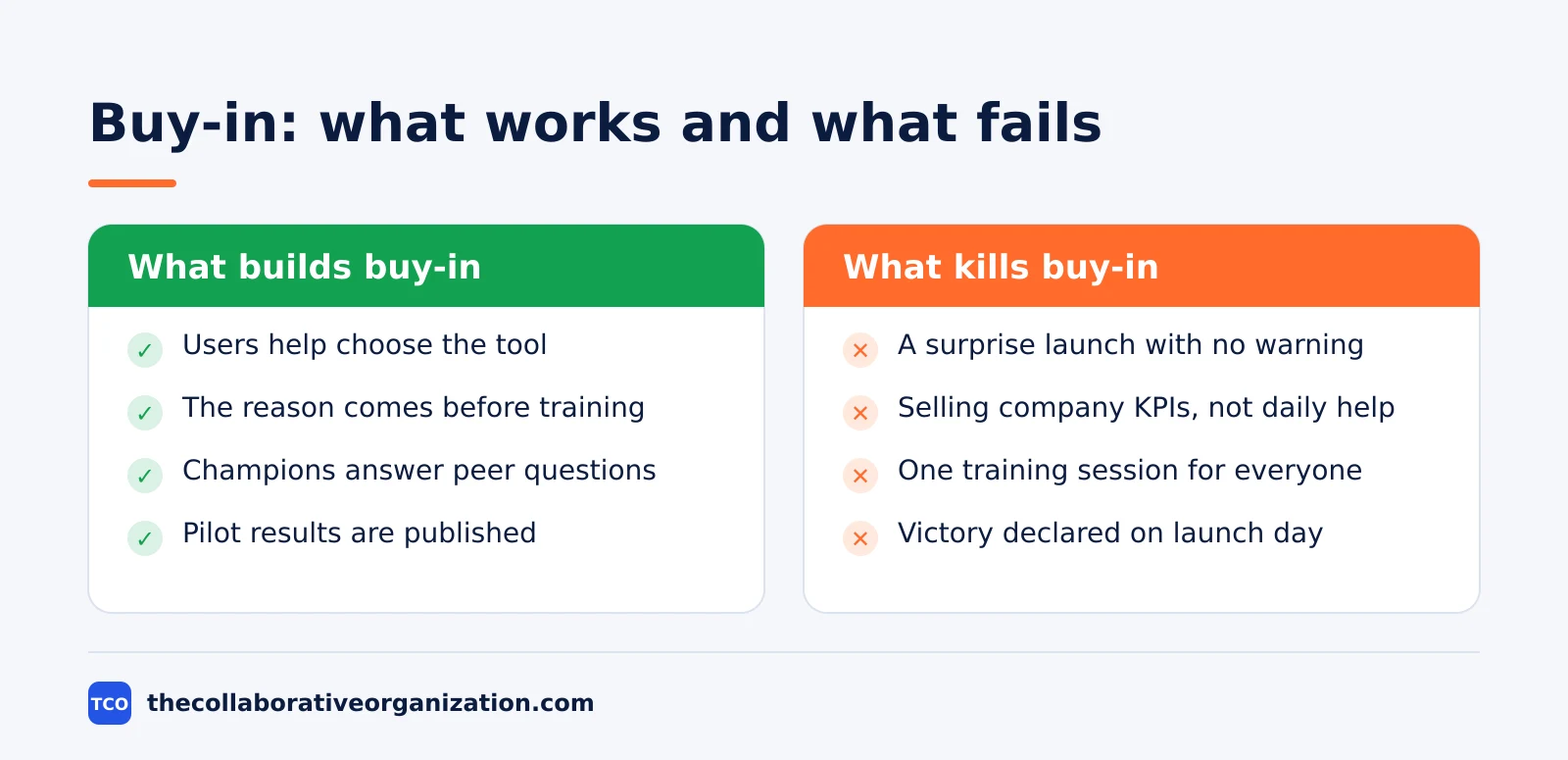
- Announcing before involving anyone. A surprise launch reads as a verdict, and people defend the old way because it is the only thing they chose.
- Selling company benefits instead of personal ones. KPIs and reporting do not answer the question each person asks first: what does this do for my day?
- One training session for everyone. A single launch-day session teaches every feature to nobody, and the people who miss it never catch up.
- Hiding the pilot results. A pilot that nobody hears about convinces nobody, so publish the first result where the next team can see it.
- Declaring victory on launch day. Buy-in is measured in weekly usage over 30 to 90 days, not in applause at the kickoff meeting.
Sources
- Prosci - The Prosci ADKAR Model: Why it Works (2025)
- Prosci - ADKAR: Core to the People Side of Change (2025)
- WalkMe - What Is Prosci Change Management? ADKAR Model Explained (2026)
- Rework - Kotter’s 8-Step Change Model Explained (With Examples) (2026)
- The PMO Leader - How to Ensure Buy-In When Introducing New Software in Your PMO (2026)
- iSAMS - How to Achieve New Software Buy-In Across Your School Departments (2026)
- McKinsey - The State of AI: Global Survey 2026 (2026)
Frequently asked questions
Why do teams resist new software?
Teams resist when they do not know why the change is happening, when the new tool makes their day harder, or when they had no say in the choice. Prosci's benchmarking finds that a lack of Awareness is the greatest source of resistance for employees and managers alike, so the fix starts with the reason, not with more training.
When should I start building buy-in for new software?
Start before you buy, not on launch day. Pick a couple of daily users, let them test the shortlist, and ask what slows them down today. Their feedback shapes the choice, and the testers become the first advocates for the tool because they helped pick it.
What is the fastest way to win over skeptics?
Give skeptics a real job in the pilot and fix one pain they named. A pilot team that shows a visible result, such as a task that now takes half the time, convinces more people than any launch email. Publish the pilot result so the next team in line can see it before they are asked to switch.
How much training does a new tool need?
More than one launch-day session, and less than a week of lectures. Train each role on the screens they will actually use, in short hands-on sessions during normal work hours, with quick guides they can check later. Add office hours in the first month so questions get answered while people are doing real work.
How long does it take a team to adopt new software?
Expect 30 to 90 days before most of the team uses the tool daily, and up to six months before it feels normal. The exact time depends on the tool and the size of the team, so set the expectation up front and track weekly usage instead of declaring success on launch day.
Related articles
guides
Free Project Management Templates: 7 to Copy (2026)
Seven free project management templates from monday, Wrike, Teamwork, Smartsheet, ClickUp, Asana and Trello, with what each one is for and what free really costs.
November 20, 2026 · 7 min read
guides
Project Proposal Template: Copy and Win Work (2026)
A project proposal template pitches the work before it is approved: problem, solution, scope, budget, timeline and terms. Copy the template and filled example.
November 20, 2026 · 10 min read
guides
Action Plan Template: Goal to Done in One Page (2026)
An action plan template turns one goal into owned steps with dates, dependencies and a success measure. Copy the table and see it filled for a support team.
November 20, 2026 · 11 min read