What Is the Critical Path Method? CPM Explained (2026) | The Collaborative Organization
By The Collaborative Organization Team · November 19, 2026 · Last verified November 19, 2026 · 11 min read
The critical path method is a scheduling technique that finds the longest chain of dependent tasks, and that chain sets the shortest time the project can take. Every task on the chain must finish on time, because any delay moves the finish date. Tasks off the chain have room to slip, and that room is called float.
Key takeaways
- The critical path is the longest sequence of dependent tasks, and its length is the shortest possible project duration.
- CPM was developed in 1957 by Morgan Walker of DuPont and James Kelley of Remington Rand.
- A forward pass gives each task its earliest start and finish, and a backward pass gives its latest start and finish.
- Total float equals late start minus early start, and tasks on the critical path have zero total float.
- CPM needs accurate duration estimates and does not account for resource limits, so it pairs well with resource leveling.
- Fast tracking runs critical tasks in parallel to shorten the schedule, while crashing adds resources to critical tasks.
What the critical path method is
The critical path method (CPM) is a way to turn a task list into a schedule by linking every task to the ones it depends on, then finding the longest chain from start to finish. Asana defines it the same way: a scheduling technique that identifies the longest sequence of dependent tasks required to complete a project. It is also called critical path analysis, or CPA.
The method answers two questions that sit at the heart of project management: what is the earliest this project can finish, and which tasks must not slip? The first answer is the length of the critical path. The second answer is the list of tasks on that path, because each one has zero float.
CPM came out of industrial maintenance work. Asana notes that it was developed in the late 1950s to address costs caused by poor scheduling. The fuller history names Morgan Walker of DuPont and James Kelley of Remington Rand as the developers in 1957, with the method published in 1959.
The PMI wording is close to the Asana wording. The PMI Lexicon defines CPM as a method that estimates the minimum project duration and finds the scheduling flexibility on the network paths. That wording is quoted on the Mudassir Iqbal CPM guide, which cites the PMI Lexicon and the PMBOK Guide.
The four parts of a CPM calculation
Every CPM calculation has four parts: the task list, the dependencies, the durations, and the float. Leave one out and the answer is a guess. Together they turn a list of work into a network with dates.
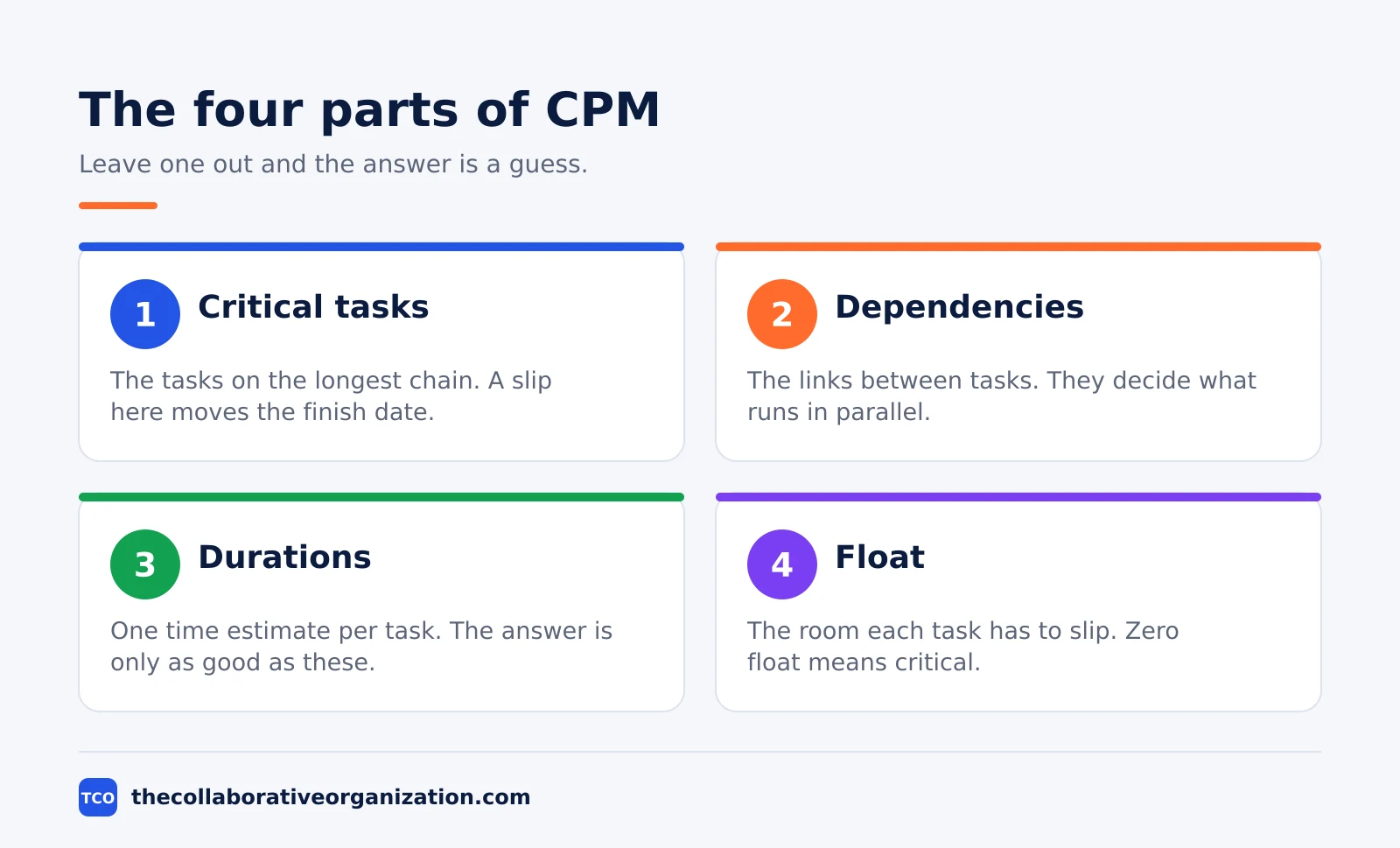
- Critical tasks. The tasks that sit on the longest chain. These are the tasks the manager watches every day, because a slip here moves the finish date.
- Task dependencies. The links between tasks, such as “build starts only after design is approved.” Dependencies decide which tasks can run in parallel and which must wait.
- Task durations. The estimated time for each task. CPM uses one estimate per task, so the quality of the answer depends on the quality of these estimates.
- Float. The room each task has to slip. Float is what the two passes calculate, and it is how you tell a critical task from a flexible one.
A network diagram shows all four parts at once. Each task is a box, each arrow is a dependency, and each box carries its early and late dates plus its float. The boxes with zero float, joined by arrows, form the critical path.
How the forward pass and backward pass work
The forward pass and the backward pass are two sweeps through the network, and together they give every task four dates. The forward pass moves left to right and finds the earliest each task can start and finish. The backward pass moves right to left from the finish date and finds the latest each task can start and finish without delaying the project.
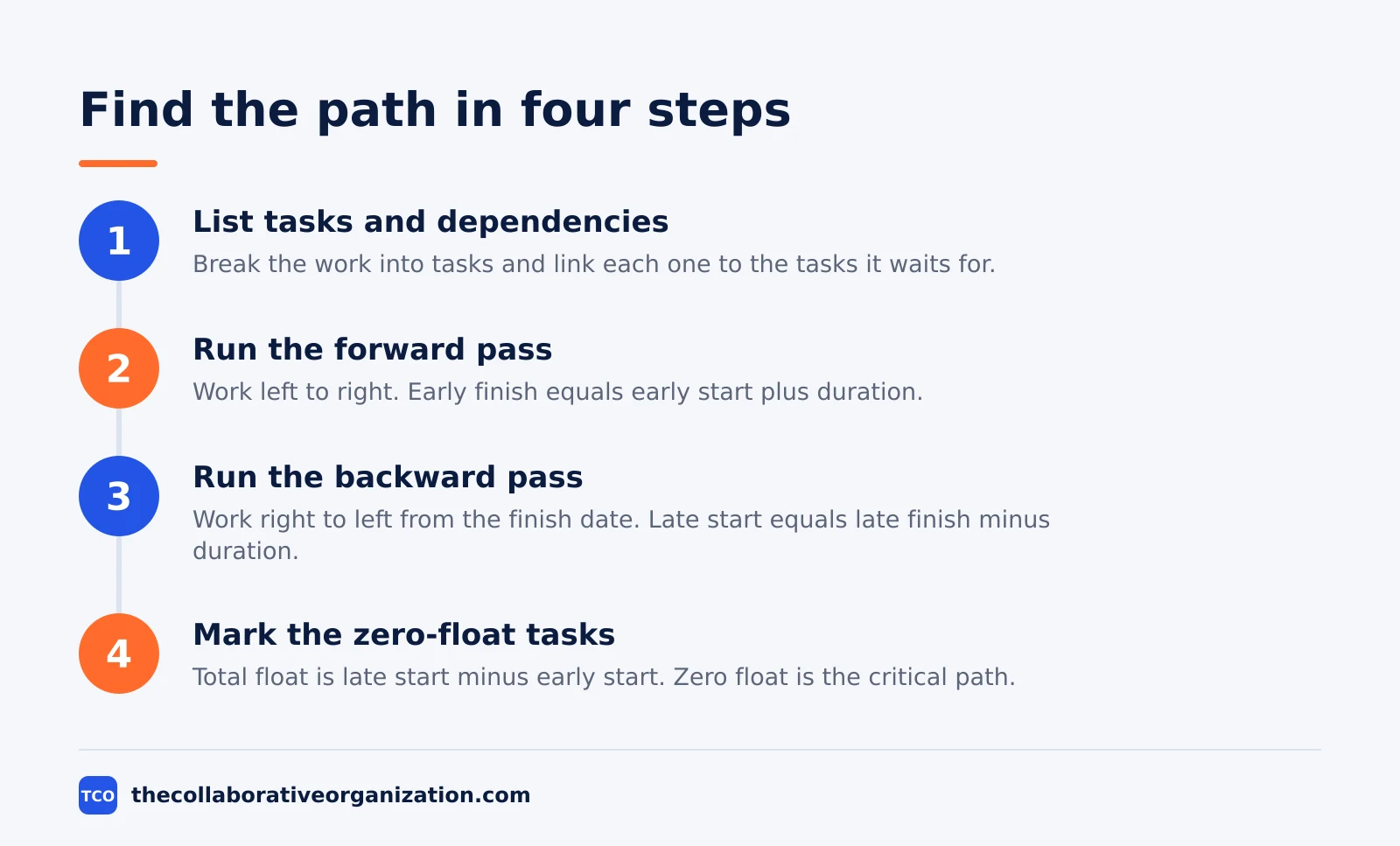
The forward pass starts at day 0. The early start of a task is the largest early finish among its predecessors, and the early finish is the early start plus the duration. A task with several predecessors waits for the slowest one, so its early start is the biggest early finish feeding into it.
The backward pass starts at the project finish date, which is the early finish of the last task. The late finish of a task is the smallest late start among its successors, and the late start is the late finish minus the duration. A task that feeds two successors must finish by the earlier of their two late starts.
Asana gives the same two formulas in its CPM guide: forward pass uses EF = ES + duration, and backward pass uses LS = LF - duration. Once both passes are done, each task has an early start, early finish, late start and late finish, and the gap between early and late is its float.
What float means, and the two kinds of float
Float is the time a task can slip without moving the project finish date, and there are two kinds: total float and free float. Total float guards the project finish date. Free float guards the next task. A task can have total float but no free float, and that distinction matters when you re-plan.
Total float equals late start minus early start, which is the same as late finish minus early finish. A task with zero total float is on the critical path. A task with five days of total float can start five days late and the project still finishes on time, as long as nothing else slips.
Free float is narrower. It equals the early start of the next task minus the early finish of the current task, and it only exists when two or more tasks share a successor. Free float is the time a task can slip without moving any task that follows it.
Float is also a warning gauge. A task with a large total float is low risk for the finish date, while a task with one day of float is nearly critical. When a task with float slips past its float, it joins the critical path, and the path changes.
Critical path method example: a website relaunch
A small website relaunch shows how the chain, the passes and the float fit together. Imagine a team relaunching a company homepage. The work has five tasks, and the durations are in working days.
| Task | Duration | Depends on | Early finish | Total float |
|---|---|---|---|---|
| A - Design the pages | 5 days | - | Day 5 | 0 days |
| B - Write the copy | 4 days | - | Day 4 | 1 day |
| C - Build the pages | 6 days | A, B | Day 11 | 0 days |
| D - Test the pages | 3 days | C | Day 14 | 0 days |
| E - Launch the site | 1 day | D | Day 15 | 0 days |
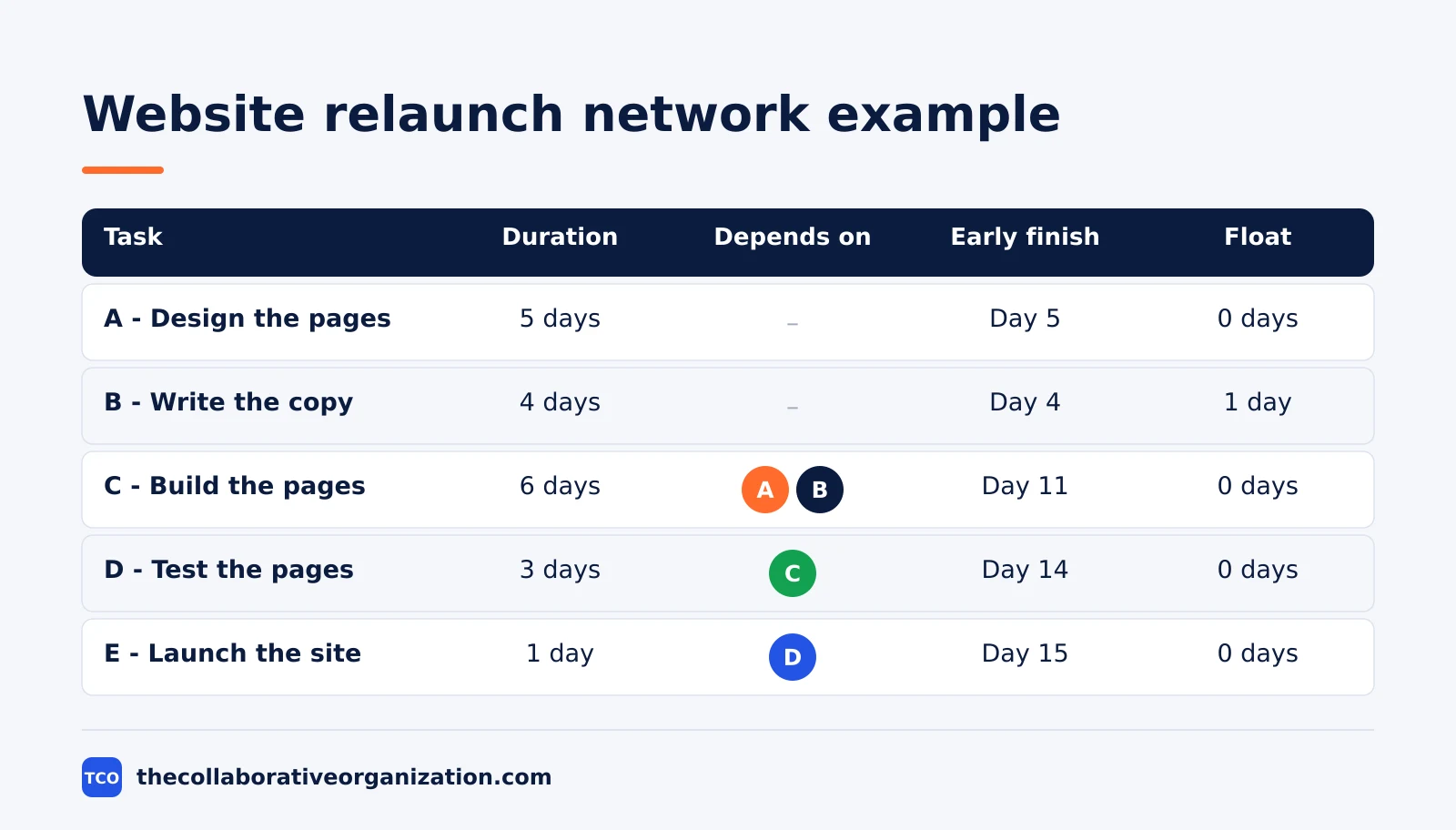
Two chains run through the network. The chain A-C-D-E takes 5 + 6 + 3 + 1 = 15 days. The chain B-C-D-E takes 4 + 6 + 3 + 1 = 14 days. The longer chain wins, so the critical path is A-C-D-E and the project takes 15 days at the earliest.
Task B, writing the copy, has 1 day of float. It can finish a day late and the build still starts on time, because the build waits for the design anyway. But if the copy slips by 2 days, it becomes critical too, and the launch moves to day 16.
When to use the critical path method, and when not to
Use CPM when the project has many dependent tasks, clear durations and a firm finish date. It fits construction, manufacturing, engineering and software releases with a set launch date. It also fits any project where a missed date would cost money, such as a product launch tied to an event.
CPM works best during planning, when it sets the schedule baseline that later progress is measured against. Our guide on how to create a project plan covers the planning steps around it, from the work breakdown structure to the baseline. Re-run the passes at each phase gate, so the path reflects what actually happened instead of the first guess.
Skip CPM when durations are rough guesses or the order of work changes every week. Asana warns that the method needs accurate estimates, that it can be rigid for fast-changing work, and that it ignores resource limits. A team that re-plans every sprint will get more from a board and a short horizon than from a full network diagram.
It also fits poorly when the real limit is people, not order. CPM assumes each task has its resources when it needs them, so a schedule can look fine on paper while one person is booked on three critical tasks at once. The fix is resource leveling, which moves tasks to fit who is free.
Critical path method vs PERT vs Gantt chart
CPM, PERT and a Gantt chart answer different questions, and teams often use all three on one project. CPM finds the longest chain when durations are known. PERT estimates durations when they are uncertain. A Gantt chart draws the schedule so people can read it.
| Method | Best for | Time estimates | Main output |
|---|---|---|---|
| CPM | Predictable tasks with known durations | One per task | Critical path and float |
| PERT | Uncertain tasks with a range of times | Three per task | Expected duration and range |
| Gantt chart | Showing the schedule to the team | Dates on bars | Timeline with dependencies |
PERT uses three estimates per task: optimistic, most likely and pessimistic. Its formula is (O + 4M + P) / 6, where O is optimistic, M is most likely and P is pessimistic. The result is an expected duration that feeds into the CPM calculation, so the two methods work as a pair rather than as rivals.
A Gantt chart is a picture, not a calculation. It draws each task as a bar on a timeline and shows dependencies with arrows, and milestones appear as diamonds. Our comparison of PERT vs Gantt chart goes deeper into when each view helps.
Tools that show the critical path
A spreadsheet can hold a first CPM network, but a project tool keeps the path next to the work and re-draws it when dates move. The path stays current when tasks, dependencies and dates live in the same place. Compare the options on our project management software shortlist before you pick one.
| Tool | Best for | Free plan | Starting price (as of November 2026) | Notable limit |
|---|---|---|---|---|
| Asana | Teams that want Timeline and Gantt views with dependencies | Free for 2 people | $10.99 per user per month, billed annually | Free plan covers 2 people |
| ClickUp | Teams that want unlimited Gantt charts on a low-cost plan | Free Forever plan | $9 per user per month (Core), billed annually | $9 price is shown against a $12 regular price |
| Trello | Small teams that want a simple board with a Timeline view | Free for up to 10 collaborators | $5 per user per month (Standard), billed annually | Timeline view needs a paid plan |
The Asana price comes from Asana pricing: the Personal plan is free for 2 users, and Starter is $10.99 per user per month when billed annually. The ClickUp pricing page lists Core at $9 per user per month billed yearly, with a $12 regular price struck through, so the $9 figure may be promotional.
The Trello pricing page lists Standard at $5 per user per month billed annually, or $6 billed monthly.
Two vendor pages did not show prices to our reader on 19 November 2026, so no price is given for them here: the monday.com pricing page and the Wrike pricing page both rendered no dollar figures, and the Jira pricing page returned an error. Check those pages directly before you budget for them.
Common critical path method mistakes to avoid
Most CPM schedules fail in the same few ways, and all of them trace back to the inputs, not the math. Check the list below before you trust a critical path.
- Guessed durations treated as facts. A path built on guesses is a guess. Base durations on past work or a PERT range, and say which tasks are estimates.
- Missing dependencies. If two tasks must run in order and the link is not drawn, the path is too short and the finish date is wrong.
- Padding every task. Padding hides the real path, because padded tasks look critical when they are not. Keep one buffer at the end instead.
- Never re-running the passes. The path changes when a task slips or finishes early. Re-run the passes at each review, or the team follows a path that no longer exists.
- Ignoring resources. A schedule that books one person on three critical tasks at once will slip. Level the resources, then re-calculate the path.
- Forgetting the finish milestone. The backward pass needs a finish date to start from. Without a fixed end, the late dates have nothing to anchor to.
Sources
- Asana - Critical Path Method (CPM): Steps, Float, Examples (2026)
- Ruh AI - Critical Path Method (2026)
- Mudassir Iqbal - Critical Path Method (CPM) Explained (2026)
- Rework - Critical Path Method (CPM): How to Find the Critical Path (2026)
- Smartgecko Academy - Critical Path Method (2026)
- Asana - Pricing (2026)
- ClickUp - Pricing (2026)
- Trello - Pricing (2026)
Frequently asked questions
What is the critical path in simple terms?
The critical path is the longest chain of tasks that must happen in order, from the start of a project to the end. Its total length sets the shortest time the project can take. Any delay to a task on this chain moves the finish date by the same amount.
What is float in the critical path method?
Float, also called slack, is the time a task can slip without moving the project finish date. Total float equals the late start minus the early start. Tasks on the critical path have zero float, while tasks off the path have some room to move.
Who invented the critical path method?
Morgan Walker of DuPont and James Kelley of Remington Rand developed the method in 1957, for scheduling maintenance work at chemical plants. Kelley and Walker published the method in 1959, and it is still the basis of most project scheduling software today.
What is the difference between CPM and PERT?
CPM uses one duration estimate per task and suits work with known, predictable times. PERT uses three estimates for each task, optimistic, most likely and pessimistic, and suits work with uncertain times. Teams often use PERT to set durations, then CPM to find the critical path.
Can a project have more than one critical path?
Yes. Two chains of tasks can tie for the longest duration, and then both are critical. Either chain can delay the project. When paths tie, the chain with the most dependencies is usually treated as the main critical path to watch.
Does the critical path method work for small projects?
It works, but it is often more effort than a small project needs. A short project with few dependencies can use a simple task list with dates. CPM pays off when many tasks depend on each other and a missed date would push the whole finish date.
Related articles
project management
How to Choose Project Management Software (2026)
Pick project management software in seven steps: define the work, count seats, price the real cost, and run a two-week pilot before you pay.
November 19, 2026 · 10 min read
project management
What Is a RACI Matrix? Definition, Roles and Examples (2026)
A RACI matrix maps who is Responsible, Accountable, Consulted and Informed for each task. Learn the four roles, how to build one, and see a worked example.
November 19, 2026 · 9 min read
project management
Daily Standup Meeting Format That Works (2026)
A daily standup is a 15-minute meeting where Developers inspect progress toward the Sprint Goal and plan the next day. Use this format to run one that ends on time.
November 19, 2026 · 10 min read