What Is Scrum? Roles, Events and How It Works (2026) | The Collaborative Organization
By The Collaborative Organization Team · November 19, 2026 · Last verified November 19, 2026 · 9 min read
Scrum is a lightweight framework that helps teams deliver value in short, fixed cycles called sprints. The Scrum Guide defines it as “a lightweight framework that helps people, teams and organizations generate value through adaptive solutions for complex problems.” A small team picks the most valuable work, builds it, and reviews it with the customer.
Key takeaways
- Scrum is a framework for complex work, built on empiricism: knowledge comes from experience and decisions come from what is observed.
- A Scrum Team has three roles: one Product Owner, one Scrum Master, and Developers, usually 10 or fewer people in total.
- Work runs in sprints of one month or less, with five events and three artifacts.
- Only the Product Owner can cancel a sprint, and a sprint goal never changes mid-sprint.
- Scrum is one way to be agile, not a synonym for agile: the Agile Manifesto sets the values, Scrum adds the structure.
What Scrum is, and where it came from
Scrum is a framework for complex problems, not a recipe for every project. It was developed in the early 1990s by Ken Schwaber and Jeff Sutherland, first presented together at the OOPSLA conference in 1995, and written down in the first Scrum Guide in 2010. The current version of the Guide dates from November 2020.
Scrum rests on two ideas: empiricism and lean thinking. Empiricism means knowledge comes from experience and decisions are based on what is observed, not on a guess made months earlier. Lean thinking means cutting waste and focusing on what matters most. The Guide calls sprints the heartbeat of Scrum, because each sprint turns ideas into value.
Three pillars hold the framework up: transparency, inspection and adaptation. Transparency means the work and the process are visible to everyone. Inspection means the team checks progress often, at every event. Adaptation means the team changes the plan as soon as inspection shows a problem, and without all three pillars, Scrum stops working.
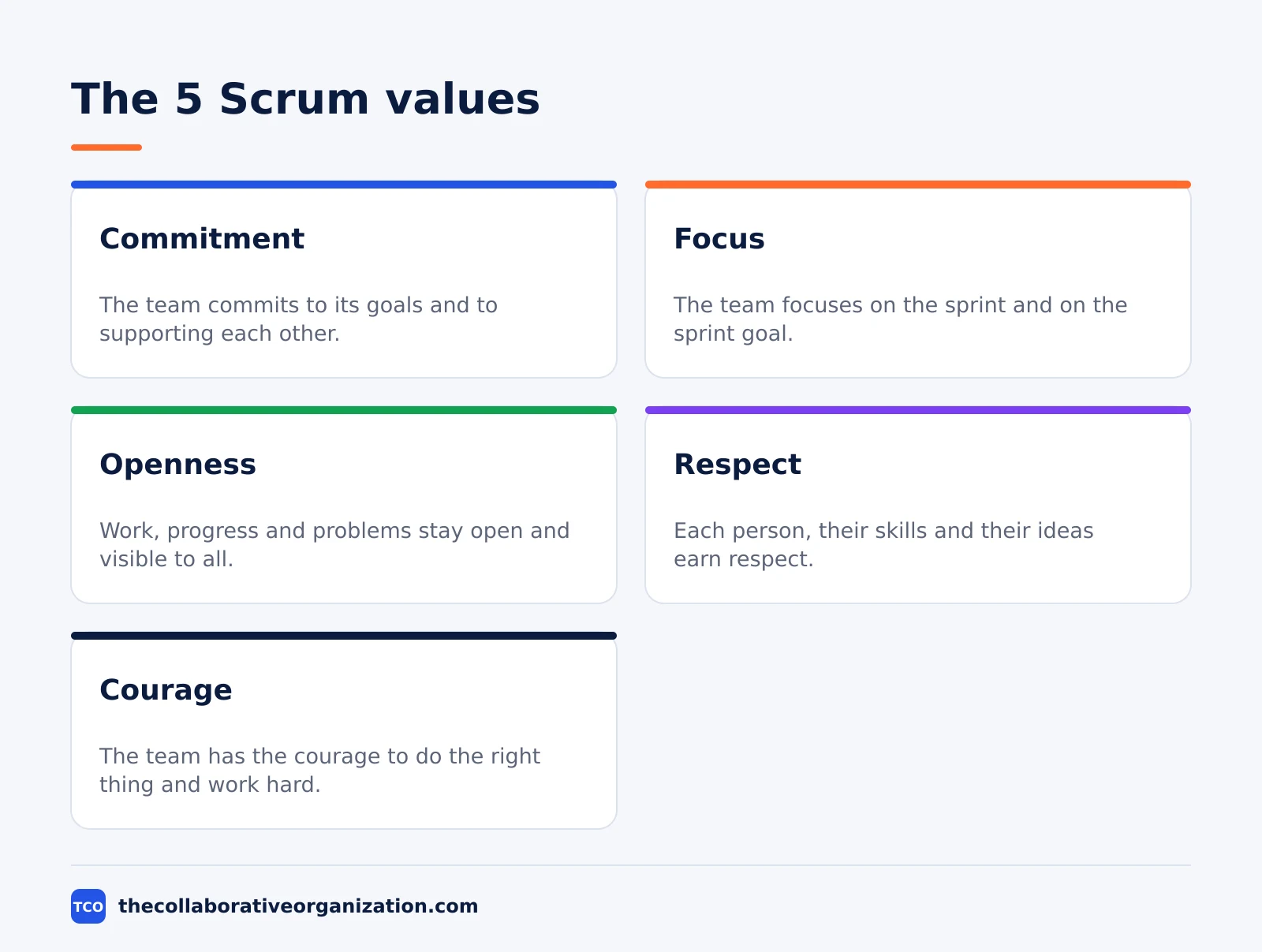
Scrum also names five values: Commitment, Focus, Openness, Respect and Courage. The team commits to its goals, focuses on the sprint, stays open about work and problems, respects each person, and has the courage to do the right thing.
The Agile Manifesto sets the wider values that Scrum follows, and Scrum adds the roles, events and artifacts that turn them into daily work.
The Scrum Team: three roles
A Scrum Team has exactly three roles, and no sub-teams or hierarchies inside it. The team is cross-functional and self-managing, which means it has all the skills it needs and decides how to do its own work. The Guide says a Scrum Team is typically 10 or fewer people.
| Role | Who it is | Main job | Owns |
|---|---|---|---|
| Product Owner | One person, never a committee | Maximizes the value of the product | Product Backlog and Product Goal |
| Scrum Master | One person, a servant-leader | Establishes Scrum and removes blocks | Team effectiveness and the Scrum events |
| Developers | Everyone who builds the product | Creates a usable increment each sprint | Sprint Backlog and “definition of done” |
The Product Owner ranks the work by value, so the team always builds the most useful item first. Only the Product Owner can cancel a sprint, and only when the sprint goal becomes obsolete.
The Scrum Master is not a project manager: the role exists to make the team effective, to coach Scrum, and to remove impediments that slow the work.
Developers include everyone who creates the product, not only programmers. They own the sprint backlog, the “definition of done”, and the daily plan. When a team cannot name its Product Owner, it cannot rank its work, and Scrum turns into a set of meetings with no direction.
The five Scrum events
Scrum has five events, and each one exists to inspect progress and adapt the plan. The sprint contains the other four events, and a new sprint starts immediately after the previous one ends. The timeboxes below are for a one-month sprint, and they shrink for shorter sprints.
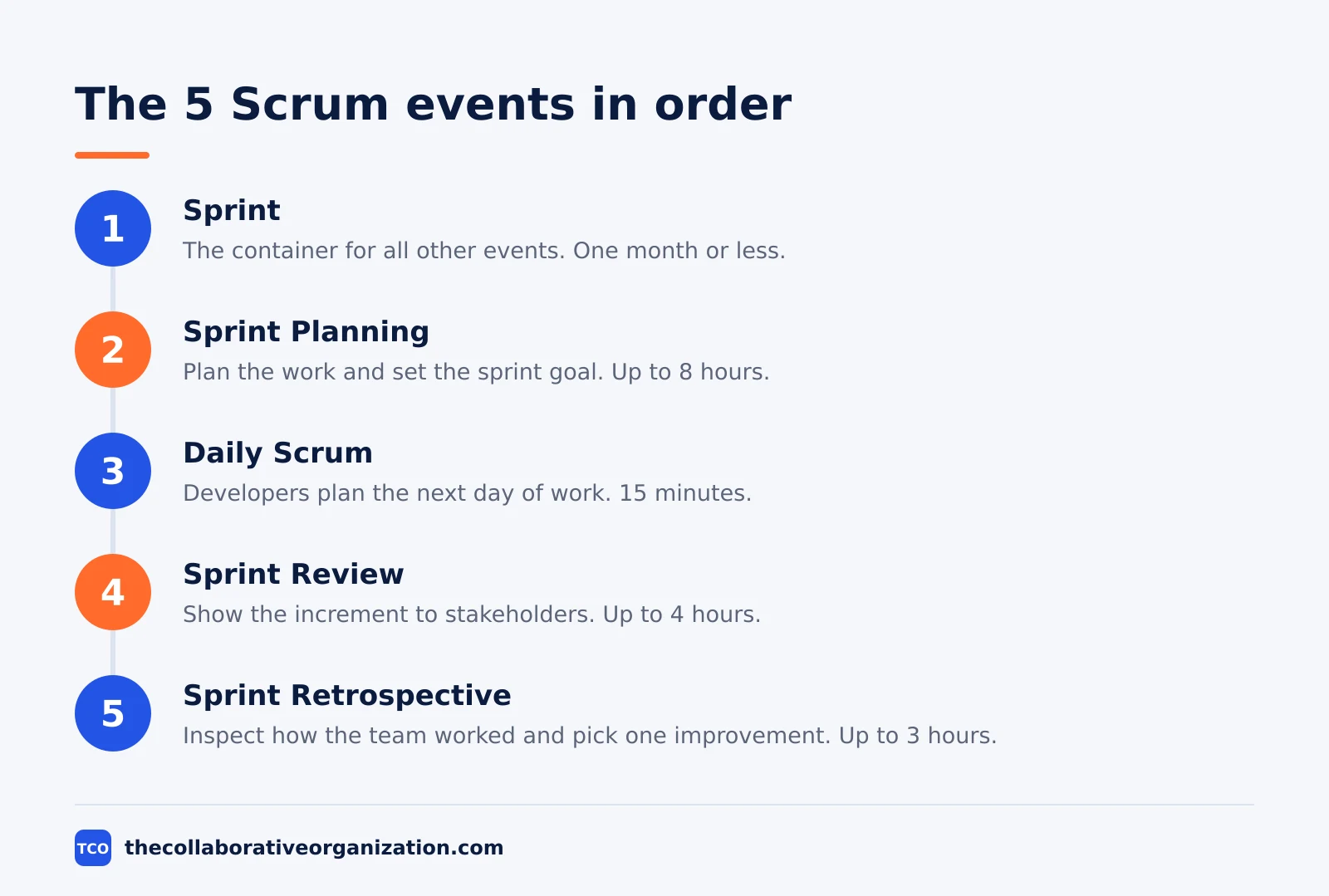
- Sprint Planning, up to 8 hours. The team plans the work for the sprint and sets a sprint goal. The Product Owner presents the most valuable work, and the Developers choose what they can finish.
- Daily Scrum, 15 minutes. The Developers plan the next day of work, inspect progress toward the sprint goal, and flag blocks. It is a planning event for the team, not a status report.
- Sprint Review, up to 4 hours. The team shows the finished increment to stakeholders and talks about what to build next. The review adapts the product backlog based on what everyone learned.
- Sprint Retrospective, up to 3 hours. The team inspects how it worked together and picks the most helpful improvement for the next sprint. No improvement is too small to try.
- Sprint, one month or less. The container for all the other events. During a sprint, no changes are made that would endanger the sprint goal, and quality never decreases.
During a sprint, the scope may be clarified and renegotiated with the Product Owner as the team learns more. That is the only way the goal stays honest: the team adapts the work, not the goal.
The three artifacts and their commitments
Scrum has three artifacts, and each one carries a commitment that makes it real. An artifact without its commitment is just a list, so the Guide pairs each one with a single promise the team keeps.
| Artifact | What it is | Commitment | Who owns it |
|---|---|---|---|
| Product Backlog | The ranked list of everything the product might need | Product Goal | Product Owner |
| Sprint Backlog | The work the team chose for this sprint, plus a plan | Sprint Goal | Developers |
| Increment | The usable product the team finished this sprint | “definition of done” | Developers |
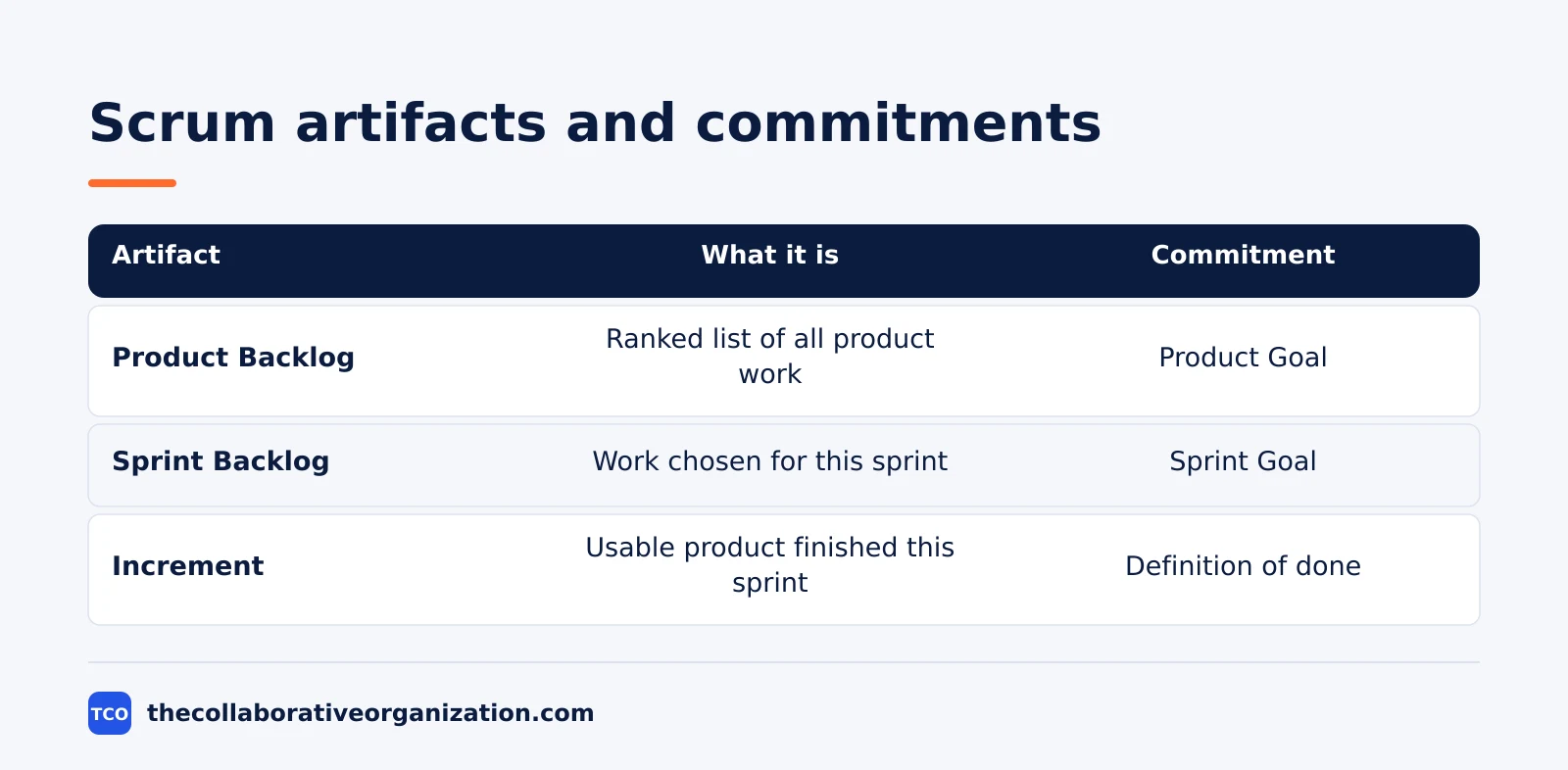
The Product Goal describes a future state of the product, and it is the target the team aims at over many sprints.
The Sprint Goal gives the team one clear aim for the sprint, and it is the reason the sprint exists. The “definition of done” is a shared standard for what finished means, so the team and the customer agree when work is truly done.
An increment must be usable, even if the team does not release it yet. A sprint that ends with half-finished work has no increment, and the team has nothing to show at the review. That rule is what keeps Scrum honest: progress is measured by working product, not by hours spent.
How a sprint works: a worked example
A two-week sprint for a team building a booking page shows how the roles, events and artifacts fit together. Imagine a team of six: one Product Owner, one Scrum Master and four Developers. The product goal is a booking page customers can use without help.
On Monday of week 1, Sprint Planning sets the goal: a working booking form with a date picker.
The Developers pull the top backlog items into the sprint backlog and agree the “definition of done”: the form works on mobile, the date picker blocks past dates, and every change has a test. Each morning, the Daily Scrum takes 15 minutes and the team plans the day.
On Friday of week 2, the Sprint Review shows the form to three customers. They like it but ask for a calendar view, so the Product Owner adds that to the product backlog.
The Retrospective picks one improvement: the team will pair on the trickiest task next sprint. The example is an illustration, not a report on a real project, but it shows the loop: plan, build, review, adapt.
Scrum vs agile, and when to use Scrum
Scrum is one way to be agile, and it fits complex work where the goal is clear but the path is not. Agile is the wider set of values, and Scrum adds the roles, events and artifacts. A team can be agile without Scrum, and a team can run Scrum events without being agile if it never listens to the customer.
Use Scrum when the work is complex, the team is small enough to meet daily, and the customer can review work at the end of each sprint. It fits software products, new services and any project where the result is hard to picture in advance.
Atlassian notes that sprints typically last one to four weeks, and two weeks is a common length.
Skip Scrum when the team cannot meet daily, when the customer cannot review work during the project, or when the scope is fixed by contract and change is not allowed. Scrum also fits poorly for single-person work, because its events exist to coordinate a team.
Digital.ai reported in its 18th State of Agile report that 74% of organizations used hybrid agile models in 2025, so many teams mix Scrum with other approaches.
Tools that support Scrum teams
A board tool supports Scrum when it can run a sprint backlog, a daily board and a burndown in one place. Our guide on how to choose project management software covers seat counts and free-plan caps before you pick one.
| Tool | Best for | Free plan | Starting price (as of November 2026) | Notable limit |
|---|---|---|---|---|
| Asana | Teams that want a sprint board with a named owner per task | Free for 2 people | $10.99 per user per month (Starter), billed annually | Free plan covers 2 people |
| ClickUp | Teams that want sprints, docs and goals in one place | Free Forever plan | $9 per user per month (Core), billed yearly | Free plan caps storage at 60 MB |
| Jira | Software teams that run Scrum sprints and track velocity | Free for up to 10 users | $9.70 per user per month (Standard), billed monthly for 1-100 users | Per-user price changes with team size |
If you have not picked a tool yet, compare the options on our project management software shortlist before your first sprint. A tool does not make a team Scrum: a board with no review and no retrospective is just a list. Start with the sprint and the review, then add the tool that makes those habits easier.
Common Scrum mistakes to avoid
Most Scrum teams fail in the same five ways, and all five are easy to spot in a review. Run through the list below at the end of each sprint.
- Skipping the retrospective. Teams that never review their own way of working repeat the same blockers in every sprint.
- Treating the Daily Scrum as a status meeting. A 30-minute report to a manager is not a 15-minute plan for the next day of work.
- Letting the sprint goal change mid-sprint. New work means old work moves out, or the sprint goal stops meaning anything.
- Having no Product Owner. A backlog with no single owner is a wish list, and the team builds whatever is loudest.
- Calling work done before it meets the definition. An increment that fails the “definition of done” is not an increment, and the review has nothing real to show.
Sources
- Scrum Guides - The Scrum Guide, November 2020 (2020)
- Agile Manifesto - Manifesto for Agile Software Development (2001)
- Atlassian - Agile vs. Scrum (2026)
- Digital.ai - 18th State of Agile Report (2025)
- Asana - Pricing (2026)
- ClickUp - Pricing (2026)
- Atlassian - Future Cloud List Pricing Tables (2026)
Frequently asked questions
What is Scrum in simple terms?
Scrum is a lightweight framework for building complex products in short, fixed cycles called sprints. A small team picks the most valuable work, builds it in a sprint of one month or less, and then reviews it with the customer. The team repeats the cycle, so the product grows in small, tested steps instead of one big launch.
What are the three roles in Scrum?
The three roles are the Product Owner, the Scrum Master and the Developers. The Product Owner ranks the work by value and owns the product backlog. The Scrum Master makes sure Scrum is followed and removes blocks. The Developers build a usable increment each sprint and own the sprint backlog and the definition of done.
How long is a Scrum sprint?
A sprint lasts one month or less, and two weeks is the most common length. The team picks a length and keeps it fixed, so a new sprint starts right after the previous one ends. Shorter sprints give faster feedback, while a one-month sprint suits work that takes longer to show. The length never changes mid-sprint.
Is Scrum the same as agile?
No. Agile is a set of values and principles for iterative work, while Scrum is one framework that puts those values into practice. Scrum adds fixed roles, events and artifacts, such as sprints and a product backlog. A team can be agile without Scrum, and it can also use Kanban or another agile framework instead.
What happens in a Daily Scrum?
The Daily Scrum is a 15-minute event where the Developers plan the next day of work. Each person shares progress toward the sprint goal and flags anything that blocks the team. It is not a status report to a manager, and it is not a meeting to solve problems in detail. The team inspects progress and adapts the plan for the day.
Related articles
project management
What Is a RACI Matrix? Definition, Roles and Examples (2026)
A RACI matrix maps who is Responsible, Accountable, Consulted and Informed for each task. Learn the four roles, how to build one, and see a worked example.
November 19, 2026 · 9 min read
project management
Daily Standup Meeting Format That Works (2026)
A daily standup is a 15-minute meeting where Developers inspect progress toward the Sprint Goal and plan the next day. Use this format to run one that ends on time.
November 19, 2026 · 10 min read
project management
How to Run a Sprint Planning Meeting (2026)
Sprint planning opens every sprint with a goal, a set of backlog items and a plan. Follow these 6 steps to run the meeting in 90 minutes for a two-week sprint.
November 19, 2026 · 9 min read