Daily Standup Meeting Format That Works (2026) | The Collaborative Organization
By The Collaborative Organization Team · November 19, 2026 · Last verified November 19, 2026 · 10 min read
A daily standup is a 15-minute meeting held every working day of a Sprint, where Developers inspect progress toward the Sprint Goal and plan the next 24 hours. It is the Scrum event called the Daily Scrum, and it ends with an actionable plan for the next day of work.
The meeting is for the team to plan together, not to report status to a manager.
Key takeaways
- A daily standup is capped at 15 minutes, whatever the size of the team.
- Its purpose is to inspect progress toward the Sprint Goal and adapt the Sprint Backlog.
- The classic format asks 3 questions: what you did, what you will do, and what blocks you.
- The 2020 Scrum Guide no longer requires the 3 questions: teams may pick any format that fits the goal.
- The Daily Scrum belongs to the Developers, and the Product Owner and Scrum Master join only as Developers when they do Sprint Backlog work.
What you need before the first standup
A daily standup needs only four things: a fixed time, a fixed place, a visible Sprint Backlog, and a timer. Pick a time that suits the whole team, such as 9:30 each morning, and hold it at the same time and place every working day. A fixed slot removes the daily debate about when to meet.
The board is the second need. The team should be able to see the Sprint Backlog and the Sprint Goal during the meeting, on a wall board or a shared screen. Miro advises teams to open the board before the meeting starts, so no one waits while someone shares a screen.
The third need is a shared rule: 15 minutes, one speaker at a time, and no problem-solving in the meeting. When a problem needs more than a minute, the people involved agree to talk right after the standup ends. The fourth need is a timer, visible to everyone, so the team can see the time run out.
A rotating facilitator helps from day one. The facilitator starts the meeting, keeps the order, and calls time at 15 minutes. Rotating the job each week keeps the meeting owned by the team instead of by one person.
How to run a daily standup in 5 steps
Run the standup in five steps, and keep the whole meeting inside 15 minutes. The steps below work for a team of 5 to 9 people meeting in person or on a video call.
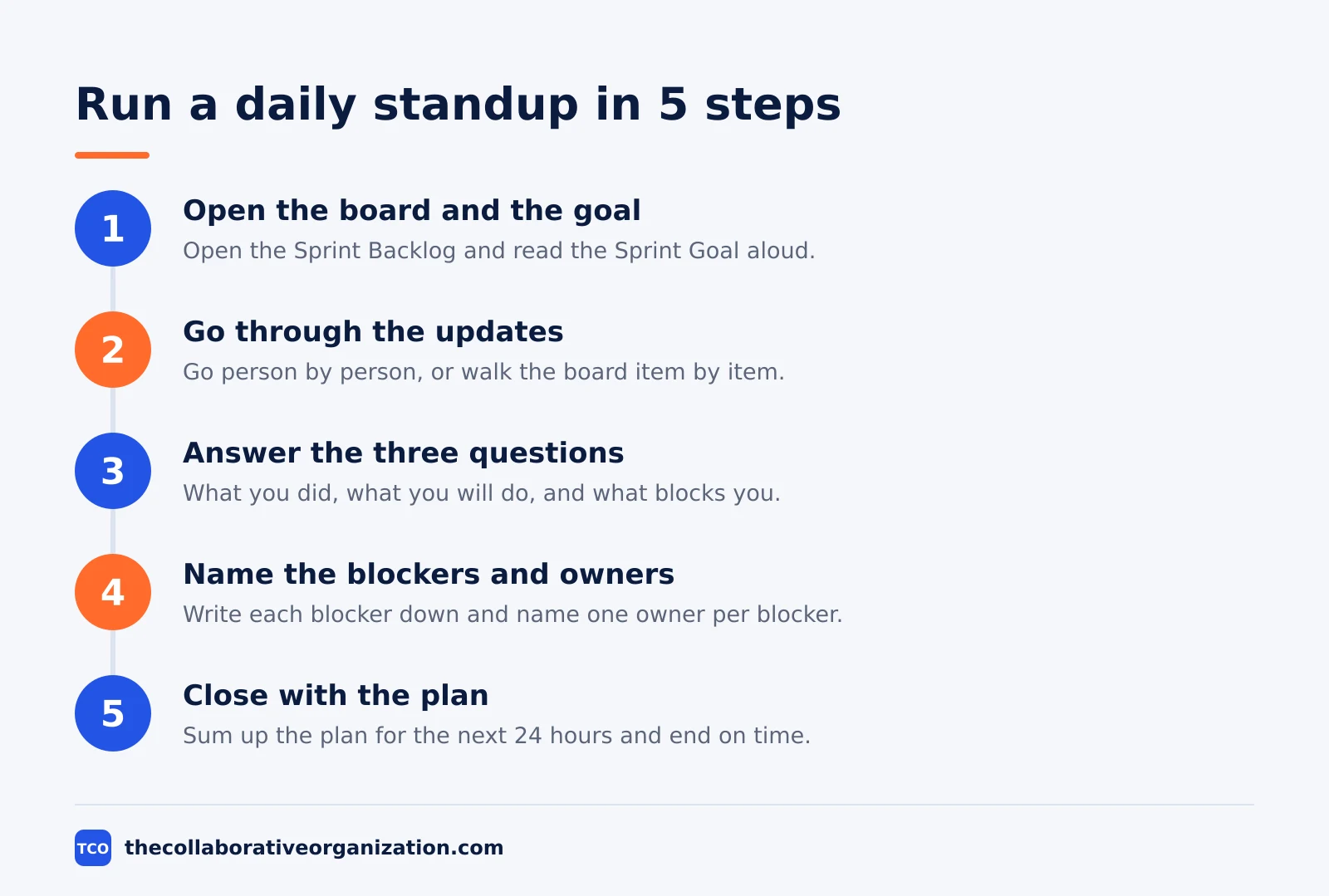
Step 1: Open the board and the Sprint Goal
The facilitator opens the Sprint Backlog and reads the Sprint Goal aloud. The outcome is a shared picture of where the sprint stands before anyone speaks. A standup that starts with the goal stays about the goal.
Step 2: Go person by person, or item by item
Each Developer gives a short update, or the team walks the board from the most urgent item to the least. The outcome is a full picture of the sprint in a few minutes. Pick one order and keep it the same each day.
Step 3: Answer the three questions, briefly
Each person covers what they finished since the last standup, what they will work on before the next one, and what blocks them. The outcome is a clear list of blockers and next steps. Keep each answer under a minute.
Step 4: Name the blockers and their owners
The facilitator writes down every blocker and names one person to chase each one. The outcome is a list of blocks with owners, not a list of complaints. No blocker should leave the meeting without a name next to it.
Step 5: Close with the plan for the next 24 hours
The facilitator sums up the plan in one or two sentences and ends the meeting on time, even if a talk is unfinished. The outcome is a shared plan for the day. Any open talk moves to a separate session right after.
The three-question format
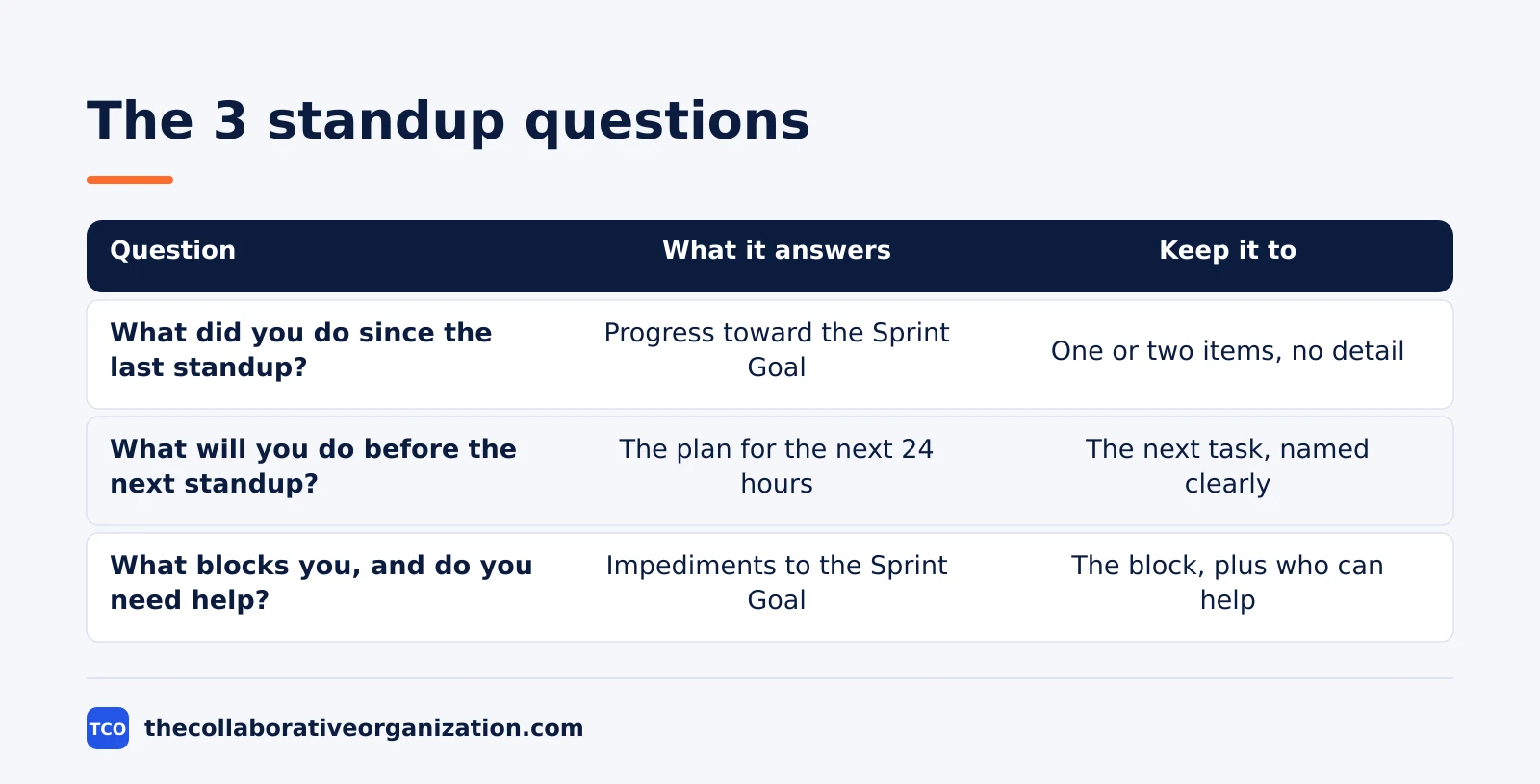
The three-question format is the most used standup format, and it works because each question has one job. The first question looks back, the second looks forward, and the third finds the blocks. The Scrum Guide no longer requires these questions, but they remain a sound starting point, especially for a new team.
| Question | What it answers | Keep it to |
|---|---|---|
| What did you do since the last standup? | Progress toward the Sprint Goal | One or two items, no detail |
| What will you do before the next standup? | The plan for the next 24 hours | The next task, named clearly |
| What blocks you, and do you need help? | Impediments to the Sprint Goal | The block, plus who can help |
One warning applies to the first question: it is not a status report. The team asks what was done to judge progress toward the goal, not to check up on people.
Rework notes that the 2020 Guide treats the three questions as a suggested technique, not a rule, and teams may choose any structure that keeps the focus on the Sprint Goal.
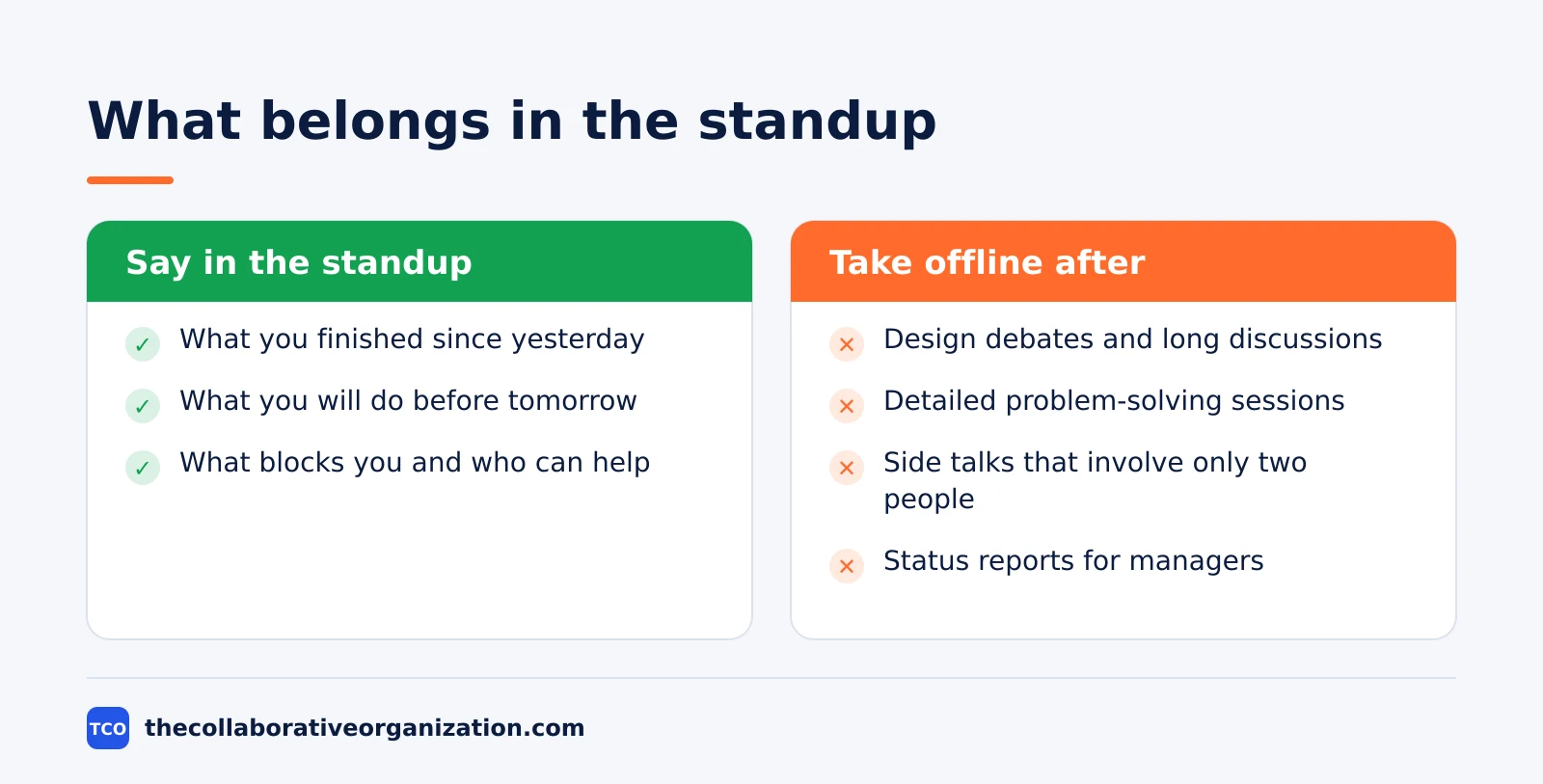
Walking the board is the main alternative. Instead of going person by person, the team walks the board item by item, from the item nearest to done to the newest one. The unit of talk becomes the work, not the person, which suits teams where several people share one item.
A sample 15-minute run sheet
A 7-person team can fit a full standup into 15 minutes with about 2 minutes per person, as the run sheet below shows. Imagine a team of 7 building a booking app for a small clinic, meeting at 9:30 each morning. The example is an illustration, not a real team.
| Minute | What happens |
|---|---|
| 0-1 | Facilitator opens the board and reads the Sprint Goal |
| 1-13 | Each of the 7 Developers gives a 90-second update |
| 13-14 | Facilitator lists the blockers and names an owner for each |
| 14-15 | Facilitator sums up the plan for the day and closes the meeting |
On a typical day, 2 blockers surface. One Developer cannot reach the clinic calendar system, so the Scrum Master owns chasing the access rights. Another Developer is waiting on a design review, so the designer agrees to review it right after the standup. Both talks happen after the meeting, not inside it.
The run sheet only works when updates stay short. A speaker who takes 4 minutes steals time from 2 teammates, so the facilitator must cut in politely and move on. A visible timer on the shared screen makes that cut feel fair instead of rude.
Remote and async standups
Remote teams run the same 15-minute standup on video, and teams across time zones can run it in writing instead. The format does not change with the medium: same time, same goal, same three questions, same hard stop. What changes is how the team shares the board and the timer.
For a video standup, keep cameras on and the board shared from the start. The facilitator calls on people in the same order each day, so no one waits to be asked. A timer app on the shared screen keeps the meeting honest, and the team should end the call at 15 minutes even when a talk is open.
For an async standup, each person posts their three updates in a shared channel before a set time, such as 10:00 each morning. Blockers get a reply the same day, and the owner of each blocker starts a thread to fix it.
The trade-off is speed: a live standup lets the team re-plan in the room, while an async one needs a fast follow-up for anything urgent.
A hybrid rule helps mixed teams: people in the office join from their desks on the same call, not from one room mic. One room mic makes remote voices hard to hear, and the standup splits into two meetings.
How to measure a good standup
A good standup shows up in the sprint, not in the meeting itself, and four signs tell you it works. First, the meeting ends on time almost every day. Second, blockers get named and owned in the meeting, then fixed the same day.
Third, the Daily Scrums stay short because the plan was clear: the team rarely needs a long re-plan after the standup. Fourth, the Sprint Goal stays on track, because the team spots drift a day after it starts instead of a week later.
Track two numbers over 4 weeks: the minutes the standup takes, and the hours from a blocker being named to it being fixed. If the minutes hold at 15 while the fix time falls, the standup is working. If the meeting creeps past 15 minutes, the cause is usually detail that belongs after the meeting, not a format problem.
Common daily standup mistakes to avoid
Most standups fail in the same five ways, and each one has a simple fix. Check for them whenever the meeting starts to drag.
- Status reports to the manager. When the team reports to one person, the meeting stops being a plan and starts being a check. Face the board, not the boss.
- Problem-solving inside the standup. A 10-minute debate in a 15-minute meeting steals time from everyone else. Park the problem and solve it right after.
- No timebox. A standup without a timer grows to 30 minutes, then 40, and the team stops trusting the meeting.
- Skipping days. A standup held only when things go wrong is a crisis meeting, not a planning habit. Hold it every working day, even when the news is boring.
- Blockers with no owner. A blocker named with no name next to it is a complaint, not a plan. Every blocker leaves the meeting with an owner.
Ownership of blockers also blurs when no one maps who decides what. A RACI chart can help there: our guide on what is a RACI matrix explains the four letters and when a chart fits a team that Scrum alone does not cover.
Tools that help daily standups
A shared board and a timer are the only tools a standup truly needs, and most project tools include both. The board shows the Sprint Backlog during the meeting, and the timer keeps the 15 minutes honest. Our guide on how to choose project management software covers seat counts and free-plan caps in more detail.
If you have not picked a tool yet, compare the options on our project management software shortlist before your next standup. The right tool is the one the team opens every morning, not the one with the longest feature list.
| Tool | Best for | Free plan | Starting price (as of November 2026) | Notable limit |
|---|---|---|---|---|
| Asana | Teams that track daily tasks and owners | Free for 2 people | $10.99 per user per month (Starter), billed annually | Free plan covers 2 people |
| monday.com | Teams that want a visual daily board | Free plan for up to 2 seats | $9 per seat per month (Basic), billed annually | Paid plans need at least 3 seats |
| ClickUp | Teams that want standups and docs in one place | Free Forever plan | $9 per user per month (Core), billed annually | Yearly billing needed for that price |
The Asana price comes from Asana pricing: the Personal plan is free for 2 users, and Starter is $10.99 per user per month when billed annually. On the monday.com pricing page, Basic is $9 per seat per month billed annually, with a 3-seat minimum. The ClickUp pricing page lists Core at $9 per user per month billed yearly.
Sources
- Scrum Guides - The Scrum Guide (2020)
- Miro - What is a Daily Standup and How to Run One? (2025)
- TeachingAgile - Daily Scrum Guide (2026)
- Rework - Daily Standup: How to Run an Effective Scrum Meeting (2026)
- Asana - Pricing (2026)
- monday.com - Pricing (2026)
- ClickUp - Pricing (2026)
Frequently asked questions
How long should a daily standup last?
No more than 15 minutes, whatever the team size. The Scrum Guide sets 15 minutes as the timebox for the Daily Scrum, and the meeting ends when the time is up. A team of 7 people has about 2 minutes each, so updates must stay short and details must move to a separate talk after the standup.
Who should attend the daily standup?
The Developers attend, because the standup is their meeting to plan the next day of work. The Scrum Master and Product Owner join as Developers only when they are actively working on items in the Sprint Backlog. Managers and stakeholders should not attend to collect status, since that turns a planning meeting into a report.
Does the Scrum Master run the daily standup?
Not by rule. The Daily Scrum belongs to the Developers, and the Scrum Master may help run it, but the team owns the meeting. Many teams rotate the facilitator each day or each week, which spreads the habit of keeping time and keeps the meeting from becoming one person's show.
Can a daily standup be async?
Yes, for teams spread across time zones, a written async standup can work. Each person posts the same three updates before a set time, and blockers get a reply the same day. The trade-off is speed: a live standup lets the team re-plan in the room, while an async one needs a fast follow-up thread for anything urgent.
What if someone has nothing to report?
Say so in one sentence and move on. A short update such as still working on the same task, with no blockers, is fine and keeps the rhythm. What matters is the plan for the day, not a long list of past work. If the same person reports nothing new for several days, that is a sign to check the work, not the format.
Related articles
project management
What Is a RACI Matrix? Definition, Roles and Examples (2026)
A RACI matrix maps who is Responsible, Accountable, Consulted and Informed for each task. Learn the four roles, how to build one, and see a worked example.
November 19, 2026 · 9 min read
project management
How to Run a Sprint Planning Meeting (2026)
Sprint planning opens every sprint with a goal, a set of backlog items and a plan. Follow these 6 steps to run the meeting in 90 minutes for a two-week sprint.
November 19, 2026 · 9 min read
project management
What Is a Product Backlog? Definition (2026)
A product backlog is an ordered list of everything that could improve a product. Learn what goes in it, who owns it, and how refinement works.
November 19, 2026 · 11 min read