What Is Agile Project Management? A Plain Guide (2026) | The Collaborative Organization
By The Collaborative Organization Team · November 19, 2026 · Last verified November 19, 2026 · 9 min read
Agile project management is a way to run a project in short cycles, so the team builds a small piece, gets feedback, and then plans the next piece. The plan changes as the team learns what the customer wants. Each cycle ends with something the customer can see and react to.
Key takeaways
- Agile delivers work in short, fixed cycles with a review at the end of each one, instead of one long plan.
- The Agile Manifesto, written in 2001 by 17 practitioners, sets out four values and 12 principles.
- Scrum, Kanban and Extreme Programming are frameworks that put agile values into practice.
- In agile, time and team size stay fixed while scope changes; in waterfall, scope stays fixed while time and cost change.
- Digital.ai found 74% of organizations used hybrid, blended or homegrown agile models in its 2025 survey.
What agile project management means
Agile project management means planning a little, building a little, and then learning from what was built before planning the next step. The team works from a prioritized list of work, picks the most valuable items, and delivers them in a short cycle. Atlassian describes it as an iterative approach that focuses on continuous releases that include customer feedback.
The idea grew out of software work, where teams found that long plans broke when customers changed their minds. A team that ships every two weeks finds problems in two weeks, not in six months. That speed is the point: feedback arrives while the work is still easy to change.
Agile is not a single method. It is a shared way of thinking that many frameworks follow. Scrum adds roles and events, Kanban limits work in progress, and Extreme Programming adds engineering practices. The team picks the framework that fits its work.
The four values and 12 principles
The Agile Manifesto sets out four values that define agile, and 12 principles that turn those values into working rules. The Manifesto was written in February 2001 by 17 software practitioners who met in Snowbird, Utah. The Manifesto states the values in plain words.
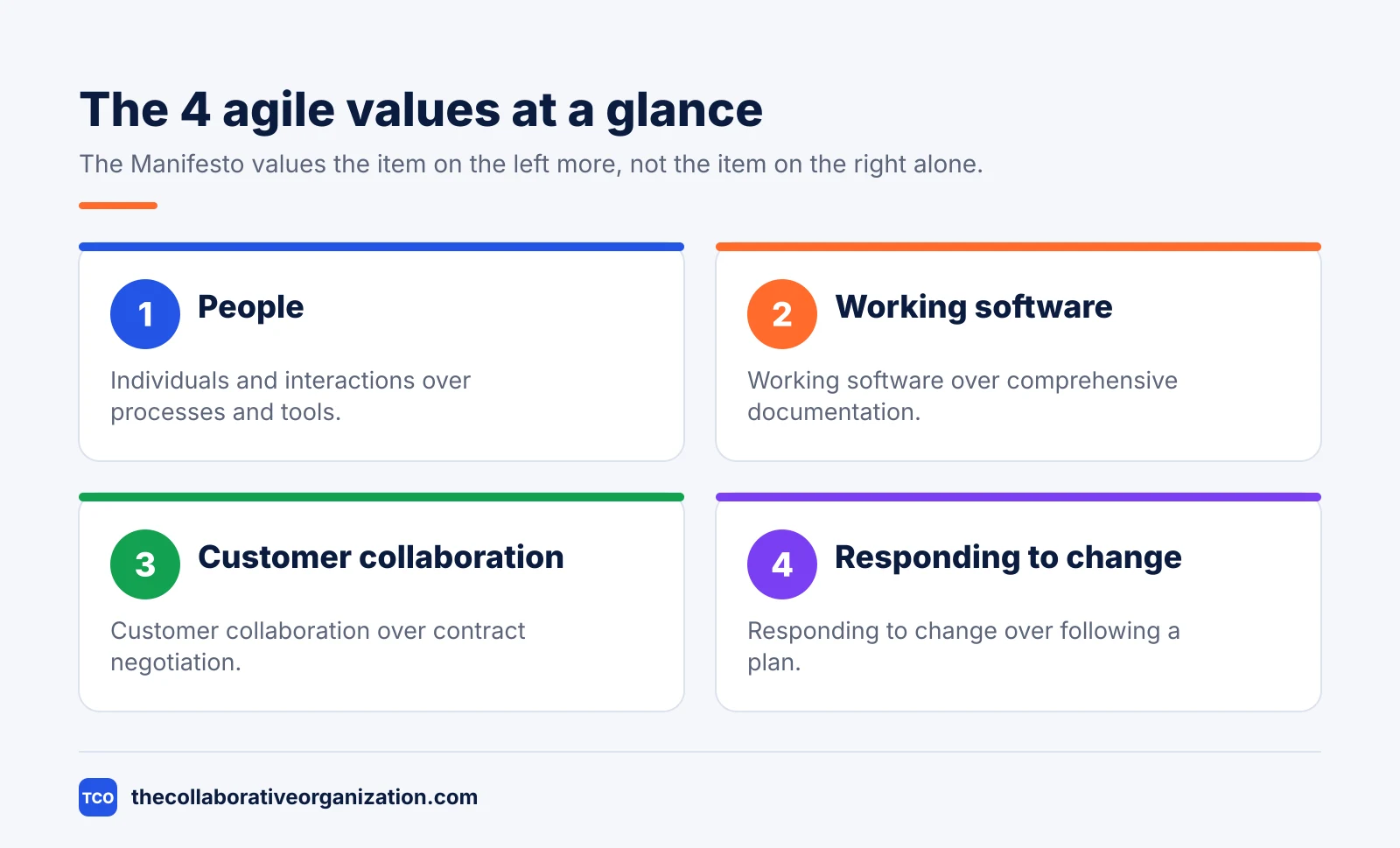
The four values are: individuals and interactions over processes and tools; “working software” over comprehensive documentation; customer collaboration over contract negotiation; and responding to change over following a plan. The Manifesto adds that the items on the right still have value, but the items on the left matter more.
The 12 principles sit behind the values. They ask teams to deliver valuable software early and often, to welcome changing requirements even late in the work, and to measure progress by working software. They also ask for motivated people, face-to-face conversation, and regular reflection on how to work better.
A team does not need to quote the principles to be agile. It needs to act on them: ship early, talk to the customer, and change the plan when the facts change.
How agile project management works
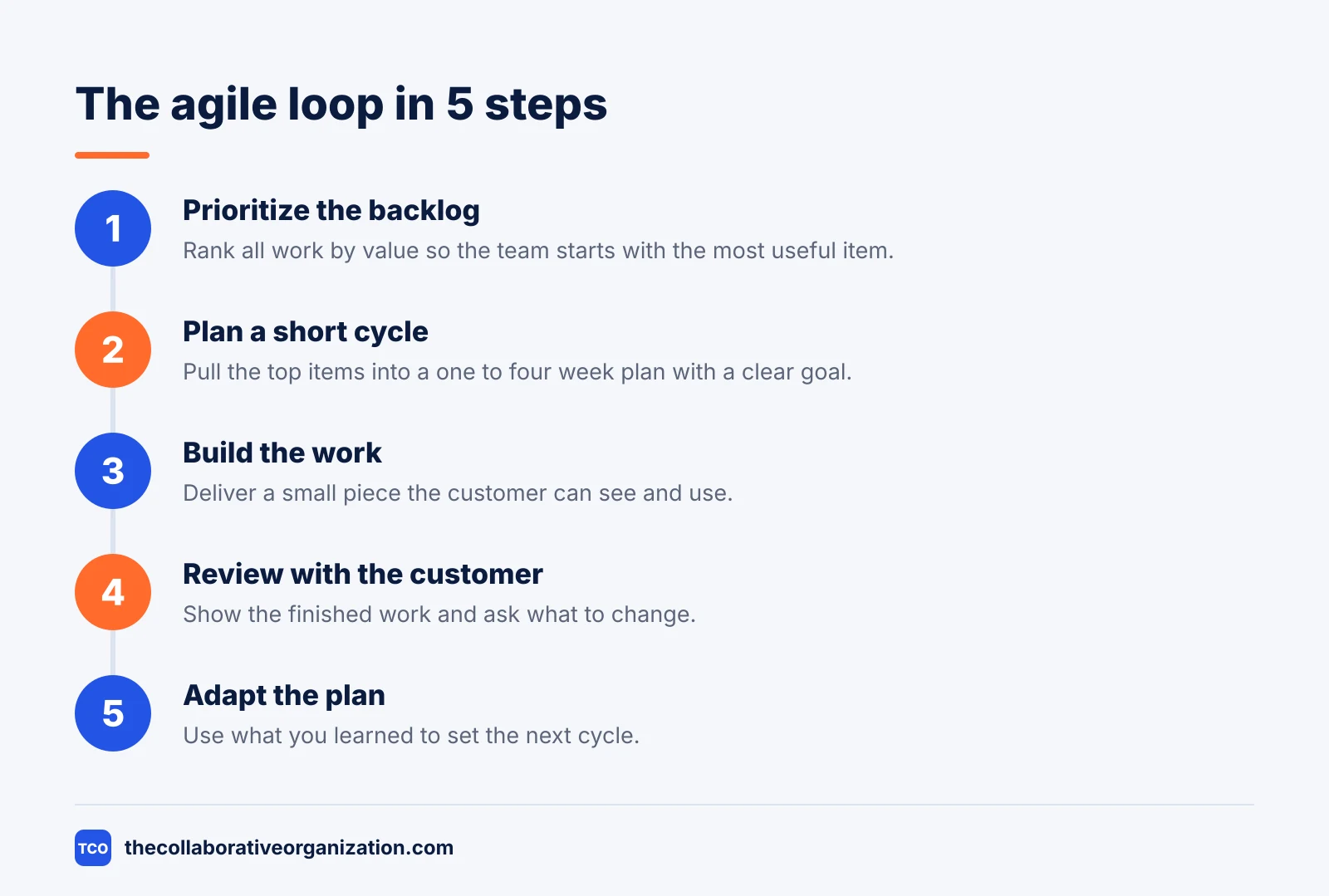
Agile work runs in a loop: prioritize the work, plan a short cycle, build it, review it with the customer, and then adapt the plan. The loop repeats until the product is done or the customer stops asking for more. Each loop is called an iteration, and in Scrum it is called a sprint.
Work starts in a backlog, a ranked list of everything the product might need. The person who owns the product ranks the list by value, so the team always works on the most useful item first. At the start of a cycle, the team pulls the top items into a short plan and agrees what “done” means for each one.
During the cycle, the team meets briefly each day to share progress and flag blocks. At the end, it shows the finished work to the customer and asks what to change. Then the team holds a short review of its own way of working and picks one thing to improve next time.
Ownership stays clear in this loop. Our guide to what is a RACI matrix shows how to name one owner for each task, which stops work from sitting with no one in charge.
Agile frameworks: Scrum, Kanban and more
Scrum, Kanban and Extreme Programming are the three agile frameworks most teams meet, and they differ in how much structure they add. Scrum is the most prescriptive, Kanban is the lightest, and Extreme Programming focuses on engineering habits. The Scrum Guide defines Scrum as a lightweight framework that helps teams generate value through adaptive solutions for complex problems.
| Framework | How work is organized | Roles | Best for |
|---|---|---|---|
| Scrum | Fixed sprints of 1 to 4 weeks | Product Owner, Scrum Master, Developers | Teams that want a clear rhythm and regular reviews |
| Kanban | Continuous flow with limits on work in progress | No fixed roles | Support teams and work that arrives in a stream |
| Extreme Programming | Short cycles with paired work and frequent releases | Coach, customer, programmers | Software teams that want strong engineering practices |
| Scrumban | Sprints with a Kanban board and flow limits | Scrum roles, used lightly | Teams moving from Scrum to flow-based work |
Scrum fits teams that can plan in two-week blocks and want a fixed review date. Kanban fits teams whose work arrives daily and cannot wait for a sprint to start. Extreme Programming fits software teams that want practices such as pair programming and test-first development built into the cycle.
No framework is agile by itself. A team can run Scrum events and still ignore customer feedback, and a team with no named framework can still ship, listen and adapt. The values matter more than the label.
Agile project management example: a website rebuild
A small team rebuilding a company website shows how agile turns a big project into short, testable steps. Imagine a team of six people: a product owner, a designer, two developers, a writer and a tester. The rebuild has 12 weeks, and the team works in six two-week cycles.
In cycle 1, the team ships the homepage and contact page, then shows them to three customers. The customers say the contact form asks for too much detail, so the team cuts four fields in cycle 2. In cycle 3, the team ships the product pages and learns visitors cannot find prices, so cycle 4 adds prices.
By cycle 6, the site is live with the pages customers asked for most, and the team has a list of smaller fixes for later. A waterfall plan would have built all the pages first and found the pricing problem only at launch.
The example is an illustration, not a report on a real project. It shows the pattern: ship a small piece, watch real people use it, and let what you learn set the next cycle.
When to use agile, and when not to
Use agile when the customer is unsure what they want, the work is complex, and feedback can change the plan. It fits new products, software features, and marketing campaigns where the result is hard to picture in advance. It also fits work where the customer can review progress every few weeks.
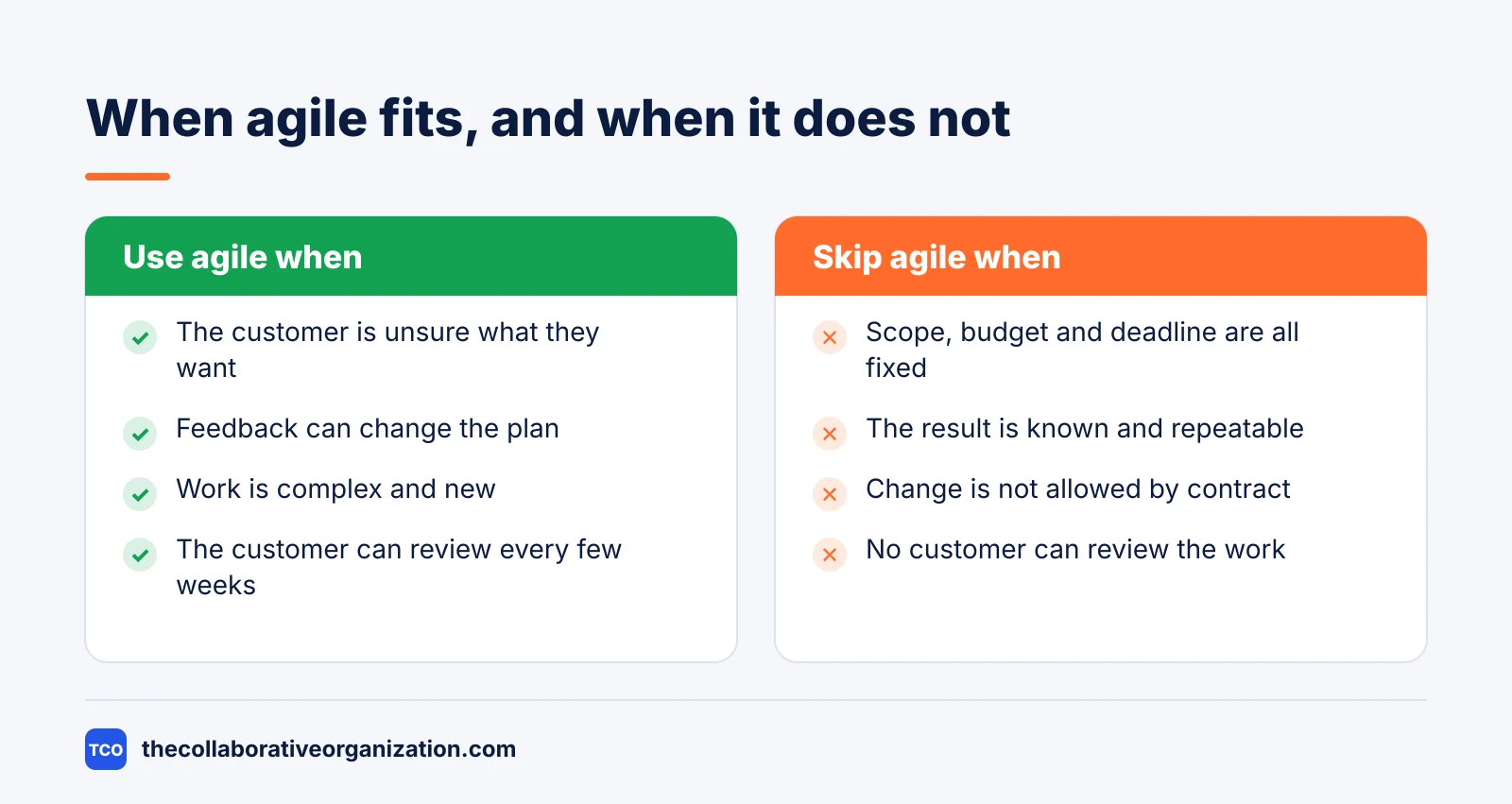
Skip agile when scope, budget and deadline are all fixed and change is not allowed. A construction project with a signed blueprint, a regulatory filing with a fixed form, or a contract naming every deliverable all suit a fixed plan better. Agile also fits poorly when the customer cannot review work because there is no feedback to act on.
A hybrid approach is common. Digital.ai reported in its 18th State of Agile report that 74% of organizations used hybrid, blended or homegrown agile models in 2025. Many teams plan the fixed parts up front and run the uncertain parts in cycles.
Tools that support agile teams
A board tool keeps the backlog, the cycle plan and the daily work in one place, so the team does not manage agile in spreadsheets and chat threads. Our guide on how to choose project management software covers seat counts and free-plan caps before you pick one.
| Tool | Best for | Free plan | Starting price (as of November 2026) | Notable limit |
|---|---|---|---|---|
| Asana | Teams that want a shared backlog with a named owner per task | Free for 2 people | $10.99 per user per month (Starter), billed annually | Free plan covers 2 people |
| ClickUp | Teams that want sprints, docs and goals in one place | Free Forever plan | $9 per user per month (Core), billed yearly | Free plan caps storage at 60 MB |
| Jira | Software teams that run Scrum sprints | Free for up to 10 users | $9.70 per user per month (Standard), billed monthly for 1-100 users | Per-user price changes with team size |
If you have not picked a tool yet, compare the options on our project management software shortlist before you start the first cycle. The right tool is the one the team will open every day, not the one with the longest feature list.
A tool does not make a team agile. A board with no reviews and no customer feedback is just a prettier plan. Start with the cycle and the review, then add the tool that makes those two habits easier.
Common agile mistakes to avoid
Most agile teams fail in the same five ways, and all five are easy to spot in a review. Run through the list below each time a cycle ends.
- Running sprints with no customer in the review. A cycle without customer feedback is just short waterfall, and the team learns nothing new.
- Treating the backlog as a wish list. A backlog with 200 unranked items is not a plan, so rank it by value and cut what no one will build.
- Skipping the retrospective. Teams that never review their own way of working repeat the same blockers in every cycle.
- Calling a status meeting a daily standup. A 30-minute status report to a manager is not a 15-minute plan for the next day of work.
- Changing scope mid-cycle without moving the goal. New work in a cycle means old work moves out, or the cycle goal stops meaning anything.
Sources
- Agile Manifesto - Manifesto for Agile Software Development (2001)
- Atlassian - Agile vs. Waterfall Project Management Methodology (2026)
- Scrum Guides - The Scrum Guide, November 2020 (2020)
- Digital.ai - 18th State of Agile Report (2025)
- Atlassian - Agile Iron Triangle (2026)
- Asana - Pricing (2026)
- ClickUp - Pricing (2026)
- Atlassian - Future Cloud List Pricing Tables (2026)
Frequently asked questions
What is agile project management in simple terms?
Agile project management is a way to run a project in short cycles instead of one long plan. The team builds a small piece, shows it to the customer, learns from the feedback, and then plans the next piece. The plan changes as the team learns, so the final result matches what the customer actually needs.
Is agile the same as Scrum?
No. Agile is a set of values and principles about how to run projects, while Scrum is one framework that puts those values into practice. Scrum adds fixed roles, events and artifacts, such as sprints and a product backlog. A team can be agile without Scrum, and it can also use Kanban or another agile framework instead.
How long is an agile iteration or sprint?
Most agile teams work in iterations of one to four weeks, and two weeks is the most common length. The team picks a length and keeps it fixed, so everyone knows when work is reviewed and when the next plan starts. Shorter cycles give faster feedback, while longer cycles suit work that takes more time to show.
Does agile mean no planning and no documentation?
No. Agile teams plan at the start of every cycle and keep a prioritized backlog of all the work. They also write documentation, but only the documentation the team and the customer actually need. The Manifesto values working software over heavy documentation, which means delivery comes first, not that documents are banned.
When is agile a bad fit for a project?
Agile is a bad fit when the scope, budget and deadline are all fixed by a contract and change is not allowed. It also fits poorly when the work is a repeatable process with a known result, such as a standard audit. In those cases a fixed plan with clear phases gives the team more control and less overhead.
Related articles
project management
What Is a RACI Matrix? Definition, Roles and Examples (2026)
A RACI matrix maps who is Responsible, Accountable, Consulted and Informed for each task. Learn the four roles, how to build one, and see a worked example.
November 19, 2026 · 9 min read
project management
Daily Standup Meeting Format That Works (2026)
A daily standup is a 15-minute meeting where Developers inspect progress toward the Sprint Goal and plan the next day. Use this format to run one that ends on time.
November 19, 2026 · 10 min read
project management
How to Run a Sprint Planning Meeting (2026)
Sprint planning opens every sprint with a goal, a set of backlog items and a plan. Follow these 6 steps to run the meeting in 90 minutes for a two-week sprint.
November 19, 2026 · 9 min read