Scrum Roles and Responsibilities Explained (2026) | The Collaborative Organization
By The Collaborative Organization Team · November 19, 2026 · Last verified November 19, 2026 · 10 min read
Scrum has three roles: Product Owner, Scrum Master, and Developers, and each one owns a different part of the work. The Product Owner decides what to build and in what order. The Scrum Master keeps Scrum working well. The Developers build the Increment. Together they form one Scrum Team with no sub-teams and no hierarchy between the roles.
Key takeaways
- A Scrum Team has exactly three accountabilities: Product Owner, Scrum Master, and Developers.
- The Product Owner is one person, not a committee, and owns the order of the Product Backlog.
- The Scrum Master is accountable for the team’s effectiveness and serves the team, the Product Owner, and the wider organization.
- Developers create the usable Increment each Sprint and own the Sprint Backlog plan.
- A Scrum Team is typically 10 or fewer people, and the roles are accountabilities, not job titles.
What are the three Scrum roles?
The three Scrum roles are the Product Owner, the Scrum Master, and the Developers, and the 2020 Scrum Guide calls them accountabilities rather than roles. The change in wording matters: an accountability is something you answer for, while a job title is only a label. One person can hold a job title such as designer and still carry the Developer accountability.
The Scrum Guide defines the team as one Scrum Master, one Product Owner, and Developers, with no sub-teams or hierarchies inside it. The team is cross-functional, so it holds all the skills needed to create value in a Sprint, and self-managing, so it decides who does what, when, and how.
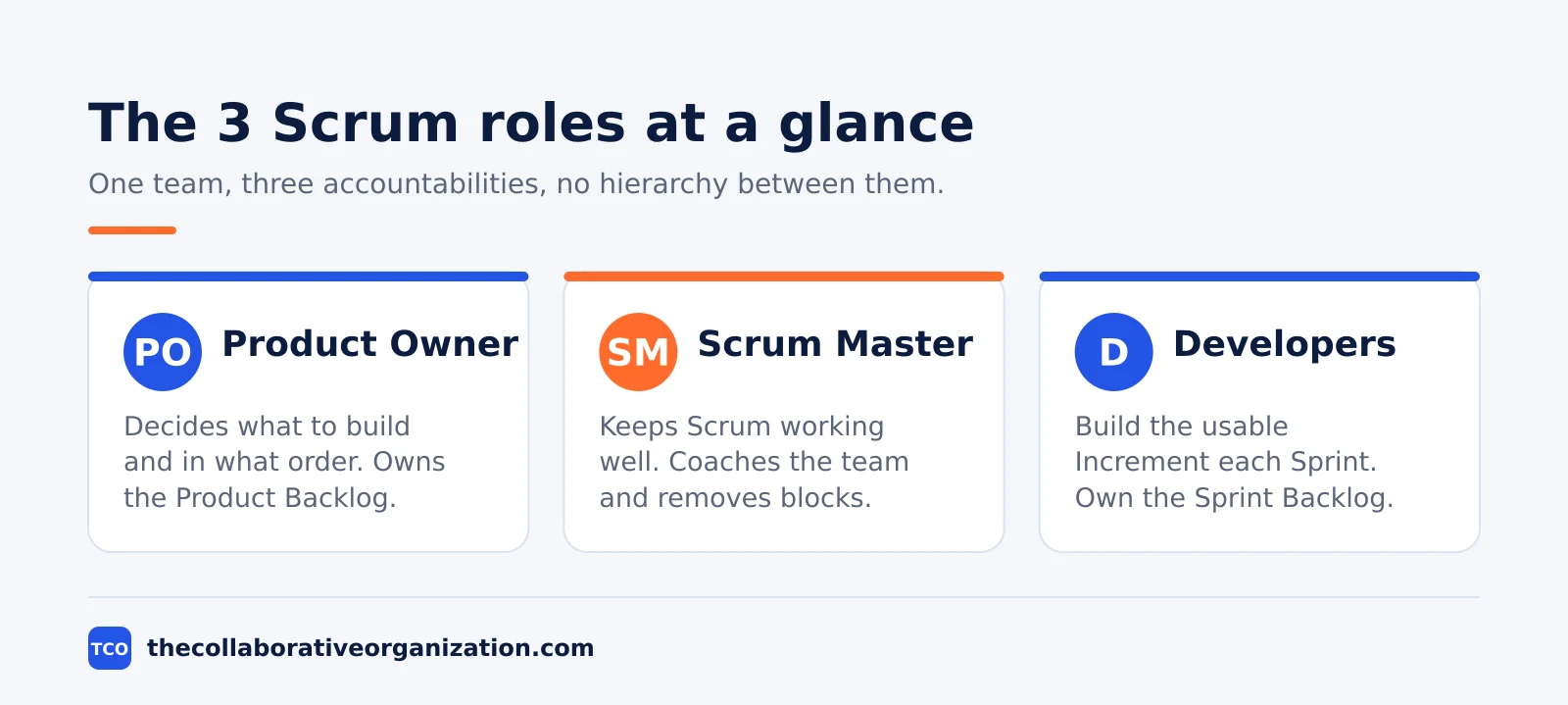
Each role answers a different question. The Product Owner answers what to build and why it matters. The Scrum Master answers how the team works together. The Developers answer how the work gets built.
When one role tries to answer another role’s question, the team slows down.
Atlassian puts the same split in plain terms: the Product Owner defines and prioritizes the backlog, the Scrum Master runs the process and removes blockers, and the Development Team delivers the work. Leadership is shared across the three, not held by one boss.
The Product Owner: what to build, and in what order
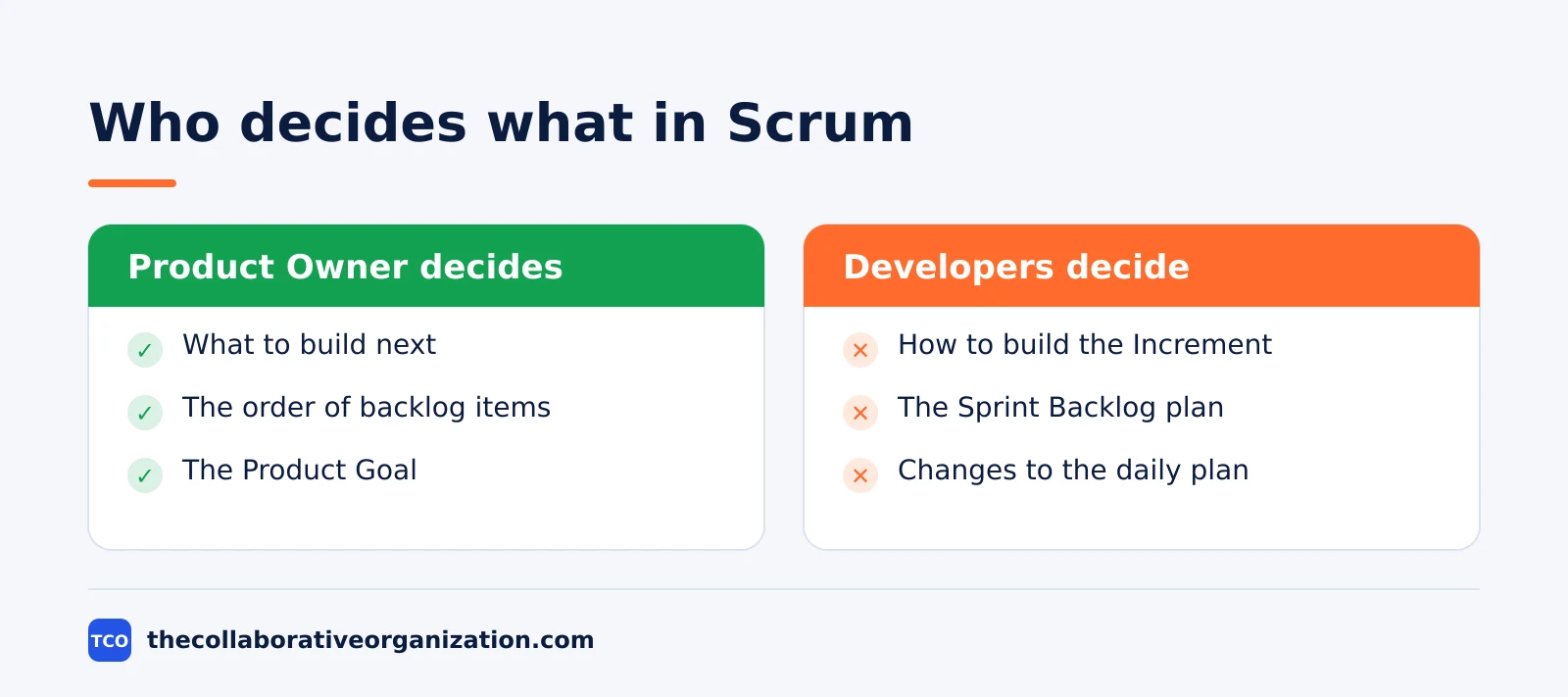
The Product Owner is accountable for getting the most value from the product, and owns the Product Backlog. That means developing and communicating the “product goal”, creating and explaining backlog items, ordering those items, and keeping the backlog visible and understood by everyone.
The Product Owner is one person, not a committee. Anyone who wants to change the backlog must convince that person, which is how the Guide keeps priorities from splitting across competing stakeholders. The Product Owner may hand the day-to-day backlog work to others, but the accountability stays with them.
Ordering is the Product Owner’s sharpest tool. The item at the top of the backlog is the next thing the team works on, so a clear order turns a long wish list into a plan. A Product Owner who orders by value, risk, and dependencies gives the team a clear next step every Sprint.
Stakeholder management takes much of the role’s time. Users, customers, and managers all ask for different things, and the Product Owner balances those asks against the product goal. Saying no to a request that does not fit the goal is part of the job, not a failure of it.
The Scrum Master: how the team works
The Scrum Master is accountable for setting up Scrum as the Guide defines it, and for the Scrum Team’s effectiveness. The Guide calls Scrum Masters true leaders who serve the Scrum Team and the larger organization, which means leading through coaching and service rather than through orders.
The Scrum Master serves the team by coaching self-management, helping the team focus on high-value Increments that meet the “definition of done”, removing blocks to progress, and keeping every Scrum event positive, useful, and inside its timebox. When a block sits outside the team’s reach, the Scrum Master takes it on.
The role also serves the Product Owner: helping with techniques for Product Backlog management, making backlog items clear and short, setting up empirical planning, and easing talks with stakeholders. A Scrum Master who helps the Product Owner write clearer items saves the whole team hours in Sprint Planning.
The third group the Scrum Master serves is the organization. That work covers leading Scrum adoption, advising on Scrum rollouts, teaching an empirical approach, and removing barriers between stakeholders and Scrum Teams. A team can run Scrum well and still stall if the wider organization blocks it.
The Developers: who builds the Increment
Developers are the people in the Scrum Team who commit to creating a usable Increment each Sprint. The word covers far more than programmers: designers, writers, testers, analysts, and anyone else who builds part of the product all count as Developers, since the Guide uses the word to include every kind of maker.
Developers carry four accountabilities. They create the plan for the Sprint, the Sprint Backlog. They build quality in by following the “definition of done”. They adapt their plan each day toward the “sprint goal”.
And they hold each other accountable as professionals.
No one outside the Developers tells them how to turn backlog items into Increments. That freedom is the point of a self-managing team: the people closest to the work choose the tools, the order of tasks, and the way to solve problems. The Product Owner sets what to build, and the Developers decide how to build it.
The Daily Scrum belongs to the Developers. They run it to inspect progress toward the Sprint Goal and adapt the Sprint Backlog for the next day. The Scrum Master may help run it, but the meeting exists for the Developers to plan their own work.
Scrum roles and responsibilities at a glance
Each role owns one artifact, one decision, and one kind of work, and the table below shows the split. Use it when a new team member asks who does what, or when two roles start to overlap.
| Role | Owns | Key decisions | Main work |
|---|---|---|---|
| Product Owner | Product Backlog | What to build, in what order | Ordering items, setting the Product Goal |
| Scrum Master | Scrum process | How the team works together | Coaching, removing blocks, running events |
| Developers | Sprint Backlog | How to build the Increment | Building, testing, adapting the daily plan |
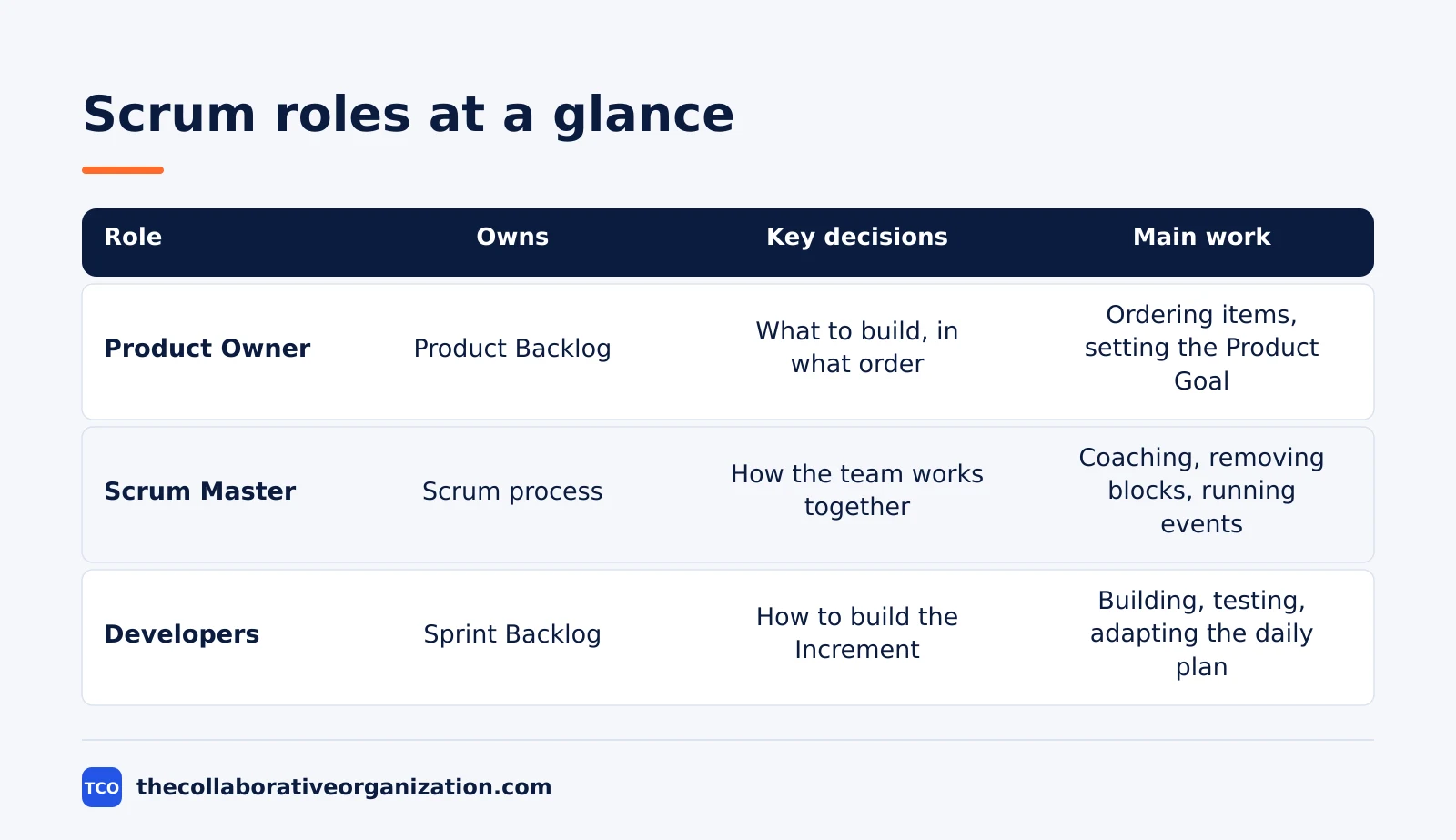
The table hides one detail worth stating: the whole Scrum Team is accountable for creating a valuable, useful Increment every Sprint. Individual roles own parts of the work, but the result belongs to the team. A Sprint with a great backlog and a weak Increment still fails.
The most common overlap is between Product Owner and Developers on sizing. The Developers who will do the work are responsible for sizing it, while the Product Owner may help them understand the item and weigh trade-offs. Size stays with the builders, and order stays with the Product Owner.
How the three roles work together in one Sprint
The three roles meet in Sprint Planning, then work in parallel until the Sprint Review, and the Sprint Goal holds them together. Imagine a team of 7 people building a booking app for a small clinic, with one Product Owner, one Scrum Master, and 5 Developers. The example is an illustration, not a real team.
In Sprint Planning, the Product Owner proposes a goal: let patients book a visit online without phoning the clinic. The Developers pick the backlog items that serve that goal and break them into tasks of one day or less. The Scrum Master keeps the meeting inside its timebox and makes sure the goal is set before the meeting ends.
During the Sprint, the Developers build the booking form, the confirmation email, and the calendar view. Each morning they hold a 15-minute Daily Scrum to check progress toward the goal and adjust the plan. The Scrum Master removes a block when the clinic’s calendar system needs access rights the team does not have.
At the Sprint Review, the team shows the working booking flow to clinic staff and hears what still confuses patients. The Product Owner uses that feedback to reorder the backlog for the next Sprint. The loop repeats, with the same three roles and a fresh goal.
Scrum roles vs job titles and project managers
Scrum roles are accountabilities inside one team, while job titles and project manager posts belong to the organization around it. Atlassian states the point directly: the three roles are not job titles, so any existing title can perform one of them. A senior engineer can be a Developer, and a product manager can be a Product Owner, without changing their title.
A project manager is not a Scrum role. Some project managers become Scrum Masters, and some become Product Owners, but the project manager job itself has no place in the Guide. Teams that keep a project manager alongside the three roles often find the manager and the Product Owner giving conflicting orders.
The same confusion shows up with the RACI matrix. A RACI chart maps who does, approves, advises on, and hears about each task, while Scrum roles say who is accountable for value, process, and building. Our guide on what is a RACI matrix explains the four letters and when a chart helps a team that Scrum alone does not cover.
Role mix-ups also appear in hiring. A job ad for a Scrum Master that asks for project plans, status reports, and team appraisals describes a project manager, not a Scrum Master. A Product Owner ad that asks for coding skills misses the point: the role needs product judgment and stakeholder trust, not a second trade.
Tools that support the three Scrum roles
A shared board keeps the three roles in sync, because the backlog, the Sprint plan, and the blockers all live in one place. The Product Owner orders items on the board, the Developers pull work from it, and the Scrum Master sees where work stalls. Our guide on how to choose project management software covers seat counts and free-plan caps in more detail.
If you have not picked a tool yet, compare the options on our project management software shortlist before the team starts its first Sprint. The right tool is the one all three roles will open every day.
| Tool | Best for | Free plan | Starting price (as of November 2026) | Notable limit |
|---|---|---|---|---|
| Asana | Product Owners who track goals and owners | Free for 2 people | $10.99 per user per month (Starter), billed annually | Free plan covers 2 people |
| monday.com | Teams that want a visual board for each role | Free plan for up to 2 seats | $9 per seat per month (Basic), billed annually | Paid plans need at least 3 seats |
| ClickUp | Teams that want sprints and docs in one place | Free Forever plan | $9 per user per month (Core), billed annually | Yearly billing needed for that price |
The Asana price comes from Asana pricing: the Personal plan is free for 2 users, and Starter is $10.99 per user per month when billed annually. On the monday.com pricing page, Basic is $9 per seat per month billed annually, with a 3-seat minimum. The ClickUp pricing page lists Core at $9 per user per month billed yearly.
Common Scrum roles mistakes to avoid
Most Scrum role problems come from one role doing another role’s job, and all five mistakes below are easy to spot. Check for them whenever a Sprint feels slow or tense.
- A Product Owner who is a committee. When 3 people share the role, no one can set the order, and the backlog fills with items no one will defend.
- A Scrum Master who assigns tasks. Assigning work breaks self-management and turns the Daily Scrum into a status report to the boss.
- Developers who wait for instructions. A team that waits for the Product Owner to plan the Sprint loses the speed that self-management gives.
- A Product Owner who sizes the work. Sizing belongs to the Developers who will do the work, and a Product Owner who sets sizes hides real risk.
- Two roles held by one person for too long. A combined Product Owner and Scrum Master can work for a few weeks, but the conflict of focus grows with every Sprint.
Sources
- Scrum Guides - The Scrum Guide (2020)
- Atlassian - Agile Scrum Roles (2026)
- Scrum.org - What is a Sprint Backlog? (2026)
- Atlassian - Sprint Planning (2026)
- Asana - Pricing (2026)
- monday.com - Pricing (2026)
- ClickUp - Pricing (2026)
Frequently asked questions
Can one person hold two Scrum roles at once?
The Scrum Guide does not ban it, but the two accountabilities pull in different directions. A Product Owner who also acts as Scrum Master must both push for value and protect the process, which creates a conflict of focus. Small teams sometimes combine the roles for a short time, but most teams keep them separate.
Is the Scrum Master the team manager?
No. A Scrum Master has no authority over people, pay, or hiring, and does not assign work to Developers. The role is a servant leader who coaches the team, removes blocks, and keeps Scrum events on track. The team manages its own work, and the Scrum Master protects the conditions that let it do that.
Who decides what the team builds next?
The Product Owner decides, because the Product Owner owns the order of the Product Backlog. Stakeholders, customers, and Developers can suggest items and try to convince the Product Owner, but only one person sets the order. That single decision point keeps priorities clear when requests compete.
How many Developers should a Scrum Team have?
The Scrum Guide says a Scrum Team is typically 10 or fewer people in total, with one Scrum Master, one Product Owner, and the Developers. Atlassian puts the usual range at 5 to 11 members. Below 5 people the team may lack the skills to finish a Sprint, and above 10 the cost of coordination rises fast.
Do Scrum roles replace job titles?
No. Scrum roles describe accountabilities, not job titles, so a designer, a writer, or an engineer can all be Developers. Your job title stays the same, and the Scrum role says what you are accountable for inside the team. This split lets teams adopt Scrum without rewriting every job description.
Related articles
project management
What Is a RACI Matrix? Definition, Roles and Examples (2026)
A RACI matrix maps who is Responsible, Accountable, Consulted and Informed for each task. Learn the four roles, how to build one, and see a worked example.
November 19, 2026 · 9 min read
project management
Daily Standup Meeting Format That Works (2026)
A daily standup is a 15-minute meeting where Developers inspect progress toward the Sprint Goal and plan the next day. Use this format to run one that ends on time.
November 19, 2026 · 10 min read
project management
How to Run a Sprint Planning Meeting (2026)
Sprint planning opens every sprint with a goal, a set of backlog items and a plan. Follow these 6 steps to run the meeting in 90 minutes for a two-week sprint.
November 19, 2026 · 9 min read