How to Estimate Story Points (2026) | The Collaborative Organization
By The Collaborative Organization Team · November 19, 2026 · Last verified November 19, 2026 · 11 min read
To estimate story points, pick 2 or 3 finished stories as baselines, compare each new item against them, and agree a number from a Fibonacci-like scale, usually through planning poker. The number is a relative size, not hours. Only the people who will do the work vote on it.
Key takeaways
- Start with baselines: 2 or 3 finished stories the team agrees on as reference sizes.
- Planning poker is the most common method: vote in private, reveal at once, discuss the outliers, then vote again.
- Use a modified Fibonacci scale: 0, 1, 2, 3, 5, 8, 13, 20, 40, 100.
- A story should take 2 to 3 minutes to size; longer means the story is unclear.
- Never average the votes, and never convert points to hours.
- Only the people who will do the work estimate; the product owner explains and the Scrum Master runs the session.
What you need before you estimate
Before you estimate, you need a clear story, a scale the team agrees on, and 2 or 3 baseline stories. Without those three, the session becomes a debate about numbers with no anchor. Gather them in backlog refinement, not in the middle of sprint planning.
First, the story must be clear enough to size. It needs a named user, a goal, and acceptance criteria that state when it is done. If the team cannot say what done means, it cannot size the work. Park unclear stories and refine them before the session.
Second, agree the scale. A modified Fibonacci scale of 0, 1, 2, 3, 5, 8, 13, 20, 40 and 100 works for most teams, and Mountain Goat Software recommends it as a starting point. The gaps grow on purpose, because bigger items are harder to size with care. Pick one scale and stick with it for several sprints.
Third, pick the baselines. Choose finished stories the whole team remembers, and agree their point values before the session starts. A baseline turns every new estimate into a comparison, which is a question people can answer.
You also need a facilitator and a timebox. The Scrum Master usually runs the session and keeps each story to a few minutes. A session for one sprint backlog should fit inside an hour.
How to estimate story points in 6 steps
Estimating story points takes six steps, and the first two happen before anyone picks up a card. The steps below work for a team that is new to points, and for a team that has used them for years.
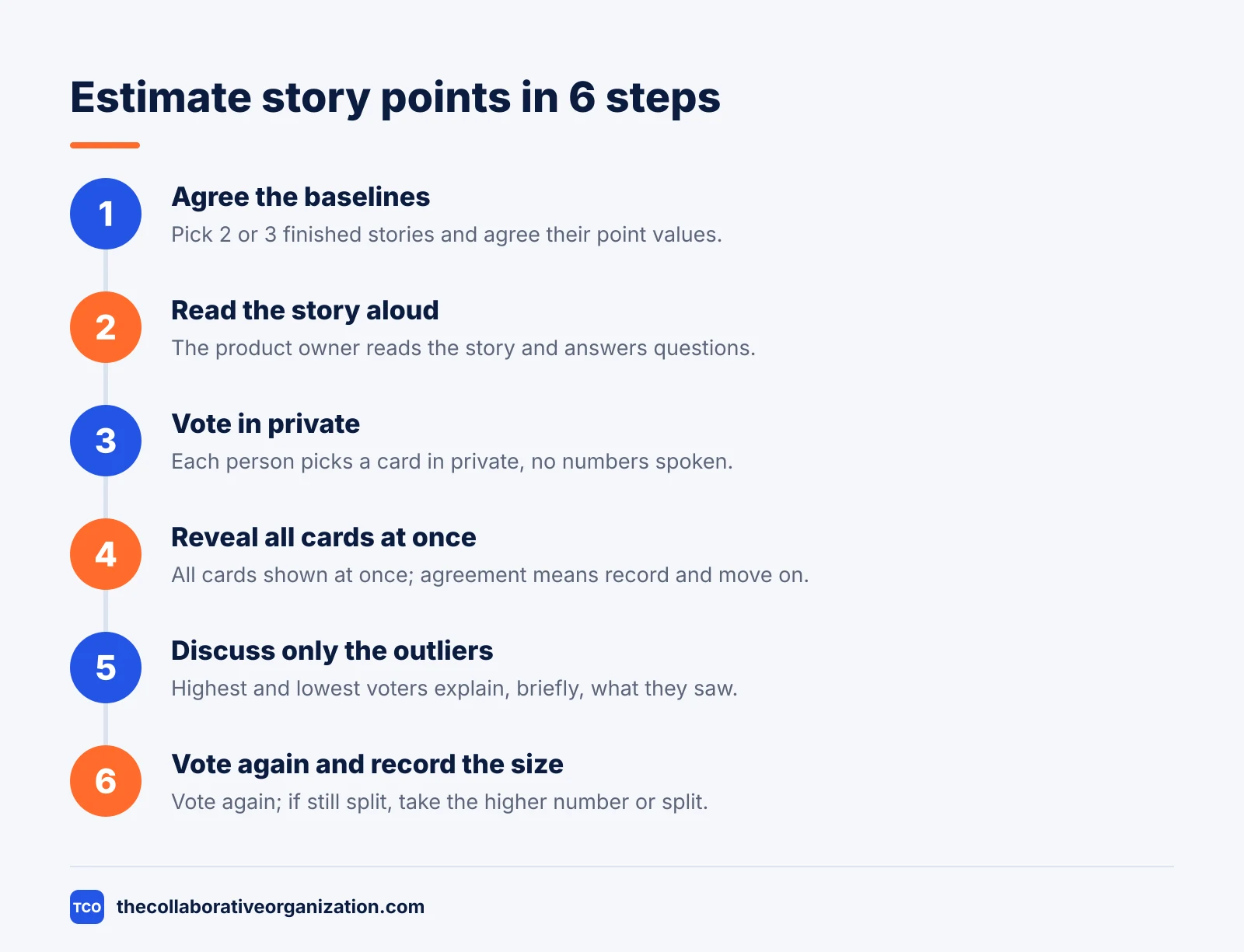
Step 1: Agree the baselines
Pick 2 or 3 finished stories and agree their point values as a team. The outcome is a shared scale: everyone knows what a 2 and a 5 look like on real work the team already did.
Step 2: Read the story aloud
The product owner reads the story and its acceptance criteria, then answers questions. The outcome is a story the whole team understands the same way. Keep this to 2 minutes, not 10.
Step 3: Vote in private
Each person who will do the work picks a card without showing it or saying a number aloud. The outcome is a set of independent judgements, free from the first number spoken. The product owner and the Scrum Master do not vote.
Step 4: Reveal all cards at once
Everyone shows their cards at the same moment. The outcome is a spread the team can see: agreement, a near miss, or a real split. If the votes match, record the number and move on.
Step 5: Discuss only the outliers
The highest and lowest voters explain their reasons, briefly. The outcome is new facts the team did not have: a hidden risk, a simpler design, or a part that already exists. The high number often points to work nobody else saw.
Step 6: Vote again and record the size
Everyone votes a second time. The outcome is usually agreement, and the team records the number and moves to the next story. If a third round still splits, take the higher number or split the story.
Picking reference stories and baselines
A baseline is a finished story the team agrees on as a fixed size, and it is the anchor that keeps every later estimate honest. Relative estimation only works when everyone compares new work against the same things. Without baselines, the scale drifts and a 5 this sprint means something different from a 5 last sprint.
Start small. Pick a finished story that was simple and clear, and call it a 2. Leave room below it: a 1 is for trivial changes that are smaller still.
Then pick two more finished stories as anchors for 3 and 5. A 3 is a standard story with a clear path, and a 5 is a story that touches several areas or carries some risk.
Choose baselines from real finished work, not from guesses. A completed item is best, because the team knows what it really took. Avoid starting with the most argued-about item in the backlog: pick items the team agrees on, so the scale starts on solid ground.
Revisit baselines as the team learns. If the team keeps finding that its 3s feel like 5s, the baseline may need to move, or the team may be sizing a new kind of work. Adjusting a baseline is fine, as long as the whole team agrees and the change is written down.
Mountain Goat Software gives a simple test for any new item: ask whether it is like the item called a 2, or closer to the item called a 5, and what makes it larger or smaller. Those three questions are often enough to place a story on the scale.
Planning poker in detail
Planning poker is a consensus technique where each person privately picks a card for a story, all cards are shown at once, and the team talks only about the gaps. James Grenning described it in 2002, and Mike Cohn later made it widely known through his book Agile Estimating and Planning. It is the most used estimation method in agile teams.
The private vote is the whole trick. In an open discussion, the first number spoken becomes an anchor, and every later judgement drifts toward it. When everyone commits to a number in private first, each vote is an independent judgement, and the spread shows what the team really thinks.
Atlassian describes the same flow: the product owner reads the story aloud, the team discusses it, each person privately selects a card, and all cards are shown at the same time.
If the cards agree, that number becomes the estimate. If they vary, the high and low voters explain, and the team votes again. Estimates usually start to converge after the second round.
The deck matters too. Cohn recommended a sequence of 0, 1, 2, 3, 5, 8, 13, 20, 40 and 100. The decks are kept small on purpose, with large jumps between numbers, so the team can reach agreement instead of debating 6 against 7.
Some decks add a ”?” card for stories nobody understands yet, and a coffee card for a break.
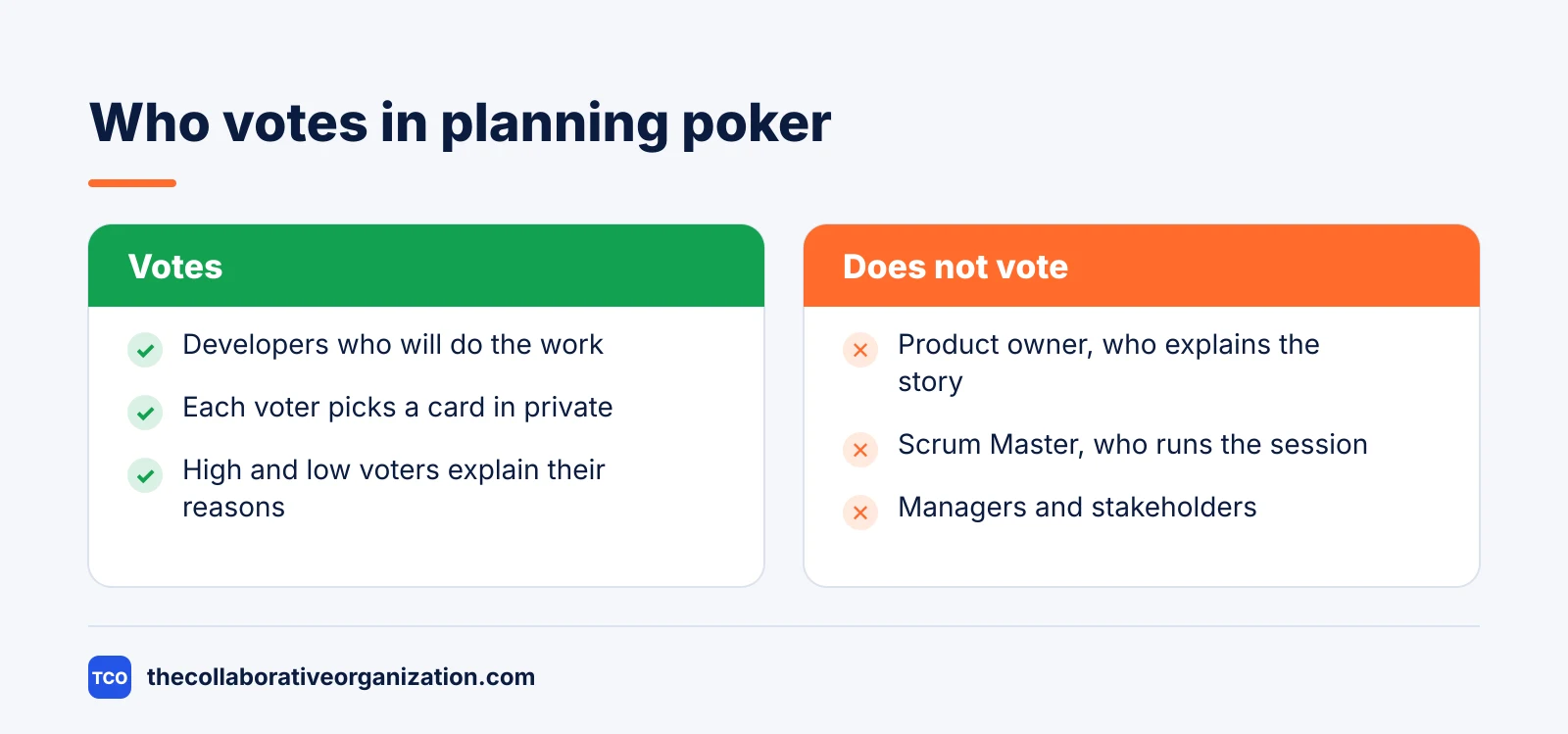
A session needs three roles. The developers vote, because they will do the work. The product owner answers questions about scope and trade-offs, but does not play a card. The Scrum Master runs the session, keeps time, and protects the team from pressure to lower a number.
Other estimation techniques
Planning poker is the default, but three other techniques fit teams that need a faster or coarser size. Each one trades detail for speed, and each one still rests on comparing new work with known work.
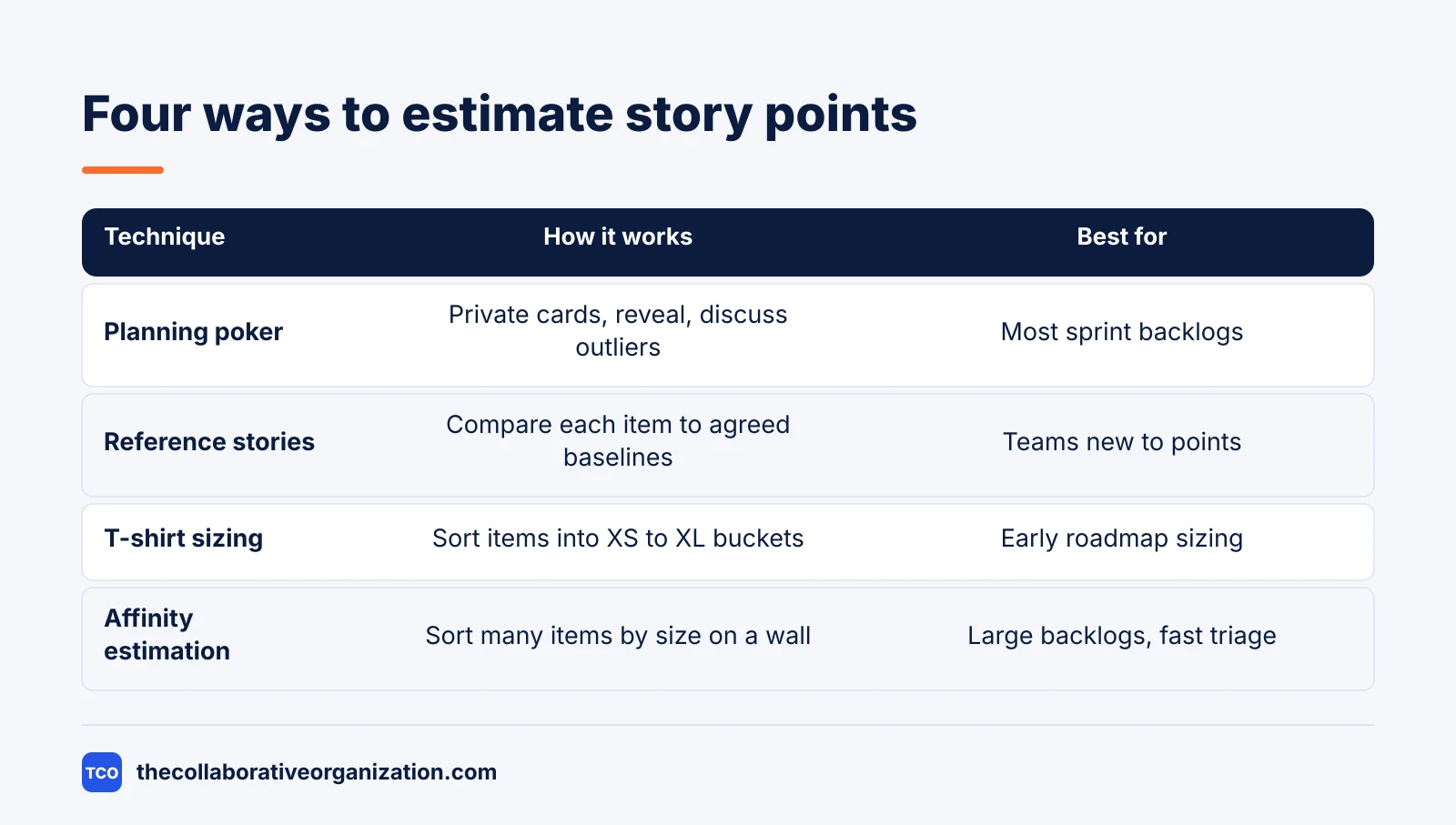
| Technique | How it works | Best for |
|---|---|---|
| Planning poker | Private cards, simultaneous reveal, discuss outliers | Most sprint backlogs |
| Reference stories | Compare each item to agreed baselines | Teams new to points |
| T-shirt sizing | Sort items into XS, S, M, L, XL buckets | Early roadmap sizing |
| Affinity estimation | Sort many items on a wall by relative size | Large backlogs, fast triage |
T-shirt sizing is the coarsest option. The team sorts stories into sizes from XS to XL without numbers, which suits early planning when the work is still vague. Later, the team can convert the sizes to points once the stories are clear enough to size properly.
Affinity estimation suits a big backlog. The team writes items on cards, sorts them on a table from small to large, and then draws lines between the groups to set the point values. It is fast, because the team sizes 20 items in one pass instead of voting on each one.
A study cited by Atlassian found that planning poker estimates were more accurate than individual ones for the same tasks. The shared discussion, not the cards, is what makes the difference: the outliers surface risks the rest of the team missed.
Worked example: estimating a sprint backlog
A team of 4 people estimating 6 stories for a 2-week sprint shows how the method works in one hour. Imagine the team finished a password-reset story last sprint and agreed it was a 2. That story is the baseline for the session.
The product owner reads the first story: shoppers can save an item to a wishlist. The team votes in private and reveals 2, 2, 3 and 2.
The voter who played 3 explains that the save button must work on both the web page and the mobile app, which the others had missed. The team votes again and agrees on 3.
The second story, syncing the wishlist across devices, splits the room: 3, 5, 8 and 5. The voter who played 8 knows the sync service has no test environment yet, which is a real risk.
The voter who played 3 thought the service already existed. After the discussion, the team votes again and agrees on 5, with a note to check the test environment first.
The third story, removing an item from the wishlist, gets four 1s: it is smaller than the baseline and clear. The fourth story, emailing a weekly wishlist summary, gets 5, 5, 8 and 5, and settles on 5.
The fifth story, a wishlist search filter, gets 2s across the board. The sixth story, migrating all saved items to a new database, gets 13, 20, 13 and 20: too big to size honestly, so the team splits it and parks the parts for refinement.
The six stories total 3 + 5 + 1 + 5 + 2 = 16 points, plus the split epic held back. Last sprint the team finished 24 points, so it has room for a few more small stories from the backlog.
Tools that support estimation
Estimation needs a place to record the size, and most teams keep it in the same tool that holds the backlog. A points field on each story, plus a sprint total, is enough. Our guide on how to choose project management software covers seat counts and free-plan caps.
If you have not picked a tool yet, compare the options on our project management software shortlist before you move the backlog. The right tool is the one the team updates during the session, not after it.
| Tool | Best for | Free plan | Starting price (as of November 2026) | Notable limit |
|---|---|---|---|---|
| Asana | Teams that store points on each task | Free for 2 people | $10.99 per user per month (Starter), billed annually | Free plan covers 2 people |
| monday.com | Teams that size work on a visual board | Free plan for up to 2 seats | $9 per seat per month (Basic), billed annually | Paid plans need at least 3 seats |
| ClickUp | Teams that want custom fields for points | Free Forever plan | $9 per user per month (Core), billed annually | Yearly billing needed for that price |
The Asana price comes from Asana pricing: the Personal plan is free for 2 users, and Starter is $10.99 per user per month when billed annually. On the monday.com pricing page, Basic is $9 per seat per month billed annually, with a 3-seat minimum. The ClickUp pricing page lists Core at $9 per user per month billed yearly.
Some teams also use a planning poker app that hides each vote until the reveal, which helps remote teams run the same flow. The app is a convenience, not a method: the discussion after the reveal is where the value sits.
Common story point estimation mistakes to avoid
Most estimation mistakes come from rushing the session, averaging the votes, or letting someone else choose the number. The five mistakes below waste the most time, and all five are easy to spot.
- Estimating unclear stories. If the team cannot say what done means, it cannot size the work. Park the story, refine it, and estimate it next time.
- Averaging the votes. An average hides the disagreement and gives a number that is not on the scale. Discuss the outliers and vote again instead.
- Letting the product owner or a manager set the size. Only the people who will do the work vote. Pressure to lower a number makes the team stop being honest.
- Converting points to hours in the session. The moment a card secretly means a number of days, the team loses the benefit of relative estimation. Keep the unit abstract.
- Skipping the baselines. Without a few finished stories as anchors, every estimate is a fresh guess. Pick baselines first, then estimate, and revisit them as the team learns.
Sources
- Atlassian - Scrum Poker for Agile Projects (2026)
- Mountain Goat Software - Introducing Story Points to a Team (2026)
- Scrum.org - Scrum Glossary (2026)
- Atlassian - Sprint Velocity in Scrum (2026)
- Asana - Pricing (2026)
- monday.com - Pricing (2026)
- ClickUp - Pricing (2026)
Frequently asked questions
How long should a story point estimation session take?
A good session runs 2 to 3 minutes per story, so a sprint backlog of 10 stories fits inside an hour. If one story takes more than 5 minutes to size, the story is unclear and should be parked for refinement. Long debates about a number usually mean the story needs more detail, not more discussion.
Who should estimate story points?
Only the people who will do the work vote on the size. The product owner explains each story and answers questions, and the Scrum Master runs the session, but neither of them plays a card. The Scrum Guide says the Developers who will do the work are responsible for sizing it.
What do you do when the team cannot agree on a number?
After two or three rounds, take the higher number or split the story, and move on. Do not average the votes, because an average hides the disagreement and gives a number that is not on the scale. If the gap comes from a real unknown, turn that unknown into a short research task first.
How many story points should a team finish per sprint?
There is no standard number, because points are relative to each team. A new team might finish 20 points per sprint, while a larger team finishes 60, and both can be healthy. Atlassian notes that new Scrum teams usually average 5 to 10 story points per person per two-week sprint.
Should you re-estimate a story after it is done?
No. Re-estimating finished work to make velocity look better hides the real gap between the estimate and the result. The team learns more by leaving the original estimate alone and talking about why it was wrong in the retrospective. Velocity is only useful when the numbers are honest.
Related articles
project management
What Is a RACI Matrix? Definition, Roles and Examples (2026)
A RACI matrix maps who is Responsible, Accountable, Consulted and Informed for each task. Learn the four roles, how to build one, and see a worked example.
November 19, 2026 · 9 min read
project management
Daily Standup Meeting Format That Works (2026)
A daily standup is a 15-minute meeting where Developers inspect progress toward the Sprint Goal and plan the next day. Use this format to run one that ends on time.
November 19, 2026 · 10 min read
project management
How to Run a Sprint Planning Meeting (2026)
Sprint planning opens every sprint with a goal, a set of backlog items and a plan. Follow these 6 steps to run the meeting in 90 minutes for a two-week sprint.
November 19, 2026 · 9 min read