Agile vs Waterfall: Differences, Pros and When to Use Each (2026) | The Collaborative Organization
By The Collaborative Organization Team · November 19, 2026 · Last verified November 19, 2026 · 8 min read
The core difference is simple: agile fixes time and team size and lets scope change, while waterfall fixes scope and lets time and cost change. Agile delivers in short cycles with feedback after each one. Waterfall plans everything up front and delivers once at the end.
Key takeaways
- Agile fixes time and team size while scope changes; waterfall fixes scope while time and cost change.
- Agile delivers small pieces in cycles with customer feedback; waterfall delivers once after all phases finish.
- Waterfall suits fixed, known work such as regulated filings; agile suits uncertain work such as new products.
- Digital.ai found 74% of organizations used hybrid, blended or homegrown agile models in 2025.
- Agile finds problems in weeks, while waterfall often finds them in testing, near the end of the project.
The core difference between agile and waterfall
Agile and waterfall differ in what they fix and what they let move. In waterfall, the team agrees the full scope first, then spends the time and money needed to build it. In agile, the team agrees how much time and how many people it has, then keeps choosing the most valuable work to fit that budget.
Atlassian puts it plainly: agile is an iterative approach that focuses on continuous releases with customer feedback, while waterfall follows a set path with limited deviation. The customer sees working software early in agile, and sees the finished product only at the end in waterfall.
The two approaches also differ in how they handle change. Agile welcomes change, even late in the work, because each cycle is a chance to change direction. Waterfall controls change through formal change requests, because a change in one phase ripples into every phase after it.
Neither approach is a shortcut. Agile needs a customer who can review work often, and waterfall needs requirements that stay still long enough to build against.
Agile vs waterfall side by side
The table below shows the same project run two ways, so you can see where each approach bends and where it breaks. Read it row by row and ask which side matches your project.
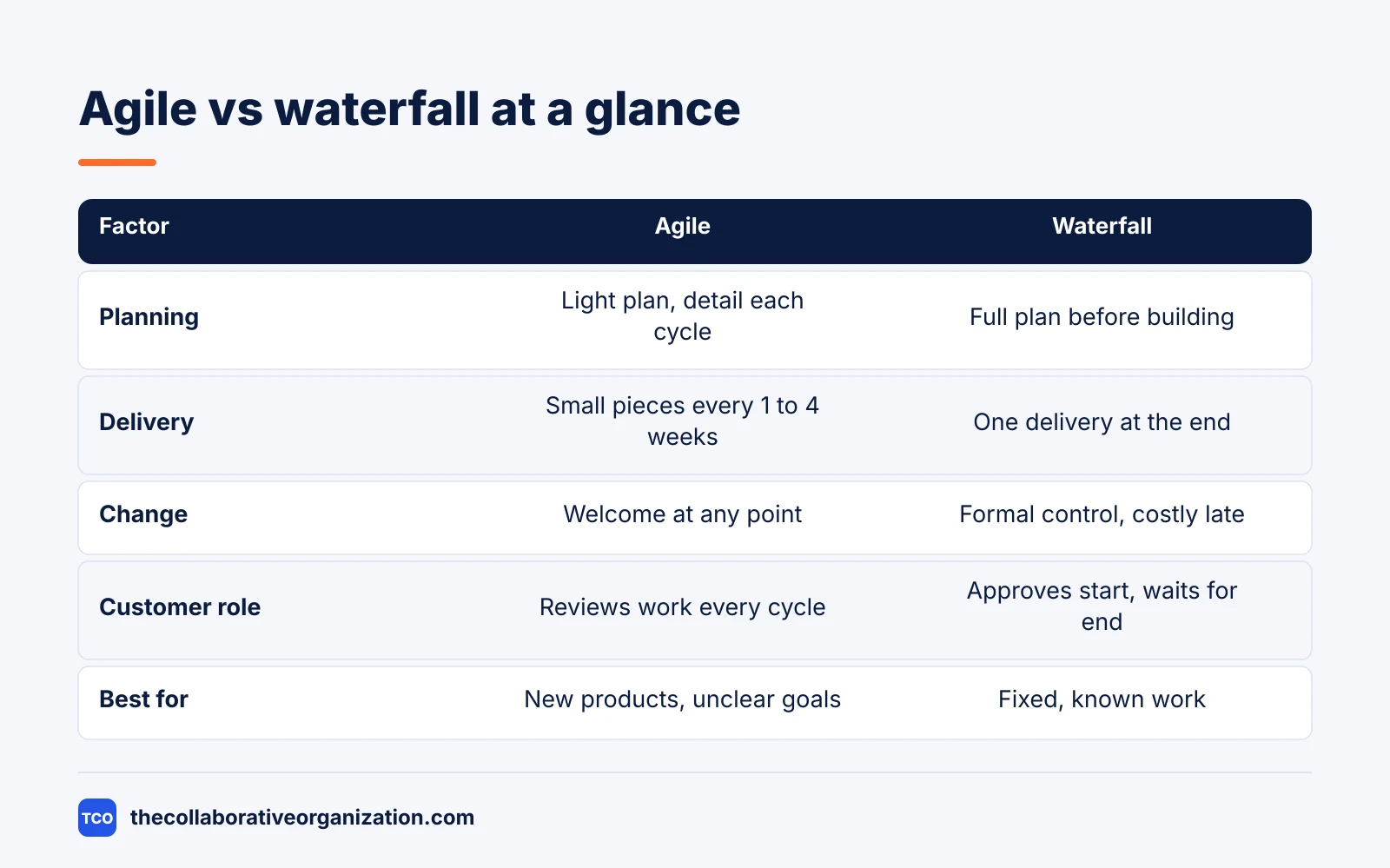
| Factor | Agile | Waterfall |
|---|---|---|
| Planning | Light plan up front, detailed plan each cycle | Full plan up front before building starts |
| Delivery | Small pieces every 1 to 4 weeks | One delivery at the end of the project |
| Change | Welcome at any point, cost stays low | Formal change control, cost grows late |
| Customer role | Reviews work every cycle | Approves requirements, then waits for delivery |
| Team | Cross-functional, self-managing | Specialists per phase, handoffs between phases |
| Best for | New products and unclear goals | Fixed, known work with strict rules |
The table makes the trade clear. Agile trades certainty about the final scope for speed and learning. Waterfall trades speed and learning for certainty about what will be built and what it will cost.
How each approach works
Agile works in a loop and waterfall works in a line, and the shape of the work decides which shape fits. Both start with a goal, but they move toward it in different ways.
How agile works
The team keeps a ranked backlog of all the work the product might need. At the start of each cycle, the team pulls the top items into a short plan and agrees what “done” means. The team builds, shows the work to the customer, and then adapts the plan for the next cycle. Scrum is the most used agile framework, and it runs this loop in fixed sprints of one month or less.
How waterfall works
The team moves through fixed phases in order: requirements, design, build, test, then launch. Each phase needs final approval before the next one starts, and going back is slow and costly. The customer approves the requirements at the start and sees the finished product at the end.
Worked example: one project, two ways
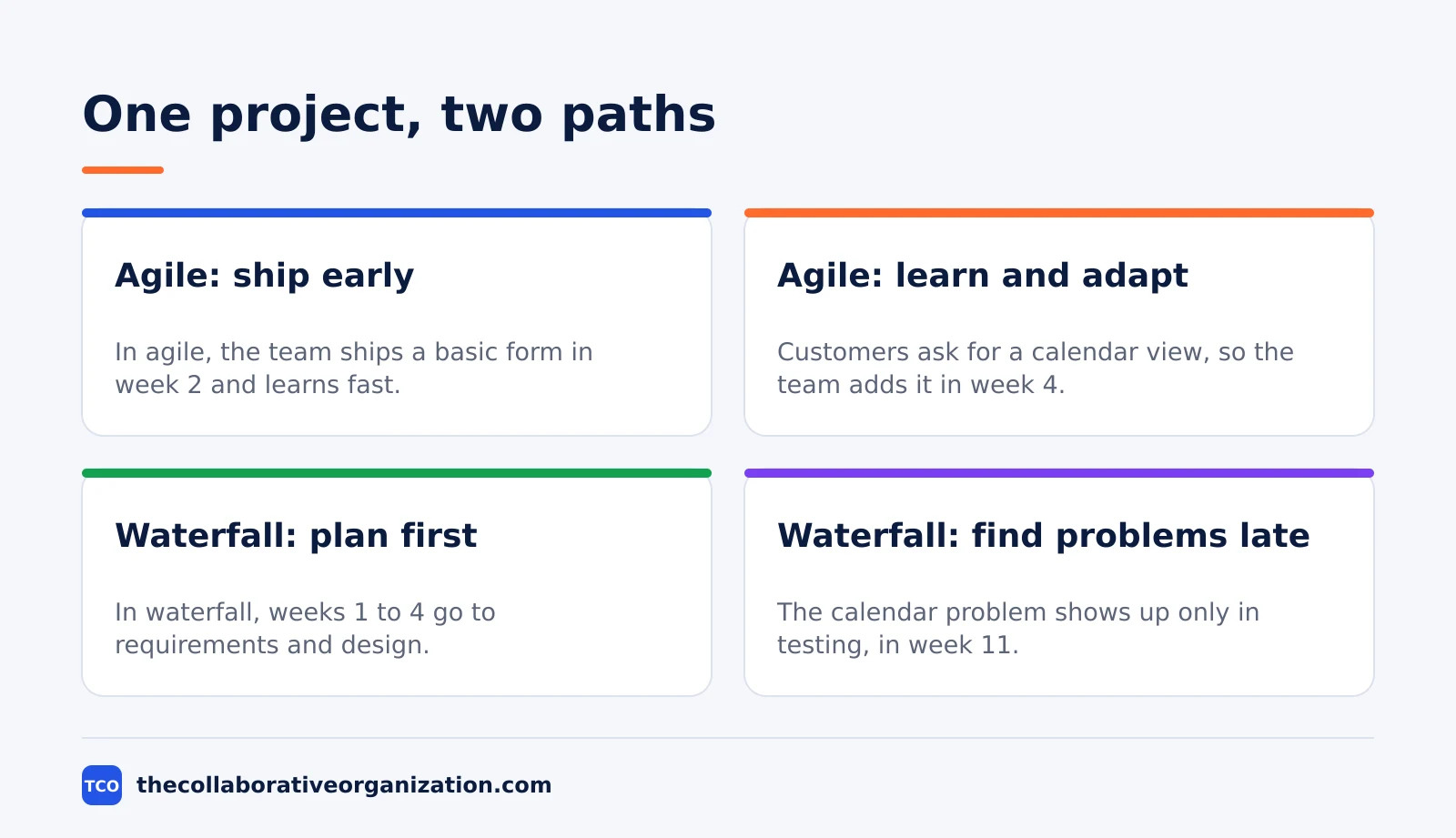
Imagine a team of six people building an online booking page in 12 weeks. In agile, the team ships a basic booking form in week 2, learns that customers want a calendar view, and adds it in week 4. In waterfall, the team spends weeks 1 to 4 writing requirements and designs, builds in weeks 5 to 10, and finds the calendar problem only during testing in week 11. The example is an illustration, not a report on a real project, but it shows the pattern: agile finds the problem early, waterfall finds it late.
Pros and cons of each approach
Agile wins on feedback and change, while waterfall wins on predictability and control. The lists below use the points Atlassian sets out in its agile and waterfall guide.
Agile pros: faster feedback cycles; problems surface early; higher potential customer satisfaction; time to market improves; flexible prioritization focused on value. Agile cons: dependencies between teams may stay unclear; there is a learning curve for the organization; a continuous delivery pipeline costs time and money to set up.
Waterfall pros: less coordination because phases are clearly defined; dependencies are easy to see; cost can be estimated once requirements are set; documentation stays strong; design is methodical before any code is written.
Waterfall cons: work is hard to split between teams; delays at phase changes waste time; specialist phase teams need extra hiring; handoffs add communication overhead; product ownership is weaker.
A team that picks agile for a fixed contract will fight the contract. A team that picks waterfall for an unclear product will fight the customer. The pros of one are the cons of the other.
Choose agile if, choose waterfall if
Choose agile when the goal is unclear and the customer can review work often; choose waterfall when the goal is fixed and change is costly. The choice is about the work, not about which method sounds modern.
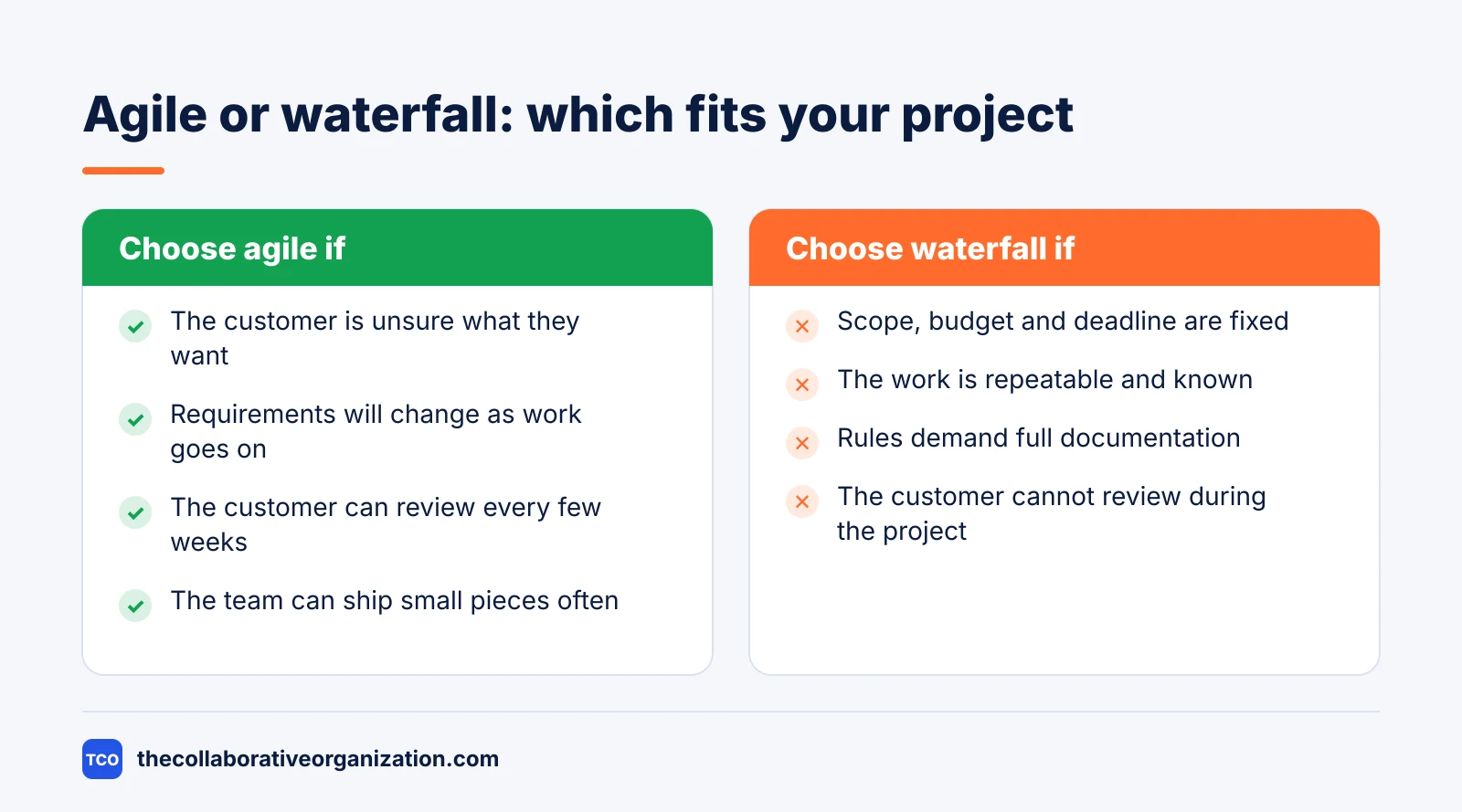
Choose agile if the customer is unsure what they want, the product is new, requirements will change, the customer can attend a review every few weeks, and the team can ship small pieces.
Choose waterfall if the scope, budget and deadline are all fixed, the work is repeatable with a known result, rules or regulators demand full documentation, or the customer cannot review work during the project.
The Agile Manifesto values responding to change over following a plan, which is the right call when the plan is a guess. When the plan is a contract, following it is the job, and waterfall fits better.
Can you combine agile and waterfall?
Yes, and most organizations already do: they run the fixed parts in waterfall phases and the uncertain parts in agile cycles. Digital.ai reported in its 18th State of Agile report that 74% of organizations used hybrid, blended or homegrown agile models in 2025.
A hybrid works when the team agrees in advance which parts are fixed and which can change. A common split runs compliance, hardware and infrastructure in waterfall, while the software and customer-facing features run in cycles. The fixed parts get a plan and a date, and the flexible parts get a backlog and a review.
Hybrid fails when no one says which parts are fixed. If the team treats everything as flexible, the fixed parts slip. If the team treats everything as fixed, the agile cycles are just short waterfall. Name the boundary in writing at the start, and check it at every review.
Our guide to what is a RACI matrix helps here too, because a hybrid project has two kinds of owners: phase owners for the fixed parts and product owners for the cycles.
Tools that support both approaches
A board tool supports both approaches when it can show a sprint board for agile work and a timeline for waterfall phases in the same place. Our guide on how to choose project management software covers seat counts and free-plan caps before you pick one.
| Tool | Best for | Free plan | Starting price (as of November 2026) | Notable limit |
|---|---|---|---|---|
| Asana | Teams that run cycles and fixed phases side by side | Free for 2 people | $10.99 per user per month (Starter), billed annually | Free plan covers 2 people |
| ClickUp | Teams that want sprints, docs and Gantt charts in one place | Free Forever plan | $9 per user per month (Core), billed yearly | Free plan caps storage at 60 MB |
| Jira | Software teams that run Scrum sprints or waterfall plans | Free for up to 10 users | $9.70 per user per month (Standard), billed monthly for 1-100 users | Per-user price changes with team size |
If you have not picked a tool yet, compare the options on our project management software shortlist before you start. The tool matters less than the agreement about which parts of the project are fixed and which can change.
Common agile vs waterfall mistakes to avoid
Most teams that fail with either approach fail in the same five ways, and all five are easy to spot. Run through the list below before the project starts.
- Picking agile because it sounds modern. A fixed contract with no room for change needs waterfall, and picking agile will not change the contract.
- Running agile cycles with no customer review. Cycles without feedback are just short waterfall, and the team learns nothing new.
- Freezing a waterfall plan that is wrong. A plan built on guesses stays wrong, so check the requirements with the customer before the build phase starts.
- Mixing the two with no boundary. A hybrid with no written line between fixed and flexible parts gives the team the worst of both.
- Measuring agile by waterfall dates. Judging a cycle by whether it hit a fixed scope misses the point: the cycle exists to learn what the scope should be.
Sources
- Atlassian - Agile vs. Waterfall Project Management Methodology (2026)
- Agile Manifesto - Manifesto for Agile Software Development (2001)
- Scrum Guides - The Scrum Guide, November 2020 (2020)
- Digital.ai - 18th State of Agile Report (2025)
- Atlassian - Agile Iron Triangle (2026)
- Asana - Pricing (2026)
- ClickUp - Pricing (2026)
- Atlassian - Future Cloud List Pricing Tables (2026)
Frequently asked questions
What is the main difference between agile and waterfall?
The main difference is what stays fixed. In waterfall, the scope is fixed and time and cost change to fit it. In agile, time and team size stay fixed and the scope changes as the team learns. Waterfall plans everything up front and delivers once at the end, while agile delivers small pieces in cycles and changes the plan after each review.
Is agile better than waterfall?
Neither is better in every case. Agile wins when the customer is unsure what they want and feedback can change the plan, because the team learns fast and adapts. Waterfall wins when the scope, budget and deadline are fixed and change is costly, because a fixed plan gives control. Most organizations use a mix of the two, with fixed parts planned up front and uncertain parts run in cycles.
Can you combine agile and waterfall in one project?
Yes, and most teams do. A common hybrid runs the fixed parts, such as compliance or hardware, in waterfall phases, while the software or customer-facing parts run in agile cycles. Digital.ai found 74% of organizations used hybrid, blended or homegrown agile models in 2025. The mix works when the team agrees in advance which parts are fixed and which parts can change.
Which is faster, agile or waterfall?
Agile usually delivers the first usable piece faster, because the team ships after the first short cycle instead of waiting for every phase to finish. Waterfall can be faster for a small, fully known job, because it skips the overhead of cycles and reviews. Speed depends on the work: agile wins when the goal is unclear, and waterfall wins when the goal is fully known.
What does waterfall mean in project management?
Waterfall is a linear way to run a project in fixed phases, such as requirements, design, build, test and launch. Each phase must be approved before the next one starts, and going back to an earlier phase is slow and costly. It suits work with a known result and fixed requirements, such as a regulated filing or a construction plan.
Related articles
project management
What Is a RACI Matrix? Definition, Roles and Examples (2026)
A RACI matrix maps who is Responsible, Accountable, Consulted and Informed for each task. Learn the four roles, how to build one, and see a worked example.
November 19, 2026 · 9 min read
project management
Daily Standup Meeting Format That Works (2026)
A daily standup is a 15-minute meeting where Developers inspect progress toward the Sprint Goal and plan the next day. Use this format to run one that ends on time.
November 19, 2026 · 10 min read
project management
How to Run a Sprint Planning Meeting (2026)
Sprint planning opens every sprint with a goal, a set of backlog items and a plan. Follow these 6 steps to run the meeting in 90 minutes for a two-week sprint.
November 19, 2026 · 9 min read