Project Life Cycle Stages: Predictive vs Adaptive (2026) | The Collaborative Organization
By The Collaborative Organization Team · November 19, 2026 · Last verified November 19, 2026 · 11 min read
A project life cycle has four stages: starting the project, organizing and preparing, conducting the work, and closing the project. Every project needs all four before the deliverables reach the client. How the work is built inside those stages depends on the development approach you pick, from fully predictive to fully adaptive.
Key takeaways
- The four life cycle stages are starting the project, organizing and preparing, conducting the work, and closing the project.
- PMI recognizes five development approaches: predictive, adaptive, iterative, incremental and hybrid.
- Predictive plans the full scope up front and suits fixed requirements, while adaptive builds in short cycles and suits high uncertainty.
- A phase gate ends each stage, and the sponsor decides there whether the project goes on, changes or stops.
- Most real projects are hybrid, mixing predictive governance with adaptive delivery.
- The PMBOK Guide, Eighth Edition, released digitally in November 2025, keeps the same four stages and five approaches.
What a project life cycle is
A project life cycle is the series of stages a project moves through from its formal start to its formal close. It is the whole journey, not one part of it. The stages give the project its shape, and the development approach says how the result is built inside that shape.
PMI now separates the two ideas. The life cycle is the stages, while the development approach is how the result is built: planned up front, built in cycles or a mix of both. That split matters, because the same four stages can hold a construction project and a software product, even though the work inside them looks nothing alike.
The eighth edition of the PMBOK Guide, released digitally in November 2025 with the print edition following in January 2026, keeps the same four life cycle stages and the same five development approaches. The new PMP exam aligned to that edition launched on 9 July 2026, so the terms in this guide are the ones the current exam uses.
The four life cycle stages
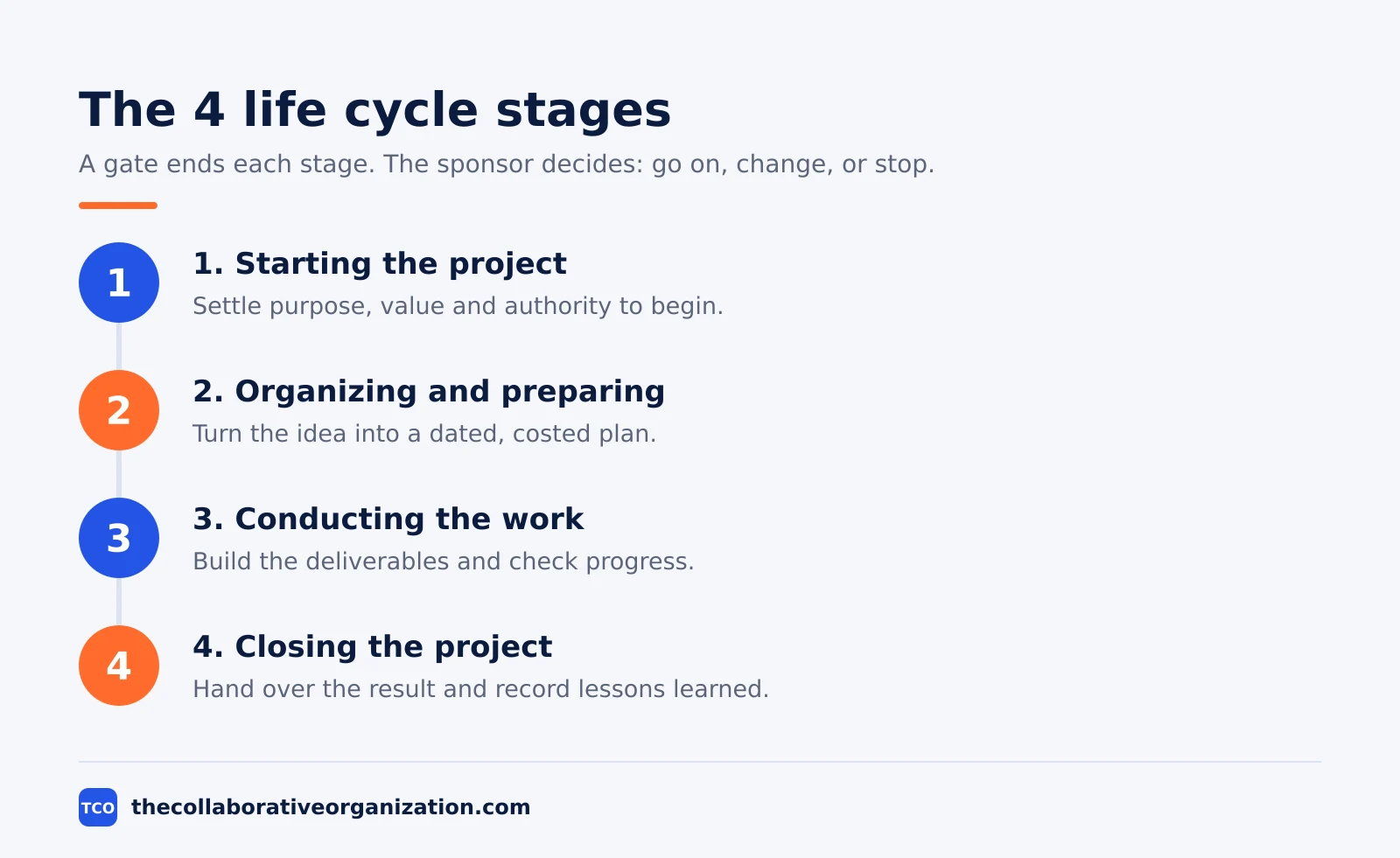
The four stages are starting the project, organizing and preparing, conducting the work, and closing the project. Each stage has a purpose and an output, and a gate at the end of each stage decides whether the project moves on. The stages look simple, but they hold all of the work a project needs.
| Stage | Main question | Key outputs |
|---|---|---|
| Starting the project | Should we do this, and who approves it? | Business case, project charter |
| Organizing and preparing | How will we do it, and by when? | Plan, schedule, budget, risk log |
| Conducting the work | Are we building the right thing, on time? | Deliverables, status reports |
| Closing the project | Is it done, and what did we learn? | Handover, final report, lessons learned |
Starting the project settles the purpose, the value and the authority to begin. Organizing and preparing turns the idea into a dated, costed plan. Conducting the work is where the team builds the deliverables and checks progress as it goes. Closing the project hands the result over, releases the team and records what the next project should do differently.
The stages are not a straight line in every approach. In a predictive project they run mostly in order, while in an adaptive project the team cycles through organizing, conducting and reviewing many times before the close. The stage names stay the same, but the rhythm changes.
Stage gates: the decision at the end of each stage
A stage gate is a checkpoint at the end of a stage where the sponsor reviews what the stage delivered and decides whether the project goes on, goes on with changes, or stops. The gate protects the budget, because it stops a weak project before the next stage spends more money on it. It also protects the team, because it gives them a clear yes before they commit to the next block of work.
At each gate the sponsor looks back at what the stage delivered and forward at the business case. Three answers are possible: go on, go on with changes, or stop. A gate that always says yes is not a gate, it is a formality, and the project loses its one real chance to stop early.
The more uncertain the work, the shorter the stages should be. A short stage means the sponsor reviews progress sooner and the team finds out sooner whether it is building the right thing. A long stage on uncertain work hides problems until the gate, when the fix is expensive.
The five development approaches
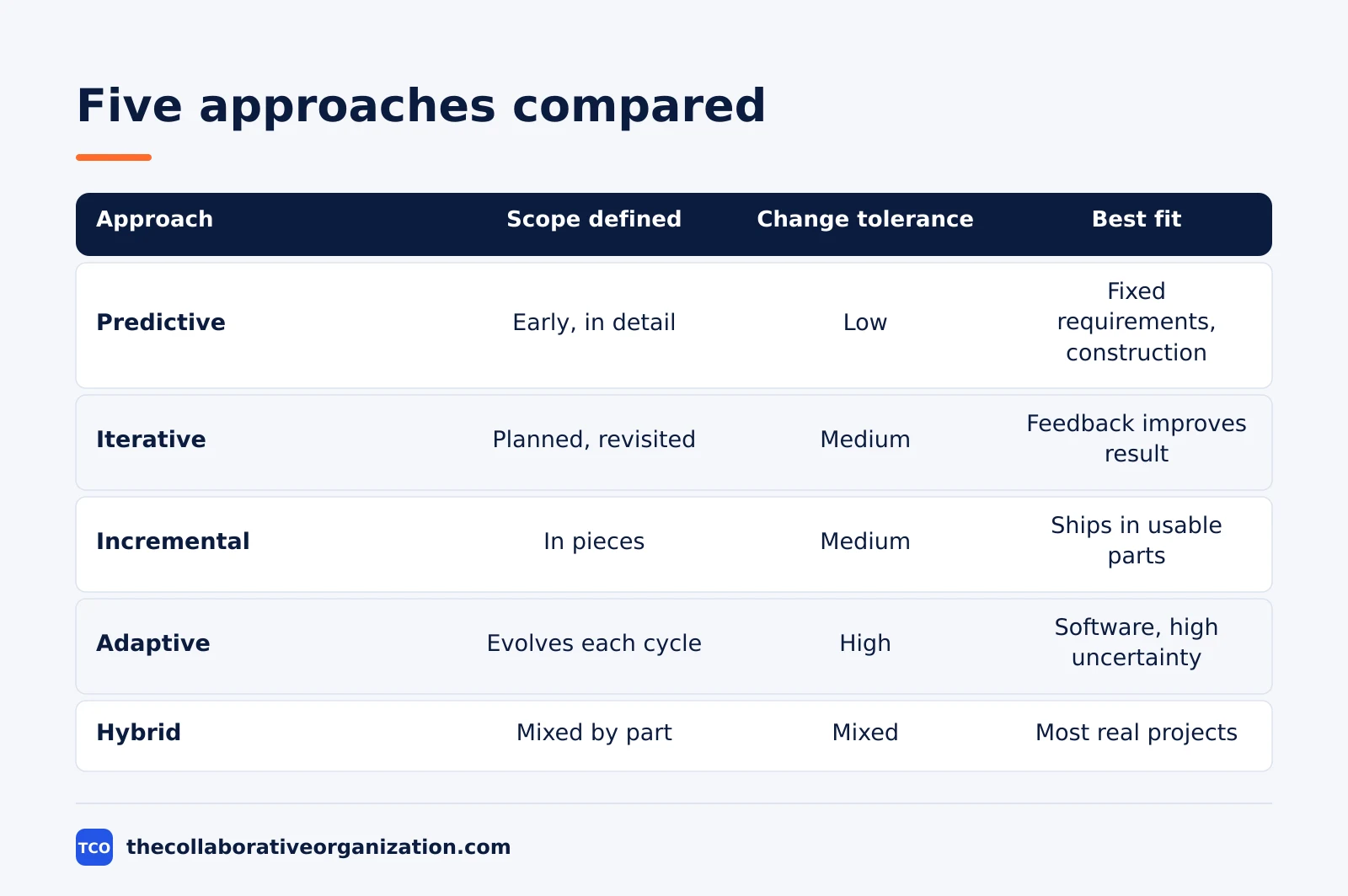
PMI recognizes five development approaches: predictive, adaptive, iterative, incremental and hybrid. The approach says how much is planned up front and how the result is built. It is the biggest choice a team makes after the stages, because it sets the rhythm of the whole project.
| Approach | Scope defined | Change tolerance | Best fit |
|---|---|---|---|
| Predictive | Early, in detail | Low | Fixed requirements, regulated work, construction |
| Iterative | Planned, then revisited | Medium | Work where feedback improves the result |
| Incremental | In pieces, one at a time | Medium | Work that can ship in usable parts |
| Adaptive | Evolves each cycle | High | Software, research, high-uncertainty products |
| Hybrid | Mixed by phase or part | Mixed | Most real projects, regulated work with agile delivery |
Predictive is the traditional form: the team builds a complete plan at the start and follows it through to the end. Plan the work, then work the plan. It suits fixed requirements, regulated industries and construction, where change is costly and the design is known before building starts.
Adaptive is change-driven. The project is split into short increments, and the team refines the deliverable again and again until the client is satisfied. Feedback is fast and low cost, because each cycle is short. PMI notes that agile describes a mindset and a set of practices, while adaptive describes the life cycle structure itself.
Iterative sits between the two: the team builds a plan in advance and revisits it as new facts arrive. Incremental delivers the result in usable pieces, so value reaches users early. Hybrid mixes the approaches, by phase or by deliverable, and it is the most common choice in real projects.
Predictive life cycle in detail
A predictive life cycle fixes the scope early and passes through its stages once, in order. The full scope is defined up front, each stage produces documented deliverables, and those deliverables are baselined before the next stage begins. The team knows what it is building from day one, and the sponsor knows what it will cost.
This approach gives control and cost certainty, which is why construction, manufacturing and compliance-heavy work lean on it. The price of that control is low tolerance for change: a late change means rework, a new baseline and often a new budget. A predictive project with unclear requirements will plan the wrong thing in great detail.
The signs that predictive fits are clear: stable requirements, proven technology, a client who wants cost certainty and a result that is costly to change once built. If three of those are true, plan it up front. If none are true, do not.
Adaptive life cycle in detail
An adaptive life cycle builds in short cycles, with the scope evolving as the team learns from feedback. Planning is rolling-wave: the team commits only to the next cycle, not to the full scope up front. Requirements change continuously as stakeholders see working output and ask for more, less or something different.
Scrum and other agile methods work this way. The team builds in fixed timeboxes, often one to four weeks, and each cycle ends with something the client can use or judge. The first release is often a minimum viable product: the smallest version users can really try. Our guide on what is scrum explains how those cycles are run.
Adaptive work needs users who take part. A team that builds in cycles but never shows the work to the client is doing the motions of agile without the feedback that makes it work. It also needs a sponsor who accepts that the final scope will differ from the first guess, because that is the point.
Hybrid life cycle in detail
A hybrid life cycle mixes predictive and adaptive work, by phase or by deliverable, inside the same project. Most real projects end up here, because few projects are fully certain or fully uncertain. The trick is to choose the approach per part, not per project, and to say which parts use which approach.
A common mix is predictive governance with adaptive delivery. The infrastructure, compliance and budget steps run in a predictive way, with fixed dates and documents, while the feature work runs in short cycles. Regulated industries such as financial services, healthcare and aerospace use this mix often, because the rules need documents while the product needs feedback.
Rework gives the same example: a software rollout that uses predictive stages for infrastructure and compliance while running agile sprints for feature work. The hybrid label only helps when the team writes down which parts are which, so no one is surprised by a fixed date in the middle of a flexible plan.
How to choose a life cycle
Choose the life cycle by asking two questions: how clear are the requirements, and how costly is change. Clear requirements and costly change point to predictive. Unclear requirements and cheap change point to adaptive. A mix of the two points to hybrid, with the certain parts planned up front and the uncertain parts built in cycles.
Four checks help you decide. First, can the client describe the result in detail today, or will they know it when they see it? Second, is the technology proven, or are you learning as you build?
Third, does the work need documents and approvals at fixed points? Fourth, can the result ship in usable pieces, or must it arrive all at once?
Our guide on agile vs waterfall compares the two ends of this range.
Our guide on waterfall vs hybrid project management covers the middle ground.
The choice is not about fashion, it is about how much you know at the start and how much change you expect.
Worked example: the same product, three life cycles
One product built three ways shows how the stages change with the approach. Imagine a team building a booking system for a small hotel chain, with 12 rooms to fill and a launch before the summer season. The four stages are the same in all three versions, but the work inside them differs.
In the predictive version, the team spends four weeks writing a full plan: every screen, every report and every price rule, signed off before building starts. Building takes eight weeks and testing takes two.
The launch happens on the fixed date. The cost is known from week one, but a late request for a new payment method costs two weeks of rework.
In the adaptive version, the team ships a booking page in three weeks, then adds rooms, payments and reports in two-week cycles, showing each version to the hotel owner.
The owner changes the payment flow twice after seeing it work, and the final product fits the real bookings better. The launch date moves by one week, and the scope is decided as the team goes.
In the hybrid version, the team plans the payment and guest-data work up front, because the rules for handling guest data are fixed, and builds the booking screens in cycles.
The fixed parts meet their dates, the flexible parts adapt, and the launch holds. Most teams would pick this version, because it protects the parts that cannot change and frees the parts that should.
Common life cycle mistakes to avoid
Most life cycle mistakes come from picking the approach by habit, not by the work in front of you. Check this list before the first stage ends.
- Predictive planning for unclear work. A full plan for requirements nobody can describe yet is fiction, and the team will rewrite it in the first month.
- Adaptive building with no feedback. Cycles without a client who reviews the output are just short waterfalls, and the final result still misses the mark.
- No gate reviews. Stages that roll into each other with no decision point remove the one chance to stop a weak project early.
- Hybrid with no written split. A hybrid project that never says which parts are predictive and which are adaptive confuses everyone at the first deadline.
- Changing the approach mid-project. A switch halfway through rewrites the plan, the schedule and the reporting, and it costs more than picking well at the start.
Tools that support each life cycle
A project tool holds the stages and the cycles in one place, so the plan, the board and the status stay together. In a predictive project the tool holds the Gantt chart and the baselines, while in an adaptive project it holds the backlog and the sprint boards. Our shortlist on the project management software page compares the options.
| Tool | Best for | Free plan | Starting price (as of November 2026) | Notable limit |
|---|---|---|---|---|
| Asana | Teams that want timelines for predictive work and boards for cycles | Free for 2 people | $10.99 per user per month (Starter), billed annually | Free plan covers 2 people |
| Trello | Small teams that want a simple board per cycle | Free for up to 10 collaborators | $5 per user per month (Standard), billed annually | $6 per user per month if billed monthly |
The Asana price comes from Asana pricing: the Personal plan is free for 2 users, and Starter is $10.99 per user per month when billed annually. The Trello pricing page lists Standard at $5 per user per month billed annually, or $6 billed monthly.
Sources
- PM Study Circle - Project Life Cycle (2026)
- Rework - Project Life Cycle: The 5 Phases Explained (2026)
- PMI - What Is Project Management (2026)
- Atlassian - Project Life Cycle: The 5 Phases Explained (2026)
- Asana - Pricing (2026)
- Trello - Pricing (2026)
Frequently asked questions
What are the stages of a project life cycle?
The four stages are starting the project, organizing and preparing, conducting the work, and closing the project. Every project needs all four before the deliverables reach the client. The names differ by source, but the shape is the same: decide, prepare, do the work, then close.
What is the difference between a life cycle and phases?
The life cycle is the whole journey from the first idea to the close, while the phases are the stages inside that journey. The development approach, such as predictive or adaptive, says how the work is built inside those stages. PMI keeps the life cycle and the approach as two separate choices.
What are the five types of project life cycle?
PMI recognizes five development approaches: predictive, adaptive, iterative, incremental and hybrid. Predictive plans everything up front, adaptive builds in short cycles with feedback, iterative revisits the plan as new facts arrive, incremental delivers in pieces, and hybrid mixes two or more of these.
Which life cycle is best for software projects?
Adaptive usually fits software best, because requirements change once users see a working version. A team that plans every feature up front spends months building the wrong thing, while an adaptive team ships a small version, learns from real use and adjusts. Fixed parts, such as security reviews, can still run in a predictive way inside the same project.
Can you change the life cycle during a project?
Yes, but it is costly, because the change rewrites the plan, the schedule and the way the team reports progress. It is better to pick the approach at the start, after checking how clear the requirements are and how much change you expect. A hybrid plan chosen early is cheaper than a switch made halfway through.
Related articles
project management
How to Choose Project Management Software (2026)
Pick project management software in seven steps: define the work, count seats, price the real cost, and run a two-week pilot before you pay.
November 19, 2026 · 10 min read
project management
What Is a RACI Matrix? Definition, Roles and Examples (2026)
A RACI matrix maps who is Responsible, Accountable, Consulted and Informed for each task. Learn the four roles, how to build one, and see a worked example.
November 19, 2026 · 9 min read
project management
Daily Standup Meeting Format That Works (2026)
A daily standup is a 15-minute meeting where Developers inspect progress toward the Sprint Goal and plan the next day. Use this format to run one that ends on time.
November 19, 2026 · 10 min read