Agile vs Scrum: What Is the Difference? (2026) | The Collaborative Organization
By The Collaborative Organization Team · November 19, 2026 · Last verified November 19, 2026 · 10 min read
Agile is a mindset written down in 2001, and Scrum is one framework that puts that mindset into practice. Agile names four values and twelve principles but no roles, meetings or artifacts. Scrum adds those parts: three accountabilities, five events and three artifacts, all inside fixed-length Sprints.
Key takeaways
- Agile is a set of 4 values and 12 principles from the Agile Manifesto, written in February 2001 by 17 practitioners.
- Scrum is a lightweight framework built on Agile, defined by the Scrum Guide, whose current version dates from November 2020.
- Scrum has 3 accountabilities, 5 events and 3 artifacts; Agile itself has none of these.
- A Sprint lasts one month or less, and a new Sprint starts at once when the previous one ends.
- In the 18th State of Agile Report (2025), 74% of organizations said they use hybrid or home-grown Agile models.
- Pick Scrum when a team wants clear rules; pick a looser Agile mix when the work flows continuously.
The core difference between Agile and Scrum
Agile is the “why” and Scrum is one “how”. Agile tells a team what to value: people over process, working results over thick documents, customer input over contract terms, and change over a fixed plan. It never tells the team who runs the meeting or how long a cycle lasts.
Scrum answers those practical questions. It names one Product Owner, one Scrum Master and the Developers, and it sets five events inside a Sprint of one month or less. A team that follows Scrum is working in an Agile way, but a team can work in an Agile way without Scrum.
Our guide to what Agile project management is explains the values in more depth.
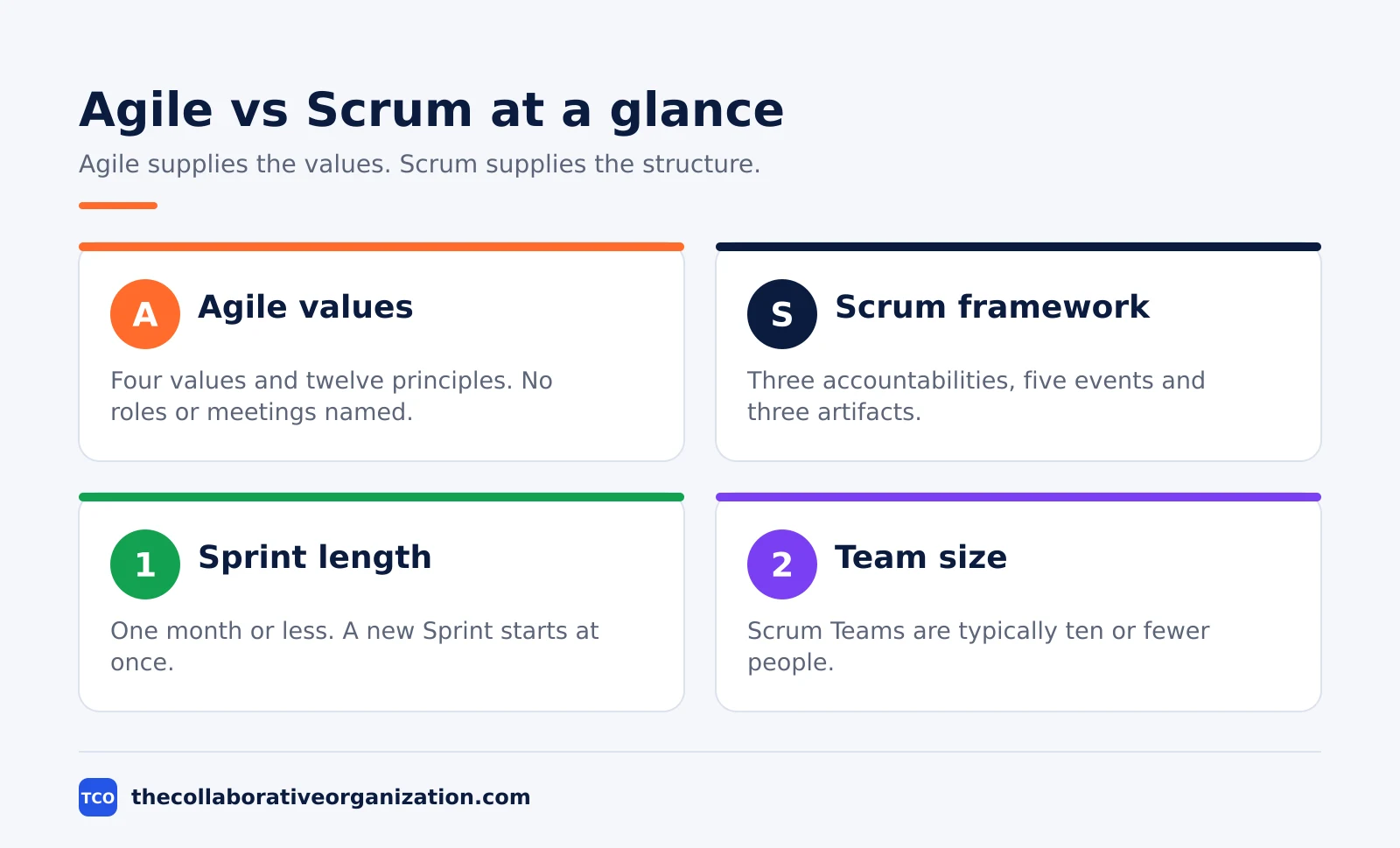
The mix-up is common because the two words appear together in job posts and tool pages. Think of it this way: Agile is the diet, and Scrum is one recipe. The recipe follows the diet, but other recipes can follow it too.
Agile vs Scrum at a glance
The table below shows the split in one place: Agile defines values, Scrum defines structure. Use it when a stakeholder asks why the team needs both words, or when a new hire asks what changes on Monday morning.
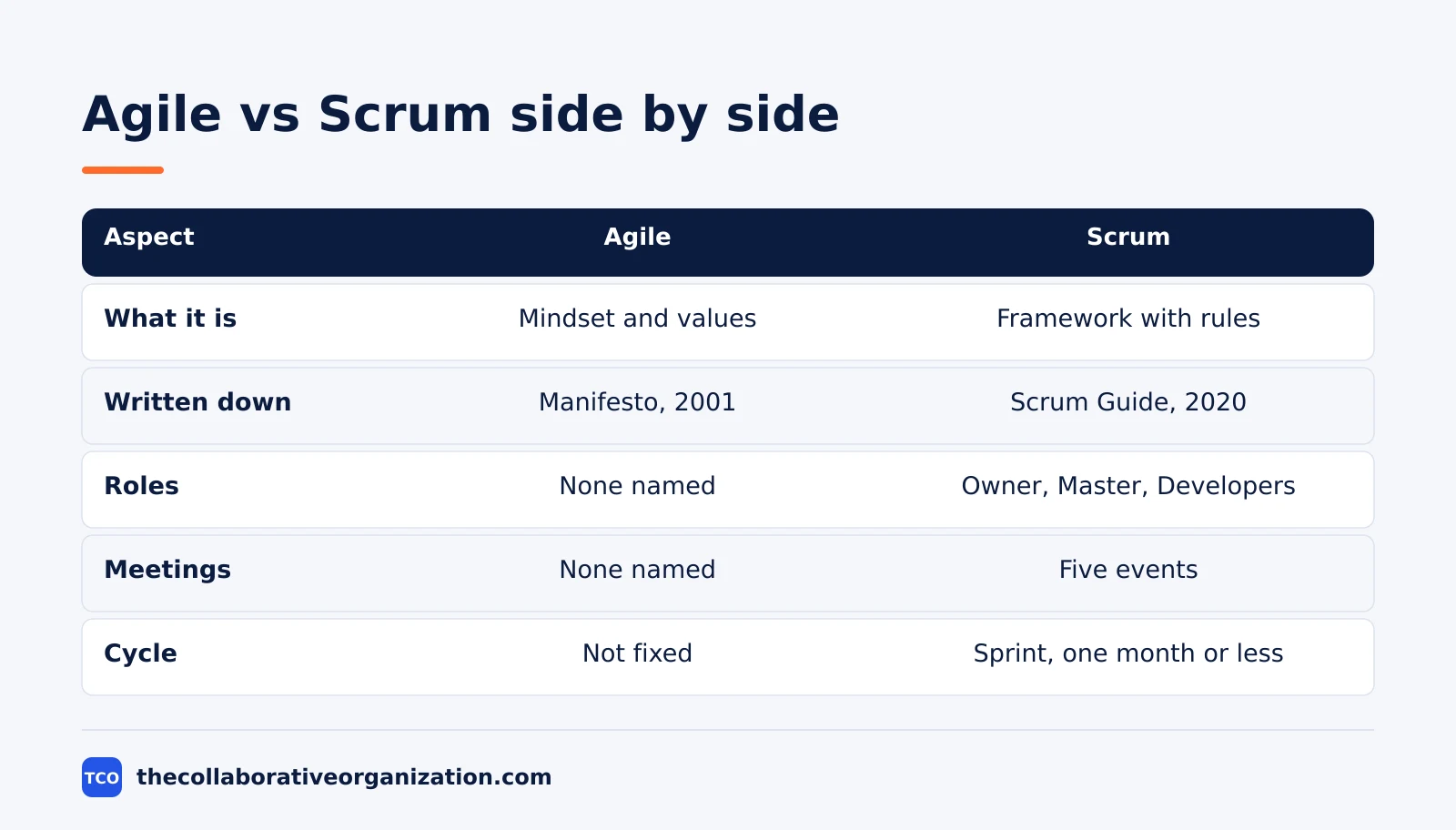
| Aspect | Agile | Scrum |
|---|---|---|
| What it is | A mindset: values and principles | A framework with fixed rules |
| Written down | Agile Manifesto, February 2001 | Scrum Guide, current version November 2020 |
| Roles | None named | Product Owner, Scrum Master, Developers |
| Meetings | None named | 5 events inside a Sprint |
| Work items | None named | 3 artifacts with commitments |
| Cycle length | Not fixed | Sprint of one month or less |
| Team size | Not fixed | Typically 10 or fewer people |
One row deserves a second look: team size. The Scrum Guide says a Scrum Team is small enough to stay nimble and large enough to finish real work in a Sprint, typically 10 or fewer people. Agile sets no size limit at all, which is why large programs often blend Scrum teams with other methods.
How Agile works
Agile works as a loop: build a small piece, show it, learn, and change the plan. The twelve principles behind the Manifesto spell out the loop: deliver working software frequently, welcome changing requirements even late in the work, and let business people and developers work together daily. Progress is measured by working software, not by documents or by hours logged.
The Manifesto itself is short. Its four values fit in 68 words, and the document has never been revised since 2001. That stability is part of its appeal: teams argue about how to apply the values, not about what the values say. The twelve principles add the working rules, from early delivery to regular reflection.
Agile also asks teams to keep a sustainable pace and to favor face-to-face conversation. Those two principles explain why many Agile teams cap work in progress and hold short daily check-ins even when they do not use Scrum.
How Scrum works
Scrum works as a fixed rhythm: plan a Sprint, build an Increment, inspect it with stakeholders, then improve how the team works. The Sprint is the container event, and the other four events happen inside it. Sprint Planning opens the Sprint, the Daily Scrum is a 15-minute check for Developers, the Sprint Review shows the Increment, and the Retrospective closes the loop.
The three artifacts each carry a commitment. The Product Backlog aims at the Product Goal, the Sprint Backlog aims at the Sprint Goal, and the Increment must meet the “definition of done”. The Scrum Guide defines Scrum as a lightweight framework for adaptive solutions to complex problems, built on empiricism and lean thinking.
Scrum Teams are self-managing: they decide internally who does what, when and how. Only the Product Owner can cancel a Sprint, and only when the Sprint Goal becomes obsolete. That single rule keeps the team from changing direction mid-Sprint on a whim while still letting the goal change when the facts change.
Choose Agile alone if your work flows continuously
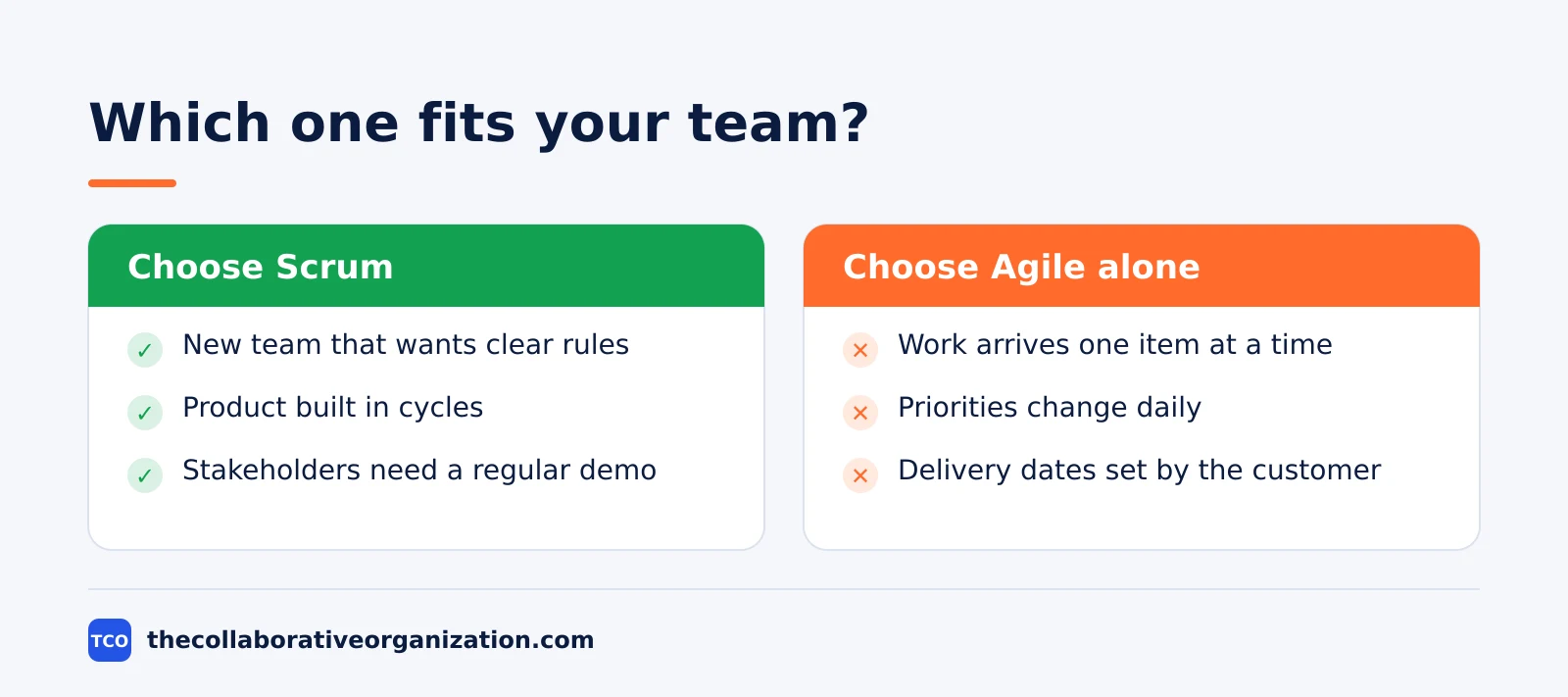
Choose a looser Agile mix when work arrives one item at a time and cannot wait for the next Sprint. Support queues, content pipelines and operations teams fit this shape. A ticket that arrives on Tuesday should not wait until a Sprint starts on Monday.
Kanban is the usual choice here. It shows work on a board, caps work in progress, and pulls the next item when capacity opens up. Our comparison of Kanban versus Scrum covers the trade-offs in detail. The team still follows Agile values: it delivers small pieces often, talks to the customer, and reflects on its flow.
- Work arrives in a stream, not in batches. A Sprint boundary adds delay without adding value.
- Priorities change daily. A fixed Sprint Goal would be rewritten before the Sprint ends.
- The team is small and the work is visible. A board and a daily check may be all the structure it needs.
- Delivery dates are set by the customer, not by a cycle. Each item ships when it is done.
Choose Scrum if your team wants clear rules
Choose Scrum when the team is new, the product is complex, and nobody wants to invent a process. Scrum hands the team a complete set of rules on day one: who owns the backlog, who runs the events, how long each event lasts, and what “done” means. That clarity helps a new team start fast.
Scrum also fits product work with a clear owner and a backlog that can be ordered. The Product Owner ranks the work by value, the team commits to a Sprint Goal, and stakeholders see a working Increment at least once a month. The Scrum roles guide explains what each accountability owns.
- The team is building a product in cycles. Each Sprint delivers a usable Increment.
- Stakeholders need a regular demo. The Sprint Review gives them one every Sprint.
- The team wants a built-in improvement loop. The Retrospective is part of the framework, not an extra.
- Work needs a single owner. One Product Owner orders the backlog, so priorities stop being a debate.
Can you combine Agile and Scrum?
Yes, and most teams already do: Scrum is Agile, and Agile teams often mix Scrum with other methods. The 18th State of Agile Report from Digital.ai found that 74% of organizations use hybrid or home-grown models rather than one pure framework. Pure Scrum is the exception, not the rule.
A common blend is Scrum for product teams and Kanban for support work inside the same company. Another is Scrumban: Sprints for planning, a Kanban board for daily flow, and WIP limits to stop overload. The Digital.ai report notes the same shift toward flexible, context-driven models.
The risk in mixing is dropping the parts that make Scrum work while keeping the name. A team that skips the Retrospective or runs Sprints with no “definition of done” is not doing Scrum badly. It is doing something else and calling it Scrum.
Worked example: a six-person team ships a booking page
A six-person team building a booking page shows the split in practice. The team follows Agile values: it ships a small piece every week, shows it to two real customers, and changes the plan based on what they say. That is Agile, and it would still be Agile if the team changed its framework.
The team runs Scrum on top of it. The Product Owner orders a backlog of 20 items and sets a Product Goal: a customer can book a room in under two minutes. Sprint 1 runs two weeks and delivers a working search page, and the Daily Scrum lasts 15 minutes.
At the Sprint Review, a customer tries the page and asks for a price filter, so the Product Owner reorders the backlog before Sprint 2.
By Sprint 3, the team ships the booking flow. The Retrospective surfaces one fix: the “definition of done” did not include a mobile check, so a bug reached the demo. The team adds the check to the definition. The values guided the choices, and the Scrum events gave the team a place to make them.
Tools that support Agile and Scrum teams
A tool helps when it shows the backlog, the Sprint and the board in one place. The choice matters less than the fit: a team that lives in Sprints needs Sprint planning and a burndown, while a flow team needs WIP limits and a cumulative flow view. Our project management software shortlist compares the options side by side.
| Tool | Best for | Free plan | Starting price (as of November 2026) | Notable limit |
|---|---|---|---|---|
| Jira | Scrum teams that want Sprints and backlogs | Free plan for up to 10 users | $9.70 per user per month (Standard), billed monthly for 1-100 users | Scrum features sit behind the paid plans |
| Asana | Teams that want boards plus timelines | Free for 2 people | $10.99 per user per month (Starter), billed annually | Free plan covers 2 people |
| monday.com | Teams that want a visual board with status columns | Free plan for up to 2 seats | $9 per seat per month (Basic), billed annually | Paid plans need at least 3 seats |
The Jira price comes from the Atlassian Jira pricing page: Standard is $9.70 per user per month when billed monthly for 1 to 100 users, after Atlassian raised list prices on 13 October 2026.
Asana lists Starter at $10.99 per user per month billed annually on its pricing page.
The monday.com pricing page lists Basic at $9 per seat per month billed annually.
Common Agile vs Scrum mistakes to avoid
Most Agile versus Scrum confusion comes from five mistakes, and all five are easy to spot. Run through the list before the next planning meeting.
- Calling any stand-up meeting Scrum. A daily check-in without a Sprint, a backlog or a Retrospective is not Scrum.
- Treating Agile as “no planning”. Agile plans often and in small steps; it does not skip planning.
- Letting the Sprint Goal change mid-Sprint. Scope can be renegotiated with the Product Owner, but the goal stays fixed unless it becomes obsolete.
- Skipping the Retrospective when the Sprint runs late. The Retrospective is the improvement loop, and it matters most when things go wrong.
- Adding Scrum roles to an Agile team that does not use Sprints. A Scrum Master without a Sprint has no Sprint to protect, so the role turns into a meeting host.
Sources
- Agile Manifesto - Principles behind the Agile Manifesto (2001)
- Scrum Guides - Scrum Guide (2020)
- Digital.ai - 18th State of Agile Report Marks the Start of the Fourth Wave (2025)
- Scrum.org - 18th State of Agile Report (2025)
- Asana - Pricing (2026)
- monday.com - Pricing (2026)
- ClickUp - Pricing (2026)
- Atlassian - Jira Pricing (2026)
Frequently asked questions
Is Scrum the same as Agile?
No. Agile is a set of values and principles written in 2001, and Scrum is one framework that puts those values into practice. A team can work in an Agile way with Kanban, Extreme Programming or a home-grown mix instead of Scrum, and a team can run Scrum ceremonies without following Agile values at all.
Do you need a Scrum Master to work in an Agile way?
No. The Scrum Master is a Scrum accountability, not an Agile requirement. Agile itself names no roles at all. You need a Scrum Master only when you adopt Scrum as your framework. An Agile team using Kanban or another method assigns work differently and does not need that role.
How long is a Sprint in Scrum?
A Sprint lasts one month or less, and most teams run one to four weeks. A new Sprint starts at once when the previous one ends, with no gap. The Sprint is the container event: Sprint Planning, the Daily Scrum, the Sprint Review and the Sprint Retrospective all happen inside it.
Can a team use Agile without sprints?
Yes. Sprints belong to Scrum, not to Agile. A team can work in an Agile way with a continuous flow of work, as Kanban teams do, pulling the next item when capacity opens up. The Agile Manifesto asks for frequent delivery of working software, and it never names a Sprint or a fixed cycle.
Which is better for a new team, Agile or Scrum?
Start with Agile values first, then pick Scrum if the team wants a clear set of rules. Scrum gives a new team defined accountabilities, five events and three artifacts, so nobody has to invent a process. A team that already has a working flow may do better with Kanban or a lighter Agile mix.
Related articles
guides
Free Project Management Templates: 7 to Copy (2026)
Seven free project management templates from monday, Wrike, Teamwork, Smartsheet, ClickUp, Asana and Trello, with what each one is for and what free really costs.
November 20, 2026 · 7 min read
guides
Project Proposal Template: Copy and Win Work (2026)
A project proposal template pitches the work before it is approved: problem, solution, scope, budget, timeline and terms. Copy the template and filled example.
November 20, 2026 · 10 min read

guides
Action Plan Template: Goal to Done in One Page (2026)
An action plan template turns one goal into owned steps with dates, dependencies and a success measure. Copy the table and see it filled for a support team.
November 20, 2026 · 11 min read