AI Productivity Statistics: What the Numbers Really Show (2026) | The Collaborative Organization
By The Collaborative Organization Team · November 19, 2026 · Last verified November 19, 2026 · 12 min read
AI can make a single task much faster, but it has not yet made most organizations more profitable. In controlled tests, AI made consultants 25% faster and developers 56% faster, yet only 6% of organizations report a large profit impact from AI. The numbers below come from the original studies, and each one names its source and year.
Key takeaways
- In a controlled test, consultants with GPT-4 finished tasks 25% faster with quality rated over 40% higher, according to Harvard Business School.
- Developers with GitHub Copilot finished a coding task 56% faster, according to a 2023 experiment.
- Across the whole US economy, generative AI saved 1.4% of all work hours, according to the NBER.
- Only 6% of organizations are AI high performers with a large profit impact, according to McKinsey.
- Workers say AI saves 11 hours a week, but they spend 6.4 hours a week checking and fixing its output, according to Glean.
How we chose these statistics
We picked statistics from the original publisher of each study, and we skipped roundups that did not link to the original. Every number below comes from a controlled experiment, a national survey, or a published study, and each one names its source and year. We kept the sample size next to each headline number.
Controlled experiments and surveys answer different questions. An experiment shows what AI does to one task in a lab or a pilot, while a survey shows how many people use AI and what they feel about it. Neither one alone shows whether AI makes an organization more profitable. Our methodology page explains how we check sources before we publish.
Most survey figures below are self-reported, which means people described their own productivity. Self-reports show direction and scale, but they are not the same as timed tests or profit figures. Browse our guides for more data-led explainers on how teams work.
What controlled experiments show
Controlled experiments give the cleanest numbers on AI productivity, because they compare two groups doing the same task. Three experiments from 2023 set the baseline that later surveys are still measured against.
Harvard Business School ran a 2023 experiment with 758 consultants at Boston Consulting Group and GPT-4. Inside the AI capability frontier, consultants using GPT-4 completed 12.2% more tasks, worked 25.1% faster, and produced output rated more than 40% higher in quality. Below-average performers gained the most, according to the working paper.
A 2023 experiment with 95 developers asked them to build an HTTP server in JavaScript as fast as possible. Developers with GitHub Copilot finished 55.8% faster than the control group, 71 minutes against 161 minutes. Of Copilot users, 88% said they felt more productive, according to arXiv.
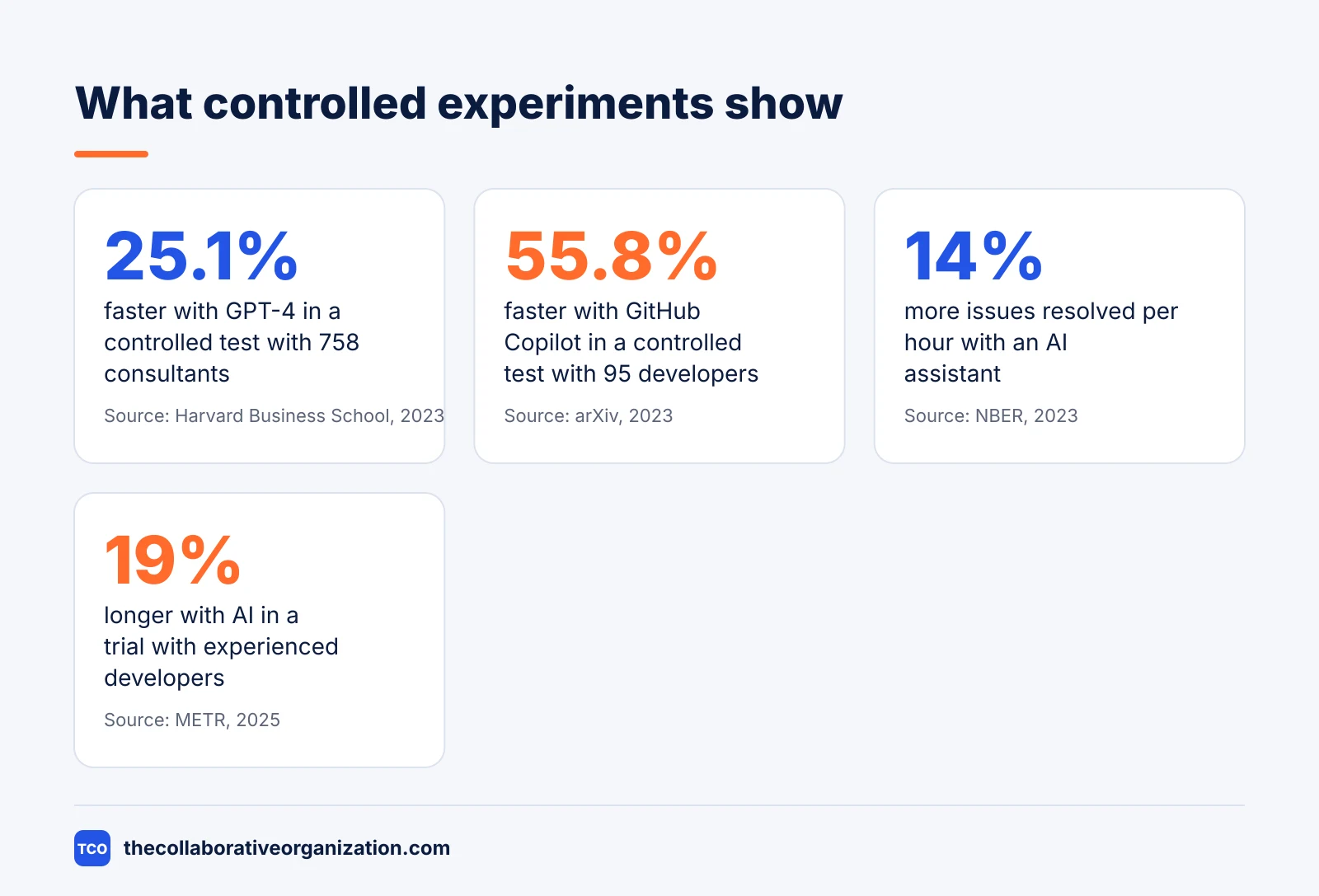
A study of 5,179 customer support agents found that an AI assistant raised issues resolved per hour by 14% on average. Newer and less-skilled workers improved 34%, while experienced workers saw minimal impact. The AI spread the best practices of the strongest workers to the rest of the team, according to NBER.
The pattern across the three experiments is clear: AI helps most on tasks inside its capability, and it helps weaker performers most. The gains are real, but they are task-level gains, not company-level gains. A faster task does not always mean a faster company, which is the theme of the next sections.
How much time AI saves across the economy
Task-level gains look large, but economy-wide gains look small, because most work hours are not AI-assisted yet. The national numbers put the experiments in perspective.
A national US study found in 2024 that 39% of adults aged 18 to 64 used generative AI, and 23% of employed respondents had used it for work in the previous week. Between 1% and 5% of all work hours were assisted by generative AI. The authors put total time saved at 1.4% of all work hours, according to NBER.
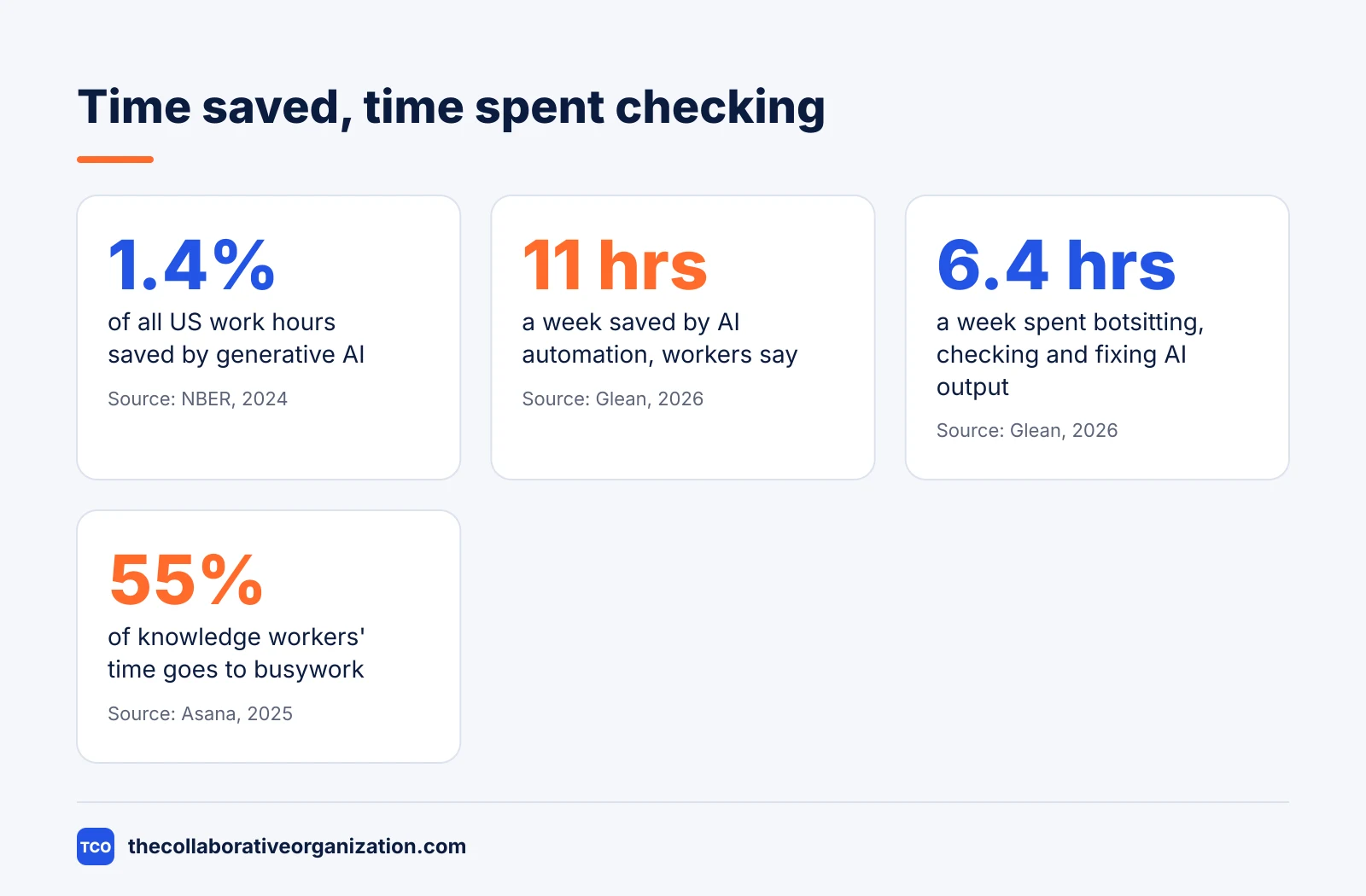
That 1.4% is small next to the task-level gains, and the reason is simple: most work hours are not AI-assisted yet. Only 9% of employed respondents used generative AI every work day. The economy-wide gain grows only as daily use grows, and daily use is still a minority habit.
Asana found in 2025 that knowledge workers spent 55% of their time on busywork. The study covered 9,236 knowledge workers in the US, UK, Germany, Japan and Australia. AI that cuts busywork saves more time than AI that speeds up skilled work.
Asana’s Anatomy of Work Index (2019) counted 103 hours a year lost to unnecessary meetings, 209 hours to duplicative work, and 352 hours talking about work. That is 664 hours a year per worker spent on work about work. The biggest time saving from AI may come from cutting that pile, not from writing faster, according to Asana.
Daily use vs occasional use
The productivity gains from AI sit with daily users, not with occasional users. Frequency of use matters more than whether someone has tried AI at all.
Slack found in 2025 that daily AI users were 64% more likely to report very good productivity than non-users. They were also 58% more likely to report better focus and 81% more likely to report greater job satisfaction. Daily use, not occasional use, is where the self-reported gains sit.
Slack found in 2025 that workers trained to use AI were up to 19 times more likely to report that AI improved their productivity. Yet 61% of workers had spent under 5 hours learning AI skills, and 30% had received no AI training. The gap between daily users and everyone else is partly a training gap.
Gallup found in 2025 that 45% of US employees used AI at work at least a few times a year, but only 23% used it frequently and 10% daily. The most common uses were consolidating information (42%), generating ideas (41%) and learning new things (36%). Most workers are still occasional users, not daily users.
The value gap: why profit lags use
Use is up, profit is rare, and the gap between the two is the most important number in this guide. Three studies from 2025 and 2026 measure it from three angles.
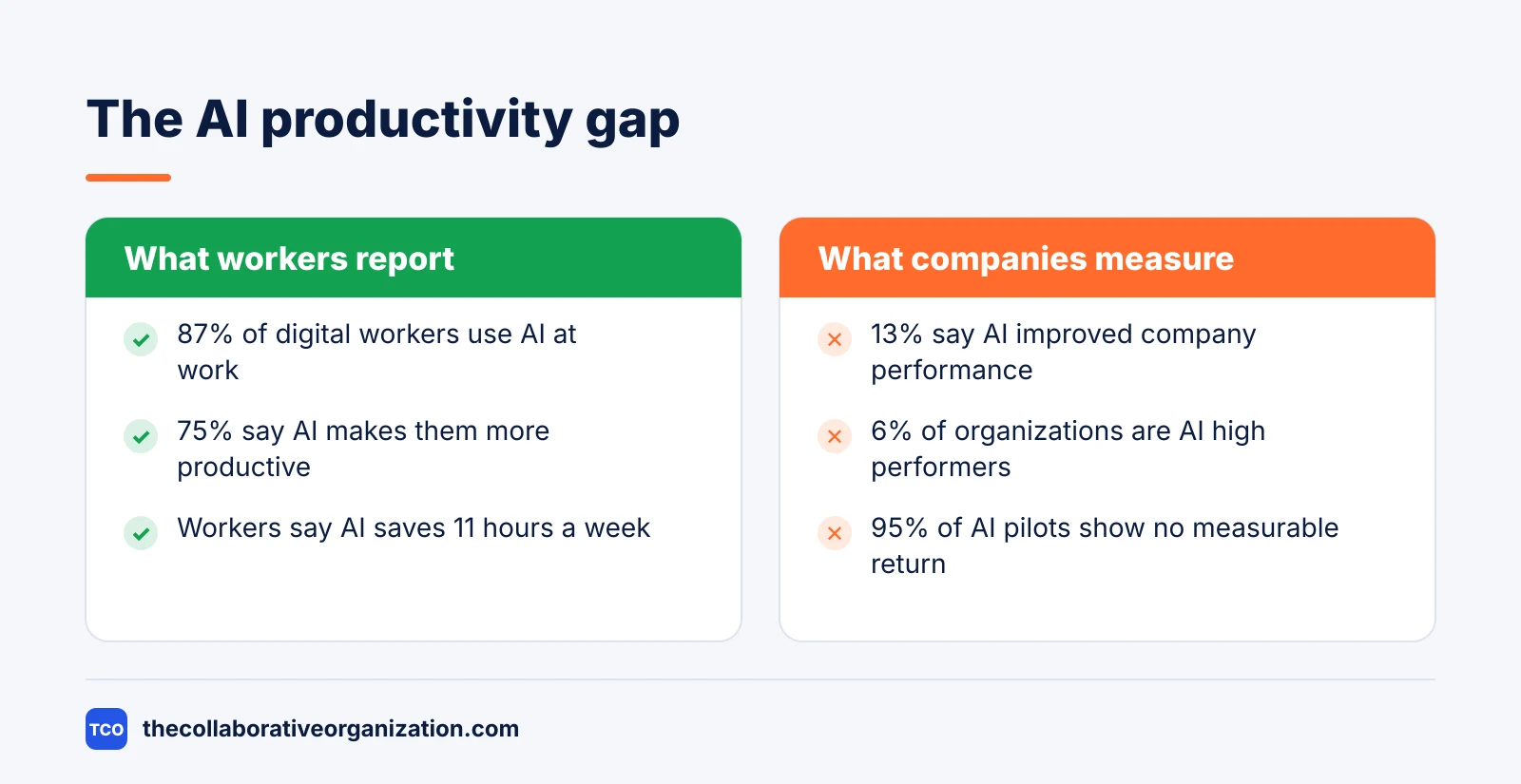
McKinsey found in 2025 that 88% of organizations used AI in at least one function, but only 39% reported any enterprise-level profit impact. Just 6% qualified as AI high performers, with 5% or more profit impact plus significant value. High performers were nearly 3 times more likely to have redesigned workflows from scratch.
MIT NANDA found in 2025 that about 95% of organizations saw no measurable return on their generative AI pilots. Only about 5% of custom tools reached production, from 60% that were evaluated and 20% that reached pilot stage. The authors put the cause down to integration, not model quality.
Glean found in 2026 that 87% of digital workers used AI at work and 75% said it made them more productive. Yet only 13% said AI had significantly improved their organization’s performance. Workers said AI automation saved roughly 11 hours a week, over a quarter of the workweek.
Glean found in 2026 that workers spent 6.4 hours a week botsitting, feeding AI context, checking outputs and debugging errors. That is 37% of their AI time, more than the 36% they spent using AI to do work. And 69% of AI users admitted to botshitting, shipping AI work they had not verified.
The other side: when AI slows work down
AI does not always help, and the cases where it hurts are as useful as the cases where it helps. They show where the capability frontier sits.
A 2025 randomized trial found that experienced developers allowed to use AI took 19% longer to finish real issues than those without AI. The developers had expected AI to speed them up by 24%, and still believed it had sped them up by 20% afterwards. The trial covered 16 developers and 246 issues, according to METR.
The Harvard Business School experiment also found the other side of the frontier. On a task outside the AI capability frontier, consultants using AI were 19 percentage points less likely to reach the correct solution than those without AI. AI helps inside its capability and hurts outside it, according to the working paper.
Stack Overflow found in 2025 that 46% of developers distrusted the accuracy of AI output, against 33% who trusted it. And 66% named ‘almost right, but not quite’ answers as their top frustration. Also, 45% said debugging AI code took more time.
Microsoft found in 2025 that 80% of the global workforce said they lacked the time or energy to do their work. Workers were interrupted every 2 minutes, or 275 times a day. AI that adds another tool to check can add to the load it was meant to cut.
AI output needs a second pair of eyes before it goes out, and teams waste less time when they agree where that review happens. Our guide to before you standardize team chat covers how to pick one channel and stick to it.
What the numbers mean
The numbers point to one conclusion: AI makes individual tasks faster, but organizations capture the gain only when they change how work is done. Training, clear checks on AI output, and redesigned workflows are what separate the 6% of high performers from the rest. Buying the tool is the easy part.
Take a support team of 10 agents that resolves 100 issues a day. Apply the NBER figure from 2023, a 14% rise in issues per hour, and the team resolves about 114 issues a day with the same staff.
Newer agents gain most, at 34%, while experienced agents gain little. The example is an illustration, not a promise: your team may gain more, or less. Naming one owner for each AI check helps, and our guide to what is a RACI matrix shows how to do that.
The table below gathers the statistics in this guide in one place, grouped by theme. Each row names the source and the year, and the source name links to the original page. Use it as a reference, and read the sections above for what each number means.
All 43 statistics in one table
| Statistic | Source | Year |
|---|---|---|
| 12.2% more tasks completed with GPT-4 | HBS/BCG | 2023 |
| 25.1% faster with GPT-4 | HBS/BCG | 2023 |
| Quality rated over 40% higher with GPT-4 | HBS/BCG | 2023 |
| 19 percentage points less likely to reach the correct solution outside the frontier | HBS/BCG | 2023 |
| 55.8% faster with GitHub Copilot | arXiv | 2023 |
| 88% of Copilot users felt more productive | arXiv | 2023 |
| 14% more issues resolved per hour with an AI assistant | NBER | 2023 |
| 34% improvement for novice and low-skilled support workers | NBER | 2023 |
| AI-allowed tasks took 19% longer | METR | 2025 |
| Developers expected a 24% speedup but still believed 20% faster after | METR | 2025 |
| 1.4% of all work hours saved by generative AI | NBER | 2024 |
| 1-5% of all work hours assisted by generative AI | NBER | 2024 |
| 39% of US adults aged 18 to 64 used generative AI | NBER | 2024 |
| 23% of employed respondents used it for work in the previous week | NBER | 2024 |
| 9% of employed respondents used it every work day | NBER | 2024 |
| 64% more likely to report very good productivity (daily AI users) | Slack | 2025 |
| 81% greater job satisfaction (daily AI users) | Slack | 2025 |
| 58% better focus (daily AI users) | Slack | 2025 |
| Daily AI use rose 233% since November 2024 | Slack | 2025 |
| Trained workers up to 19x more likely to report AI improving productivity | Slack | 2025 |
| 61% of workers spent under 5 hours learning AI skills | Slack | 2025 |
| 30% of workers received no AI training | Slack | 2025 |
| 88% of organizations used AI in at least one function | McKinsey | 2025 |
| 39% of organizations reported any enterprise profit impact from AI | McKinsey | 2025 |
| 6% of organizations are AI high performers | McKinsey | 2025 |
| 62% of organizations at least experimenting with AI agents | McKinsey | 2025 |
| 95% of organizations saw no measurable return on AI pilots | MIT NANDA | 2025 |
| 5% of custom AI tools reached production | MIT NANDA | 2025 |
| 87% of digital workers used AI at work | Glean | 2026 |
| 75% of digital workers said AI made them more productive | Glean | 2026 |
| 11 hours a week saved by AI automation | Glean | 2026 |
| 6.4 hours a week spent botsitting | Glean | 2026 |
| 69% of AI users admitted to botshitting | Glean | 2026 |
| 13% said AI significantly improved their organization’s performance | Glean | 2026 |
| 46% of developers distrusted AI output accuracy | Stack Overflow | 2025 |
| 66% named ‘almost right’ answers as their top frustration | Stack Overflow | 2025 |
| 56% average wage premium for workers with AI skills | PwC | 2025 |
| 80% of the workforce lacked time or energy to do their work | Microsoft | 2025 |
| 55% of knowledge workers’ time went to busywork | Asana | 2025 |
| 103 hours a year lost to unnecessary meetings | Asana | 2019 |
| 209 hours a year lost to duplicative work | Asana | 2019 |
| 352 hours a year spent talking about work | Asana | 2019 |
| 45% of US employees used AI at work at least a few times a year | Gallup | 2025 |
Common AI productivity statistics mistakes to avoid
Most bad takes on AI productivity statistics come from the same five errors, and all five are easy to avoid. Check the list below before you quote a number.
- Quoting a task-level gain as a company-level gain. A 56% faster coding task does not mean a 56% more productive company.
- Treating self-reported productivity as measured output. Daily users feel more productive, but only timed tests and profit figures show whether they are.
- Ignoring the hidden labor. Botsitting and rework eat the hours AI saves, so count the checking time too.
- Trusting the feeling over the timer. In the METR trial, developers believed AI had sped them up by 20% when it had slowed them by 19%.
- Using a 2023 experiment as if it described 2026 tools. Models change fast, so check the date on every study you quote.
Sources
- Harvard Business School - Field Experimental Evidence of the Effects of AI on Knowledge Worker Productivity (2023)
- arXiv - The Impact of AI on Developer Productivity (2023)
- NBER - Generative AI at Work (2023)
- NBER - The Rapid Adoption of Generative AI (2024)
- METR - Early 2025 AI Experienced OS Dev Study (2025)
- McKinsey - The State of AI 2025 (2025)
- MIT NANDA - The GenAI Divide (2025)
- Glean - Work AI Index (2026)
- Salesforce - Daily AI Workforce Use Growth (2025)
- Gallup - AI Use at Work Rises (2025)
Frequently asked questions
How much faster does AI make workers?
In controlled tests, consultants with GPT-4 worked 25.1% faster, developers with GitHub Copilot finished a coding task 55.8% faster, and support agents with an AI assistant resolved 14% more issues per hour. The gains vary by task and by skill: weaker performers gained the most in both the consulting and the support studies.
How much time does AI save at work?
Across the whole US economy, generative AI saved 1.4% of all work hours in 2024, according to the NBER. Workers in the Glean survey of 2026 said AI automation saved roughly 11 hours a week, but they also spent 6.4 hours a week botsitting, feeding AI context, checking outputs and debugging errors.
Why do so few companies profit from AI?
McKinsey found in 2025 that only 39% of organizations reported any enterprise-level profit impact from AI, and only 6% were high performers with 5% or more profit impact. MIT NANDA found in 2025 that about 95% of generative AI pilots showed no measurable return. The gap is workflow redesign and training, not the model itself.
Can AI make workers slower?
Yes, in some settings. A 2025 METR trial found that experienced developers allowed to use AI took 19% longer to finish real issues. In the Harvard Business School experiment, consultants using AI on a task outside its capability were 19 percentage points less likely to reach the correct solution. Stack Overflow found in 2025 that 45% of developers said debugging AI code took more time.
Who gains most from AI at work?
Weaker performers gain the most. In the Harvard Business School experiment, below-average consultants gained the most from GPT-4. In the support study, newer and less-skilled agents improved 34%, while experienced agents saw minimal impact. Training matters too: Slack found in 2025 that trained workers were up to 19 times more likely to report AI improving their productivity.
Related articles
guides
AI in the Workplace Statistics: 30+ Numbers That Matter (2026)
AI use at work rose fast in 2025: 45% of US workers use it, 88% of organizations use it, and agents are next. Here are 30+ verified statistics with sources.
November 19, 2026 · 14 min read
project management
What Is a RACI Matrix? Definition, Roles and Examples (2026)
A RACI matrix maps who is Responsible, Accountable, Consulted and Informed for each task. Learn the four roles, how to build one, and see a worked example.
November 19, 2026 · 9 min read
project management
Daily Standup Meeting Format That Works (2026)
A daily standup is a 15-minute meeting where Developers inspect progress toward the Sprint Goal and plan the next day. Use this format to run one that ends on time.
November 19, 2026 · 10 min read