AI in the Workplace Statistics: 30+ Numbers That Matter (2026) | The Collaborative Organization
By The Collaborative Organization Team · November 19, 2026 · Last verified November 19, 2026 · 14 min read
AI moved from experiment to everyday work in 2025. In the third quarter of 2025, 45% of US employees used AI at work, and 88% of organizations used it in at least one business function. The numbers below come from the original surveys, not from roundups, and each one names its source and year.
Key takeaways
- 45% of US employees used AI at work in Q3 2025, up from 21% in 2023, according to Gallup.
- 88% of organizations use AI in at least one function, but only 6% see a large profit impact, according to McKinsey.
- AI agents are the next step: 46% of leaders already use them to automate full workflows, according to Microsoft.
- The average worker gets 117 emails and 153 Teams messages a day, and is interrupted every 2 minutes, according to Microsoft.
- AI skills pay: workers with AI skills earn a 56% wage premium, according to PwC.
How we chose these statistics
We picked statistics from the original publisher of each survey, and we skipped roundups that did not link to the original. Most numbers below come from surveys published in 2024 or 2025, and each one names its source and year. One older series, Asana’s Anatomy of Work Index from 2019, is included because it is the source for the hours lost to meetings and duplicative work.
The surveys below measure different groups: US workers, desk workers in six countries, organizations, or developers. A figure for one group does not describe the others, so compare numbers from the same survey before you draw a conclusion. Our methodology page explains how we check sources before we publish a guide.
Most figures below are self-reported, which means people described their own use and their own productivity. Self-reports show direction and scale, but they are not the same as measured output. Browse our guides for more data-led explainers on how teams work.
AI adoption at work: how many people use it
Adoption rose fast in 2025, and the rise shows up in every survey we checked. The pattern is the same across groups: use is now normal, daily use is still a minority, and technology workers lead by a wide margin.
Gallup found in 2025 that 45% of US employees used AI at work at least a few times a year in the third quarter, up from 40% in the second quarter. Frequent use, a few times a week or more, rose from 19% to 23%, and daily use rose from 8% to 10%. Gallup surveyed 23,068 US adults.
Use varies sharply by industry, Gallup found in 2025: 76% of workers in technology and information systems used AI, against 58% in finance and 57% in professional services. Retail, healthcare and manufacturing sat far lower, at 33%, 37% and 38%. Only 15% of workers said AI was likely to eliminate their job within five years, a figure unchanged since 2023.
McKinsey found in 2025 that 88% of organizations used AI in at least one business function, up from 78% a year earlier. More than two-thirds used AI in more than one function, and half used it in three or more. The survey covered 1,993 participants in 105 countries in June and July 2025.
Slack found in 2025 that 60% of desk workers used AI, and daily use had risen 233% since November 2024. Of desk workers, 42% used AI weekly or more. The survey covered 5,156 desk workers in Australia, France, Germany, Japan, the UK and the US.
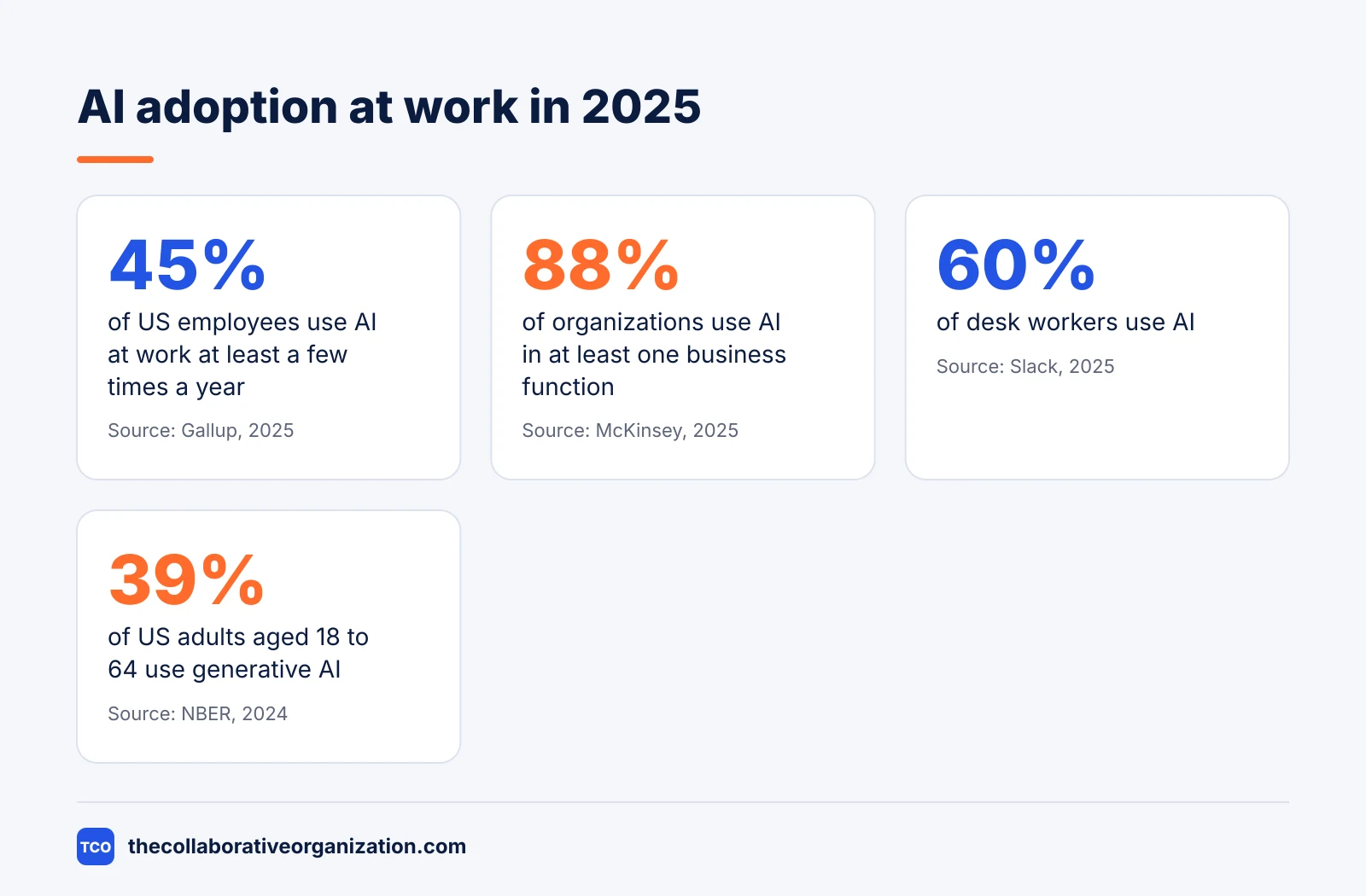
A US study found in 2024 that 39% of adults aged 18 to 64 used generative AI, and 23% of employed respondents had used it for work in the previous week. Only 9% used it every work day. The authors note that work adoption of generative AI has been as fast as the personal computer, according to NBER.
Stack Overflow found in 2025 that 84% of developers used or planned to use AI tools, up from 76% a year earlier. Of professional developers, 51% used AI tools daily. The survey covered more than 49,000 developers in 177 countries.
AI agents: the next step
Agents are the next step after assistants, and leaders are moving faster than their teams. An agent does not just answer a question: it runs a task, or a whole workflow, on its own.
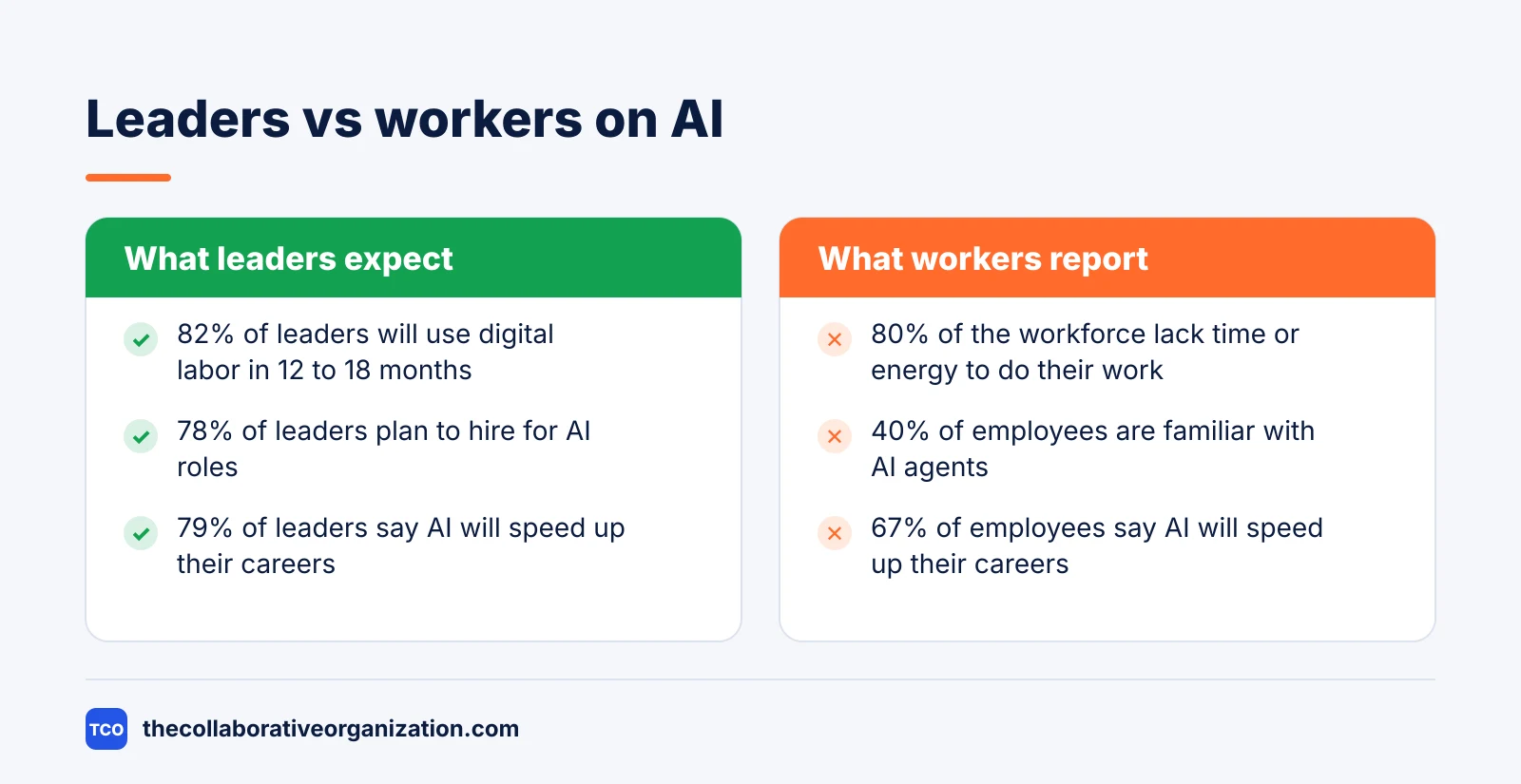
Microsoft found in 2025 that 82% of leaders were confident they would use digital labor to expand capacity in the next 12 to 18 months. Of leaders, 81% expected agents to be moderately or extensively integrated into their AI strategy in that window. The report surveyed 31,000 workers in 31 countries.
Microsoft found in 2025 that 46% of leaders said their organizations already used AI agents to fully automate workflows or processes. But familiarity lagged: 67% of leaders were familiar with AI agents, against 40% of employees. Of leaders, 78% were considering hiring for AI-specific roles.
McKinsey found in 2025 that 62% of organizations were at least experimenting with AI agents, and 23% were scaling an agentic system somewhere in the enterprise. In any single function, no more than 10% were scaling agents. The gap between trying agents and running them at scale is the story of 2025.
Slack found in 2025 that 40% of desk workers had worked with an AI agent, and 23% had offloaded tasks to agents. Daily agent users were more than twice as likely to express high trust in AI. In the UK, daily AI users reported 82% higher productivity and 106% higher job satisfaction.
Digital.ai found in 2025 that AI adoption in agile delivery had risen from 68% to 84% in one year. Only 49% of organizations had AI governance guardrails in place. The survey covered nearly 350 participants, mainly agile coaches and consultants at large enterprises.
The infinite workday: email, meetings and interruptions
The workday is crowded, and AI arrived inside a day that was already full. Microsoft calls this the infinite workday: work with no clear start and no clear end.
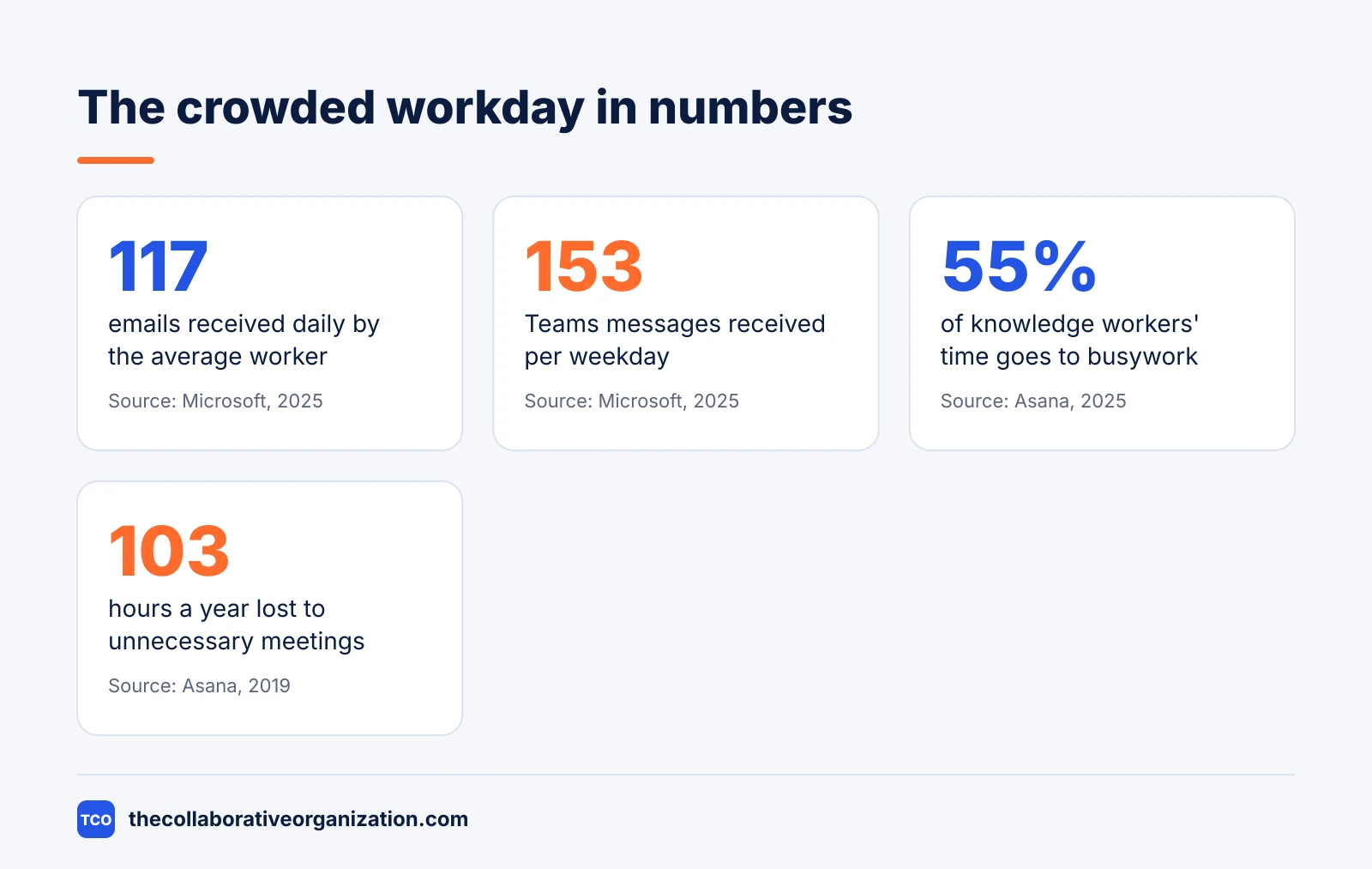
Microsoft found in 2025 that the average worker received 117 emails a day and 153 Teams messages each weekday. Workers were interrupted every 2 minutes, or 275 times a day, by a meeting, email or chat. The figures come from Microsoft 365 usage signals, not from a survey.
Meetings filled the middle of the day: 50% took place between 9 and 11 in the morning and 1 and 3 in the afternoon, according to Microsoft. Meetings after 8 in the evening rose 16% year over year, and 29% of workers were back in the inbox by 10 at night.
Nearly a third of meetings spanned multiple time zones, up 35% since 2021.
Microsoft found in 2025 that 48% of employees and 52% of leaders said work felt chaotic and fragmented. One in 3 employees said the pace of work over the past five years made it impossible to keep up. And 80% of the global workforce said they lacked the time or energy to do their work.
Asana found in 2025 that knowledge workers spent 55% of their time on busywork. The study covered 9,236 knowledge workers in the US, UK, Germany, Japan and Australia. Busywork here means admin, status updates and chasing information, not the skilled work people were hired to do.
Asana’s Anatomy of Work Index (2019) counted 103 hours a year lost to unnecessary meetings, 209 hours to duplicative work, and 352 hours talking about work, according to Asana. Of workers, 88% said time-sensitive projects had fallen behind because of the volume of tasks. The average employee used 10 different apps every day.
Chat and meetings feed each other: a question asked in chat becomes a meeting, and the meeting creates follow-up chat. Our guide to before you standardize team chat covers how to pick one channel and stick to it.
Jobs, skills and pay
AI is changing which skills pay, and which jobs grow, faster than it is removing jobs. The big surveys agree on the direction, even when they disagree on the size.
The World Economic Forum found in 2025 that 170 million jobs would be created and 92 million displaced by 2030, a net gain of 78 million. The churn equals 22% of today’s jobs. The report surveyed more than 1,000 employers covering 14 million workers in 55 economies.
The same report found in 2025 that 39% of core skills would change by 2030, down from 44% in 2023. Of employers, 63% named skills gaps as the biggest barrier to change. And 59 of 100 workers will need training by 2030, while 11 are unlikely to receive it, according to the World Economic Forum.
PwC found in 2025 that workers with AI skills earned an average 56% wage premium, double the 25% premium of the previous year. Productivity growth in industries most exposed to AI rose from 7% to 27%, nearly four times faster. Job availability grew 38% in roles most exposed to AI.
McKinsey found in 2025 that 32% of organizations expected their total workforce to shrink in the year ahead, while 43% expected no change and 13% expected growth. The median organization expected a 30% decrease in a given function’s workforce next year. Software engineers and data engineers were the most in-demand AI roles.
Trust, training and the strategy gap
The gap in 2025 is not between using AI and not using it: it is between leaders and workers, and between trying AI and getting value from it. Training decides which side of the gap a worker lands on.
Slack found in 2025 that workers trained to use AI were up to 19 times more likely to report that AI improved their productivity. Yet 61% of workers had spent under 5 hours learning AI skills, and 30% had received no AI training at all. Training, not the tool, decided whether people got value from AI.
Microsoft found in 2025 that 79% of leaders believed AI would accelerate their careers, against 67% of employees. And 46% of respondents saw AI as a thought partner, while 52% saw it as a command-based tool. The top reason employees turned to AI over a colleague was 24/7 availability, named by 42%.
Gallup found in 2025 that 37% of US workers said their organization had implemented AI to improve productivity, efficiency and quality. But 40% said it had not, and 23% did not know. Individual contributors were far less sure than leaders: 26% did not know, against 7% of leaders.
McKinsey found in 2025 that only 39% of organizations attributed any enterprise-level profit impact to AI, and most of those put it under 5% of profit. Just 6% qualified as AI high performers, with 5% or more profit impact plus significant value. High performers were nearly 3 times more likely to have redesigned workflows from scratch.
Stack Overflow found in 2025 that 46% of developers distrusted the accuracy of AI output, against 33% who trusted it. Only about 3% highly trusted it. And 66% named ‘almost right, but not quite’ answers as their top frustration with AI tools.
What the numbers mean
The numbers tell one story in three parts: use is up, time is still scarce, and profit is still rare. Workers adopt AI fast, the workday stays crowded, and only a small group of organizations turns use into measured profit. That gap is the real finding of 2025, not any single percentage.
Take a team of 100 people and apply the Gallup numbers from 2025: 45 of them use AI at work, 23 use it frequently, and 10 use it daily. If the team matches the Microsoft numbers, 80 of them lack the time or energy to do their work.
The example is an illustration, not a survey result, but it shows why the averages feel so different from person to person. Naming one owner for each AI task helps here, and our guide to what is a RACI matrix shows how to do that.
The table below gathers every statistic in this guide in one place, grouped by theme. Each row names the source and the year, and the source name links to the original page. Use it as a reference, and read the sections above for what each number means.
All 35 statistics in one table
| Statistic | Source | Year |
|---|---|---|
| 45% of US employees used AI at work at least a few times a year | Gallup | 2025 |
| 23% of US employees used AI frequently, a few times a week or more | Gallup | 2025 |
| 10% of US employees used AI daily | Gallup | 2025 |
| 76% of technology workers used AI, the highest of any industry | Gallup | 2025 |
| 88% of organizations used AI in at least one business function | McKinsey | 2025 |
| 60% of desk workers used AI | Slack | 2025 |
| 42% of desk workers used AI weekly or more | Slack | 2025 |
| Daily AI use rose 233% since November 2024 | Slack | 2025 |
| 39% of US adults aged 18 to 64 used generative AI | NBER | 2024 |
| 23% of employed respondents used generative AI for work in the previous week | NBER | 2024 |
| 84% of developers used or planned to use AI tools | Stack Overflow | 2025 |
| 51% of professional developers used AI tools daily | Stack Overflow | 2025 |
| 82% of leaders confident they will use digital labor in the next 12 to 18 months | Microsoft | 2025 |
| 46% of leaders say their organizations already use agents to automate workflows | Microsoft | 2025 |
| 67% of leaders familiar with AI agents, against 40% of employees | Microsoft | 2025 |
| 78% of leaders considering hiring for AI-specific roles | Microsoft | 2025 |
| 62% of organizations at least experimenting with AI agents | McKinsey | 2025 |
| 23% of organizations scaling an agentic AI system somewhere | McKinsey | 2025 |
| 40% of desk workers had worked with an AI agent | Slack | 2025 |
| 23% of desk workers had offloaded tasks to agents | Slack | 2025 |
| AI adoption in agile delivery rose from 68% to 84% in one year | Digital.ai | 2025 |
| 117 emails received daily by the average worker | Microsoft | 2025 |
| 153 Teams messages received per weekday | Microsoft | 2025 |
| Workers interrupted every 2 minutes, 275 times a day | Microsoft | 2025 |
| 48% of employees say work feels chaotic and fragmented | Microsoft | 2025 |
| 55% of knowledge workers’ time goes to busywork | Asana | 2025 |
| 103 hours a year lost to unnecessary meetings | Asana | 2019 |
| 209 hours a year lost to duplicative work | Asana | 2019 |
| 352 hours a year spent talking about work | Asana | 2019 |
| 170 million jobs created and 92 million displaced by 2030 | World Economic Forum | 2025 |
| 39% of core skills will change by 2030 | World Economic Forum | 2025 |
| 56% average wage premium for workers with AI skills | PwC | 2025 |
| 32% of organizations expect their workforce to shrink in the year ahead | McKinsey | 2025 |
| 46% of developers distrust the accuracy of AI output | Stack Overflow | 2025 |
| 39% of organizations report any enterprise-level profit impact from AI | McKinsey | 2025 |
Common AI workplace statistics mistakes to avoid
Most bad takes on AI statistics come from the same five errors, and all five are easy to avoid. Check the list below before you quote a number.
- Comparing surveys that measure different groups. A figure for US workers does not describe desk workers in six countries, and a figure for organizations does not describe employees.
- Quoting a self-reported feeling as measured output. Daily AI users report higher productivity, but that is their own rating, not a timed test.
- Treating one big number as the whole story. Adoption is up and profit is rare at the same time, and both facts matter.
- Using an old figure as if it were new. Some series relabel their measures over time, so check the year and the survey size before you quote a number.
- Trusting a roundup with no link to the original. If a statistics page does not link to the survey it quotes, skip it and find the original.
Sources
- Gallup - AI Use at Work Rises (2025)
- McKinsey - The State of AI 2025 (2025)
- Microsoft - Breaking Down the Infinite Workday (2025)
- Microsoft - Work Trend Index 2025 Executive Summary (2025)
- Salesforce - Daily AI Workforce Use Growth (2025)
- World Economic Forum - The Future of Jobs Report 2025 (2025)
- PwC - Global AI Jobs Barometer 2025 (2025)
- Stack Overflow - Developer Survey 2025 Results (2025)
- Asana - State of AI at Work 2025 (2025)
- Digital.ai - 18th State of Agile Report (2025)
Frequently asked questions
How many people use AI at work in 2025?
Gallup found in 2025 that 45% of US employees used AI at work at least a few times a year, and 10% used it daily. McKinsey found in 2025 that 88% of organizations used AI in at least one business function. Slack found in 2025 that 60% of desk workers used AI. The figures measure different groups, so they describe different populations.
What percentage of workers use AI agents?
Slack found in 2025 that 40% of desk workers had worked with an AI agent, and 23% had offloaded tasks to agents. Microsoft found in 2025 that 46% of leaders said their organizations already used agents to fully automate workflows or processes. McKinsey found in 2025 that 62% of organizations were at least experimenting with agents.
Does AI make workers more productive?
Self-reported numbers say yes, but measured profit says not yet. Slack found in 2025 that daily AI users were 64% more likely to report very good productivity. McKinsey found in 2025 that only 39% of organizations reported any enterprise-level profit impact from AI, and only 6% qualified as AI high performers with 5% or more profit impact.
How much time do workers lose to busywork?
Asana found in 2025 that knowledge workers spent 55% of their time on busywork. Its Anatomy of Work Index (2019) counted 103 hours a year lost to unnecessary meetings, 209 hours to duplicative work, and 352 hours talking about work. Microsoft found in 2025 that the average worker received 117 emails a day and 153 Teams messages each weekday.
Will AI take jobs?
The World Economic Forum found in 2025 that 170 million jobs would be created and 92 million displaced by 2030, a net gain of 78 million. Gallup found in 2025 that only 15% of US workers said AI was likely to eliminate their job within five years, a figure unchanged since 2023. PwC found in 2025 that workers with AI skills earned a 56% wage premium.
Related articles
guides
AI Productivity Statistics: What the Numbers Really Show (2026)
AI can make a task 25% to 56% faster in controlled tests, but only 6% of organizations see a large profit impact. Here are 30+ verified statistics with sources.
November 19, 2026 · 12 min read
project management
What Is a RACI Matrix? Definition, Roles and Examples (2026)
A RACI matrix maps who is Responsible, Accountable, Consulted and Informed for each task. Learn the four roles, how to build one, and see a worked example.
November 19, 2026 · 9 min read
project management
Daily Standup Meeting Format That Works (2026)
A daily standup is a 15-minute meeting where Developers inspect progress toward the Sprint Goal and plan the next day. Use this format to run one that ends on time.
November 19, 2026 · 10 min read