Epic vs Story vs Task: What Is the Difference? (2026) | The Collaborative Organization
By The Collaborative Organization Team · November 19, 2026 · Last verified November 19, 2026 · 10 min read
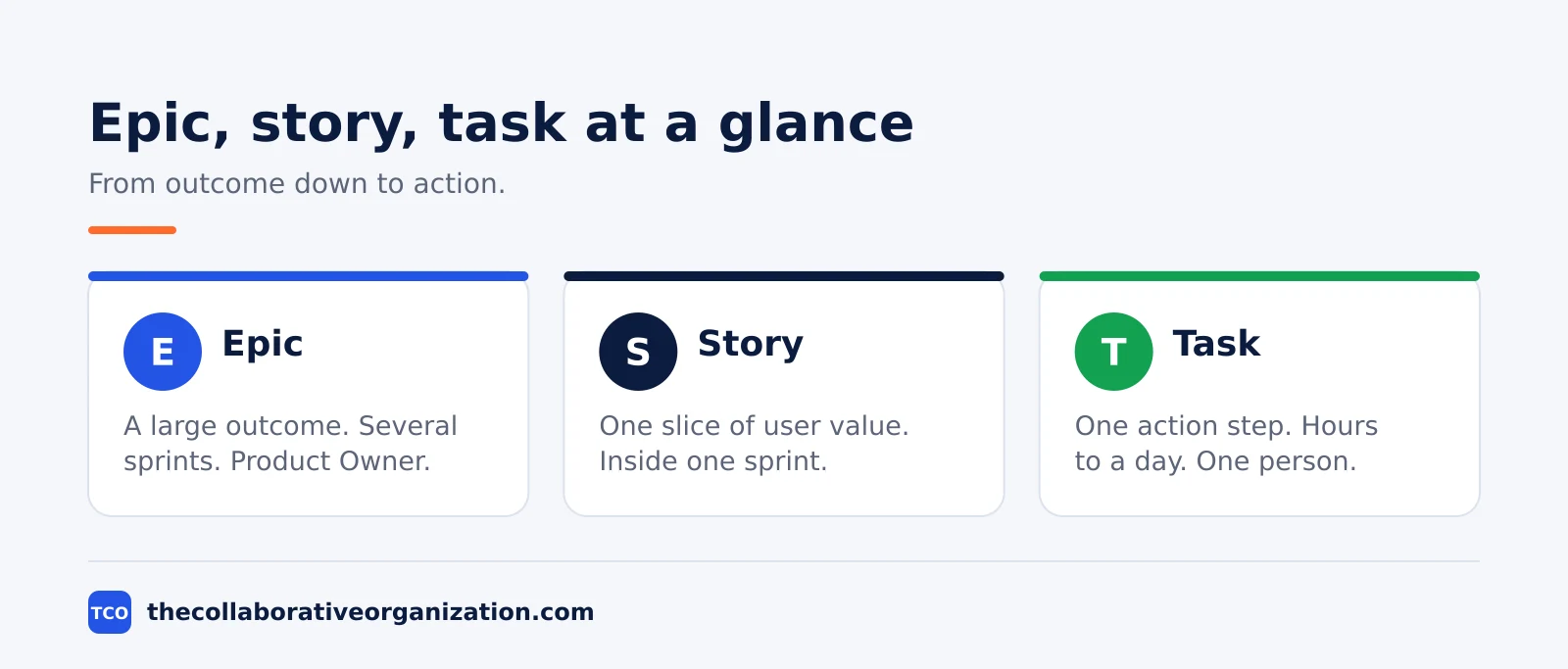
The core difference is size and audience: an epic is a large outcome that spans several sprints, a story is one slice of user value that fits inside one sprint, and a task is one piece of work that takes hours to a day. A story is a unit of value, while a task is a unit of work.
Key takeaways
- The hierarchy runs Initiative, Epic, Story, Task, from months of work down to hours.
- An epic spans several sprints; a story fits inside one sprint; a task takes hours to a day.
- If a customer would notice the change, it is a story; if only the team would notice it, it is a task.
- None of these terms appears in the Scrum Guide, which talks only about Product Backlog items.
- In Jira, Story, Task and Bug are peers below Epic, while Azure DevOps nests Task below User Story.
Epic vs story vs task at a glance
The table below shows the three levels side by side, with the test that settles most arguments in the last column. Keep it open during backlog refinement until the split becomes habit.
| Level | What it is | Time to finish | Who owns it | The test |
|---|---|---|---|---|
| Epic | A large outcome or feature | Several sprints | Product Owner | Needs several stories to finish |
| User story | One slice of user value | Inside one sprint | The team | A user would notice it alone |
| Task | One concrete action step | Hours to a day | One person | Only the team would notice it |
The chain has one more level above the epic. An initiative is a group of related epics that drives toward a common goal, often across a quarter or more, and it belongs to leadership rather than to one team. Atlassian describes the same nesting: epics group related stories under a larger goal, and initiatives are collections of epics.
What an epic is
An epic is a large body of work that breaks down into smaller user stories and is delivered over a set of sprints. Atlassian gives that definition, and it adds that epics often span several teams and that their scope changes as the team learns more. Stories are added and removed as the team gets feedback.
An epic frames a business outcome or a large capability, such as improving the checkout flow or letting customers return items online. It is a planning unit and a communication unit: stakeholders read it to see what the team is doing this quarter, while the team reads the stories inside it to see what to build this sprint.
The rule that settles most arguments about epics is time. Any scope of work the team estimates at weeks or longer, rather than hours or days, should be treated as an epic and broken down into smaller stories. If an item fits in one sprint, it is a story, not an epic.
What a user story is
A user story is a short requirement written from the perspective of an end user, small enough for the team to finish inside one sprint. It usually follows the shape “As a user, I want an action so that I get a benefit”, and it carries acceptance criteria so everyone knows when it is done.
A story is the smallest unit of work that delivers value on its own. Our guide on how to write user stories shows the shape in detail, including acceptance criteria and the split from epics.
A story is estimated, often in story points, and the team agrees the estimate before the sprint starts.
A story is also a promise to talk, not a full specification. Ron Jeffries described stories as card, conversation and confirmation: the card holds the short text, the conversation fills in the detail, and the confirmation sets the test. That is why a story stays short on paper and grows in discussion.
What a task is
A task is a specific piece of work the team does to finish a story, written in the team’s own words rather than the user’s. Typical tasks are writing a test, updating a component, configuring an API, or drafting the copy for one screen. No customer asks for a task, and no customer would notice one on its own.
Tasks are estimated in hours, not in story points, and they do not need acceptance criteria in the same way stories do. A task is done when the work is done.
The Developers decide how to split the work and who picks it up, so tasks are not handed out from outside the team.
A task can take longer than a story. That does not promote it to a story. The test is visibility, not hours: if a person outside the team would notice the change, it is a story; if only the team would notice it, it is a task.
How the three levels fit together
One epic breaks into several stories, and each story breaks into several tasks, forming a tree from outcome down to action. The split happens in two steps. First, the epic is split into user stories, each a thin slice of value written from the user’s view. Second, each story is split into tasks, the concrete actions one person can pick up and finish.
What is a product backlog explains where the three levels live: the backlog holds epics at the top and stories below them, and tasks appear when the team plans a sprint. The backlog is ordered by value, so the most valuable epic’s stories sit at the top.
The nesting is the same in most tools, but the names shift. Jira ships with a default hierarchy where Epic sits above Story, Task and Bug, and Subtasks sit below those.
Azure DevOps uses a different shape in its Agile template: Epic, then Feature, then User Story, then Task, so a task really is a child of a story there. The idea is the same in both: big to small, outcome to action.
Epic vs story vs task example: checkout
A checkout improvement shows all three levels on one piece of work. The example below is an illustration, not a real project, and it uses the tests from the table above.
The epic is “Improve the checkout flow”, owned by the Product Owner and sized at three sprints. It splits into four stories:
- Guest checkout. A guest checks out without an account.
- Saved address. A customer saves a delivery address.
- Delivery slot. The page shows the delivery slot before payment.
- Confirmation email. An order confirmation goes out by email.
The guest checkout story splits into five tasks: design the guest form, build the form, add validation, write the tests, and update the help page. Each task takes hours to a day and belongs to one person. The story ships when its tasks are done, and the epic closes when the last story ships.
Choose the right level for your item
Pick the level by asking two questions: who would notice this, and how long will it take. The answers place the item in the tree without a debate.
- Choose an epic if the work needs several stories, spans several sprints, or involves more than one team. Write the outcome in one sentence and list the open questions.
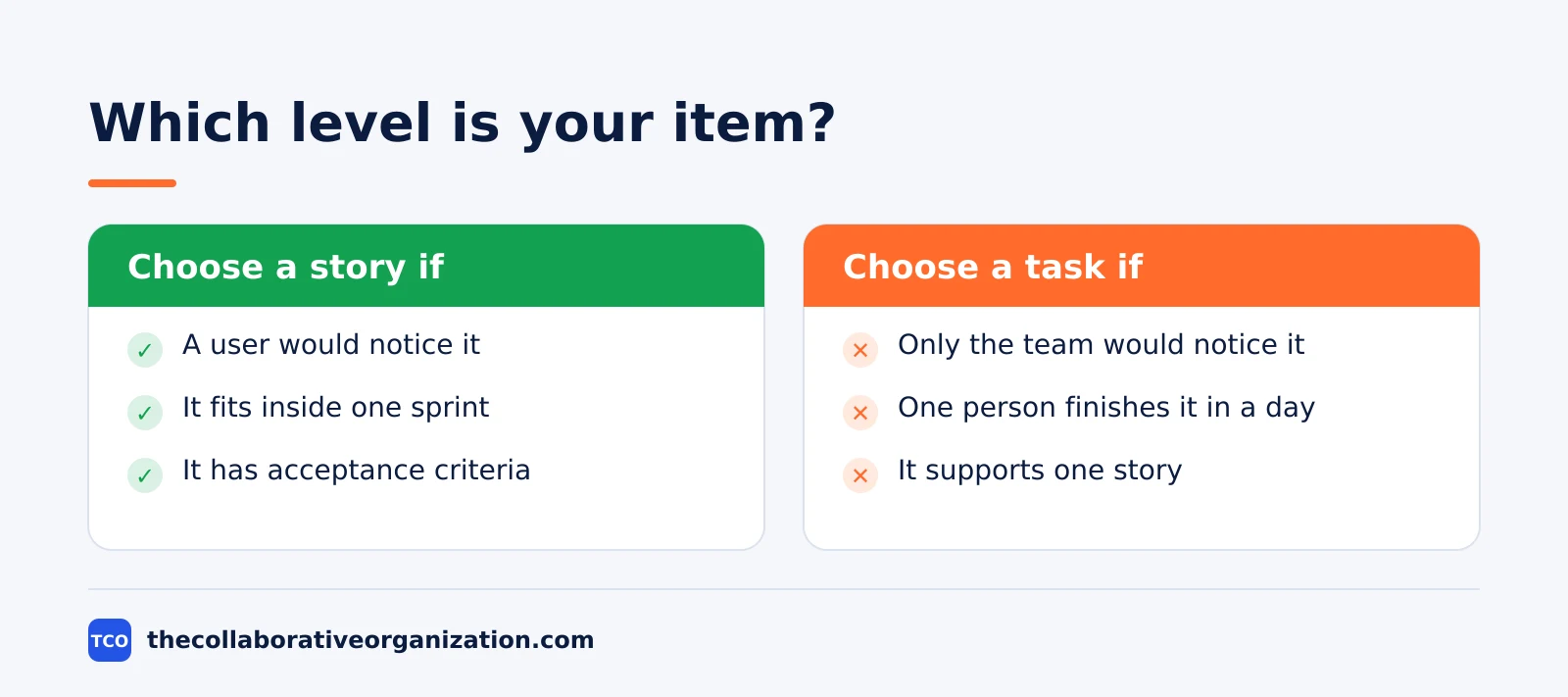
- Choose a story if one user would notice the change, the team can estimate it, and it fits inside one sprint. Write it from the user’s view with acceptance criteria.
- Choose a task if only the team would notice the work, it supports one story, and one person can finish it in hours to a day. Write it in the team’s words.
If a story cannot be finished in a sprint, it is really an epic and needs splitting. If a task delivers user-visible value on its own, it is probably a story. Run those two checks at refinement and the backlog stays at the right size.
Can you combine them, and do you need all three?
Yes, the three levels work as one system, and most teams need all three, but a small team can skip the epic level for small work. The combination is the point: the epic keeps the goal visible, the story keeps the value visible, and the task keeps the work visible.
A two-person team shipping one feature a sprint may not need epics at all. It can work from stories and tasks, and promote a story to an epic only when it grows past a sprint. A team with a quarterly roadmap and several workstreams needs epics, because stories alone cannot show stakeholders what the quarter holds.
None of these terms appears in the Scrum Guide. The guide talks only about Product Backlog items, which are refined until the team can finish them in a sprint.
Epics, stories and tasks are practices that grew around Scrum, mostly from Extreme Programming and from tools such as Jira and Azure DevOps. That is why the names differ between tools, while the nesting stays the same.
Tools that show the hierarchy
A tool should show the tree: the epic, its stories, and the tasks under each story, with progress at every level. The Product Owner reads the epic view, the team reads the story view, and one person reads the task view. Compare the options on our project management software shortlist before you pick one.
| Tool | Best for | Free plan | Starting price (as of November 2026) | Notable limit |
|---|---|---|---|---|
| Jira | Teams that want the Epic, Story, Task and Subtask hierarchy | Free for up to 10 users | $9.70 per user per month (Standard), billed monthly for 1-100 users | Story, Task and Bug are peers, not nested |
| ClickUp | Teams that want nested tasks and custom hierarchies | Free Forever plan | $9 per user per month (Core), billed annually | Yearly billing needed for that price |
| Asana | Teams that want goals above tasks and subtasks | Free for 2 people | $10.99 per user per month (Starter), billed annually | Free plan covers 2 people |
The Jira price comes from the Jira pricing page: Standard is $9.70 per user per month billed monthly for 1 to 100 users, after Atlassian raised list prices on 13 October 2026.
The ClickUp pricing page lists Core at $9 per user per month billed yearly, and Asana lists Starter at $10.99 per user per month billed annually on its pricing page.
Common epic, story and task mistakes to avoid
Most mix-ups come from writing an item at the wrong level, and the fix is a quick test, not a new process. Run through the list below at the next refinement.
- A story with no user in it. If the text says “set up the database table” and no user would notice it, it is a task wearing a story’s clothes. Rewrite it or demote it.
- An epic that fits in one sprint. An epic that finishes in a sprint is a story. Rename it and skip the extra tracking.
- Tasks with acceptance criteria. Tasks do not need the same checks as stories. Keep the task short and put the checks on the story.
- Estimating tasks in story points. Stories take points, tasks take hours. Mixing the two makes both numbers meaningless.
- One level for everything. A backlog of only epics hides the work, and a backlog of only tasks hides the goal. Use all three levels where they fit.
Sources
- Atlassian - Epics, Stories, and Initiatives (2026)
- Atlassian - Epics (2026)
- Parallel - What Is an Epic in Agile? Guide (2026)
- Taskade - Agile Epic Explained (2026)
- Projan - Epic vs User Story vs Task (2026)
- Mudassir Iqbal - Epic vs Feature vs User Story vs Task (2026)
- Atlassian - Jira Pricing (2026)
- ClickUp - Pricing (2026)
- Asana - Pricing (2026)
Frequently asked questions
What is the main difference between an epic, a story and a task?
Size and audience. An epic is a large outcome that spans several sprints. A story is one slice of user value that fits inside a single sprint. A task is one piece of implementation work, usually hours long, that helps finish a story. A story is a unit of value, while a task is a unit of work.
Can a task be bigger than a story?
It can take longer, but it is still a task if no user would notice it on its own. The test is not hours but visibility: if a customer would notice the change, it is a story. If only the team would notice it, it is a task, even when it takes two days.
Does Jira treat tasks as children of stories?
No, not by default. In Jira, Epic sits above Story, Task and Bug, which are peers at the same level, and Subtasks sit below them. In Azure DevOps, the Agile template nests it differently: Epic, then Feature, then User Story, then Task.
Do tasks need acceptance criteria?
No, not in the way stories do. A story needs acceptance criteria because it delivers user-facing value that someone must check. A task is done when the work is done, so a short description and a done state are usually enough.
How do you know when a story is really an epic?
When the team cannot estimate it, cannot test it in isolation, or cannot finish it inside one sprint. A story the team cannot size with reasonable agreement is too big, whatever it is called. Split it by user action until each piece fits a sprint.
Related articles
project management
How to Choose Project Management Software (2026)
Pick project management software in seven steps: define the work, count seats, price the real cost, and run a two-week pilot before you pay.
November 19, 2026 · 10 min read
project management
What Is a RACI Matrix? Definition, Roles and Examples (2026)
A RACI matrix maps who is Responsible, Accountable, Consulted and Informed for each task. Learn the four roles, how to build one, and see a worked example.
November 19, 2026 · 9 min read
project management
Daily Standup Meeting Format That Works (2026)
A daily standup is a 15-minute meeting where Developers inspect progress toward the Sprint Goal and plan the next day. Use this format to run one that ends on time.
November 19, 2026 · 10 min read