Agile for Non-Software Teams: A Practical How-To (2026) | The Collaborative Organization
By The Collaborative Organization Team · November 19, 2026 · Last verified November 19, 2026 · 12 min read
Agile for non-software teams means running work in short cycles, showing finished work often, and changing the plan based on what you learn. Marketing, HR, operations and event teams use the same ideas software teams use, but they swap code for campaigns, hires, policies and events.
Key takeaways
- Agile started in software, but its core is short cycles, visible work and fast feedback, which fit marketing, HR, operations and events.
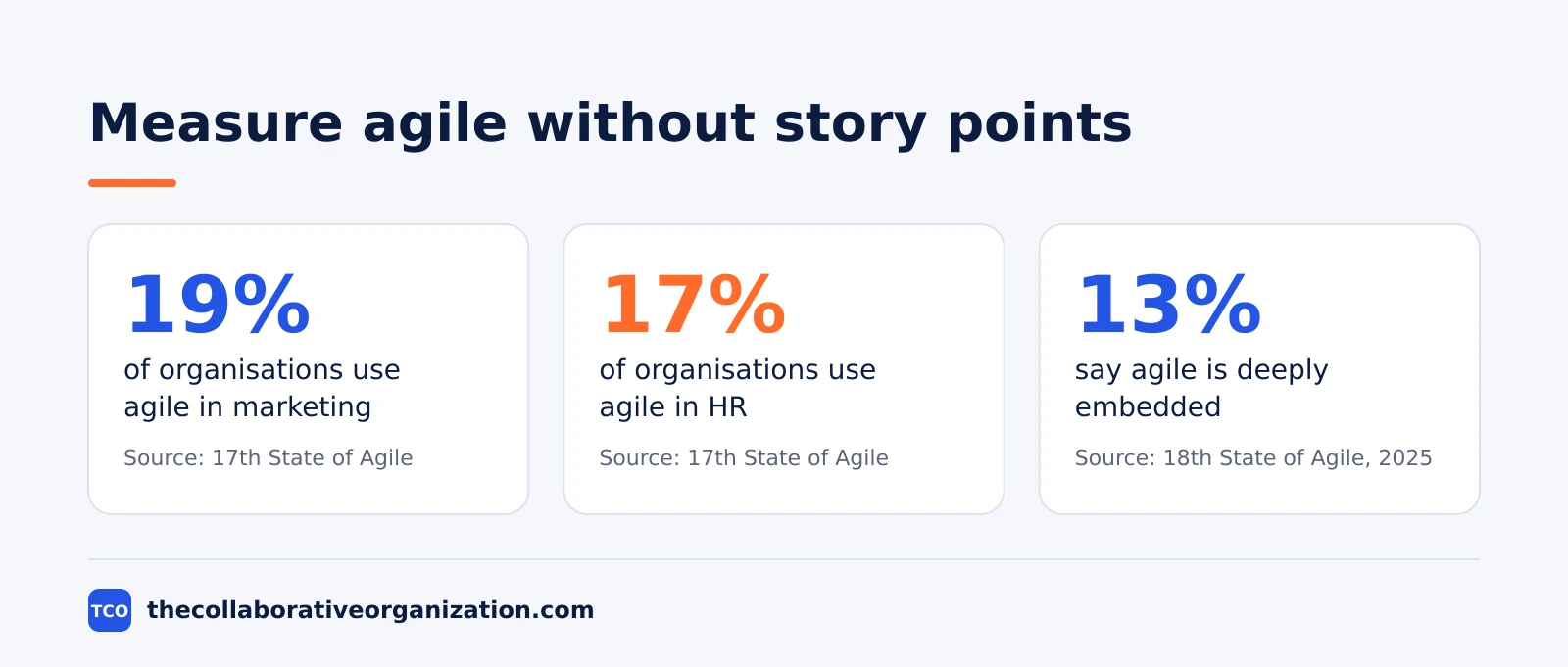
- In the 17th State of Agile Report, marketing used agile in 19% of organisations, HR in 17%, business operations in 28% and customer support in 22%.
- Only 13% of organisations in the 18th State of Agile Report (2025) say agile is deeply embedded across the business.
- Kanban suits steady incoming work, while one- or two-week cycles suit batch work such as campaigns and hiring rounds.
- Replace “user stories” with short deliverable statements and replace story points with cycle time and finished work.
- Start with one team, one board and one short cycle, then expand only after three or four cycles show results.
What agile means when there is no software
Agile outside software means the same four values from the Agile Manifesto, applied to a different kind of finished work. The Manifesto was written in February 2001 by 17 practitioners, and its values put people and interaction ahead of process, working results ahead of long documents, customer collaboration ahead of contracts, and responding to change ahead of following a plan. A marketing team delivers a campaign instead of working software, and an HR team delivers an onboarded hire instead of a release.
The shift that matters most is the definition of finished work. Software teams ship code a user can run. A non-software team ships something a stakeholder can use or judge: a draft press release, a shortlist of candidates, a signed policy, or a booked venue.
If nobody outside the team can see or use the result, the cycle produced activity, not value. That test keeps the work honest.
Teams that skip this translation step end up with agile in name only. They hold standups and call their to-do list a backlog, but nothing changes about what gets finished or how often. The Agile Manifesto values still apply, because they describe how people work together, not what they build. Start from the values, then pick practices that serve them.
Why non-software teams adopt agile
Teams adopt agile outside software because most of their work changes while it is in progress. A campaign pivots when a competitor launches first. A hiring round stalls when a manager rewrites the job description. An event changes when a venue falls through. A long plan written in January cannot survive those changes, so teams break work into short cycles and adjust at each review.
The numbers back up the spread beyond IT. In the 17th State of Agile Report, agile reached business operations in 28% of organisations, customer support in 22%, marketing in 19% and HR in 17%, while IT sat at 69%.
Those figures come from Plaky, which summarised the 17th report. Software still leads, but the method has clearly moved past the engineering floor.
Adoption is not the same as success. Only 13% of organisations in the 18th State of Agile Report (2025) say agile is deeply embedded across the business, and 25% say it is practised in some departments but inconsistently.
That gap is the reason this guide starts small: a team that proves the rhythm on one kind of work earns the right to spread it.
Choose the right agile shape for your work
Pick Kanban for steady incoming work and short cycles for batch work, because the shape should match how work arrives. A support desk, a design request queue and an HR ticket inbox never stop, so a board with a limit on work in progress fits them best. A campaign, a hiring round and a product launch arrive in batches with a deadline, so a one- or two-week cycle fits them best. Mixing the two is fine when one team handles both kinds of work.
Our guide to what is Kanban explains the board, the work-in-progress limit and the pull rule in detail. The short version is simple: work is visible, new work starts only when capacity frees up, and nothing hides in an inbox. That alone fixes the most common non-software problem, which is work that nobody can see.
Short cycles need a different discipline.
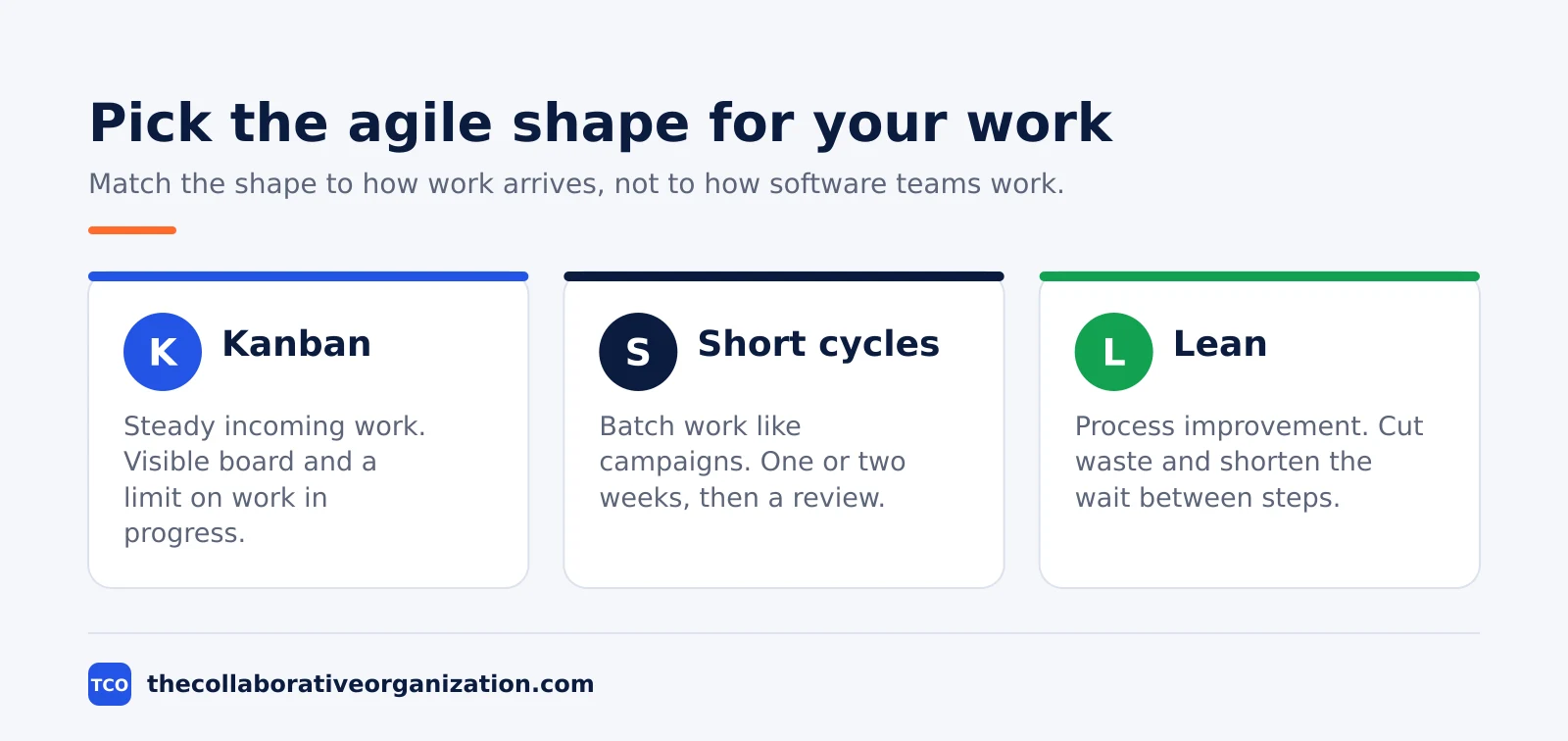
A team that runs Scrum in software uses sprints, a product backlog and a demo. A non-software team keeps the cycle and the review, but swaps the backlog for a deliverable list and the demo for a show-and-tell of finished work.
A campaign review shows the draft assets and the early results, not a slide deck about the plan.
| Work pattern | Best shape | Cycle length | Review shows | | Steady requests | Kanban board | Continuous | Finished items each week | | Campaign or launch | Short cycles | 1-2 weeks | Draft assets and results | | Hiring round | Short cycles | 1-2 weeks | Shortlist and scorecards | | Policy or process change | Short cycles | 2 weeks | Draft policy and feedback | | Event planning | Short cycles | 1-2 weeks | Bookings and run sheet |
What you need before the first cycle
You need a named owner, a visible board, a short list of finished-work definitions, and a fixed review time, and nothing else to start. The owner is the person who decides what the team works on next and who accepts finished work. Without that person, the board fills with work nobody prioritised and nobody can finish. Give the role to one person, not a committee.
The board can be a physical wall or a tool, but it must show every item in one place. Columns such as To do, In progress, In review and Done work for most teams. Add a column only when work regularly waits in a distinct place, such as legal approval or budget sign-off.
A board with ten columns hides work instead of showing it.
Write a “definition of done” for each kind of work before the cycle starts. A blog post is done when it is drafted, edited, approved and scheduled, not when the first draft exists. A hire is done when the offer is signed and the start date is set, not when the interviews finish.
These short definitions stop the argument about whether something is finished.
How to run agile for a non-software team in 6 steps
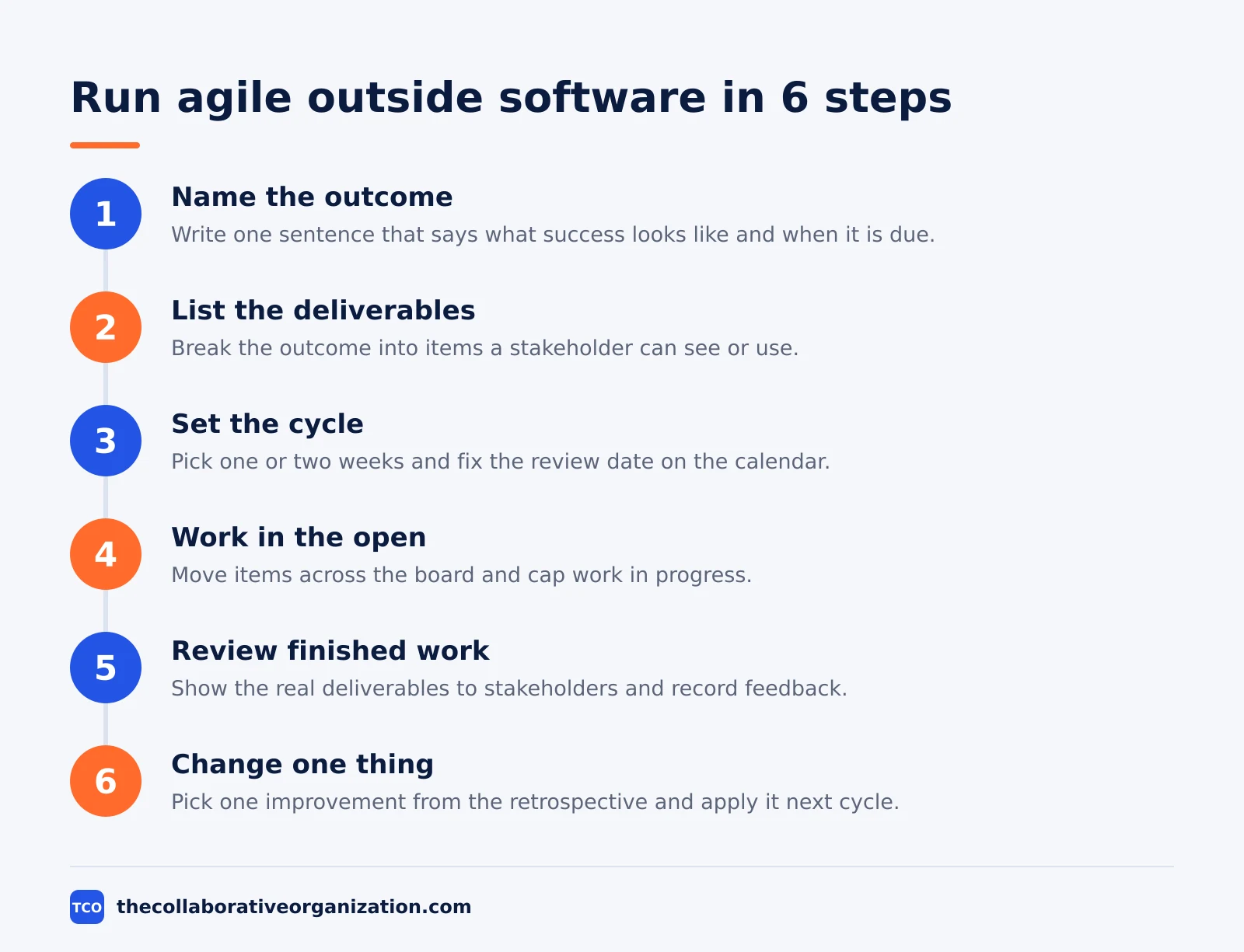
Running agile outside software takes six steps: name the outcome, list the deliverables, set the cycle, work visibly, review finished work, then adjust. Each step has a clear outcome, so the team knows when it is done. The whole setup takes about a week for a first team.
Step 1: Name the outcome in plain language
Write one sentence that says what success looks like and when it is due. A marketing example is “increase qualified leads by 20% by the end of the quarter”. An HR example is “fill three sales roles with signed offers by 30 June”. Every task in the cycle should trace back to that sentence, and any task that does not should wait.
Step 2: List the deliverables, not the activities
Break the outcome into items a stakeholder can see or use. A campaign breaks into a landing page draft, three social posts and one email sequence. A hiring round breaks into a job post, a scorecard and a shortlist of five candidates. Keep each item small enough to finish inside one cycle, and drop anything that is only a meeting or a status update.
Step 3: Set the cycle length and the review date
Pick one or two weeks and fix the review on the calendar before work starts. A two-week cycle suits campaigns and hiring, while a one-week cycle suits fast-moving support or content work. The review is the deadline that makes the cycle real, so do not move it when work slips. A slipped review teaches the team that dates do not matter.
Step 4: Work from the board, in the open
Move each item across the board as it progresses, and limit work in progress to two or three items per person. When a card stalls, the team sees it the same day instead of at the end of the cycle. A short check-in two or three times a week is enough for most non-software teams, and it should focus on blocked work, not status reports.
Step 5: Review finished work with stakeholders
Show the actual deliverables at the review, not a summary of effort. A campaign review shows the draft page and the email. A hiring review shows the scorecard and the shortlist. Stakeholders give feedback on the work itself, and the team records what changes before the next cycle. This is the moment agile earns its keep.
Step 6: Hold a short retrospective and change one thing
Ask three questions: what helped, what slowed us down, and what will we change next cycle. Pick one change, not five, and write it on the board. A team that changes one small thing each cycle improves faster than a team that writes a long list and changes nothing. Our guide to the daily standup meeting format shows how to keep these check-ins short and focused on blockers.
Worked example: a marketing team runs its first cycle
A five-person marketing team at a mid-size software company runs a two-week cycle to launch a spring campaign, and the example below shows what each step looks like in practice. The team is fictional, and the numbers are an illustration, not a case study. The outcome is “publish the spring campaign and collect 200 demo requests by the end of the month”.
In week one, the team lists six deliverables: a landing page draft, a product video script, three social posts, one email, a webinar page and a tracking sheet. The owner ranks them, and the team pulls the landing page, the email and the social posts first.
The video script waits, because it needs the landing page copy before it can be written.
By the review on day ten, the landing page draft and the email are done and shown to the sales lead, who asks for a clearer price line on the page. The social posts are in review, and the webinar page has stalled because the speaker has not confirmed a date.
The team moves the webinar page to the next cycle, fixes the price line, and starts the video script. The cycle produced three finished items and one clear decision, which is a good first result.
How to measure success without story points
Measure cycle time, finished work per week and stakeholder satisfaction, because those three numbers fit any kind of work. Cycle time is the number of days from starting an item to marking it done. Finished work per week is a simple count of items that reached Done. Stakeholder satisfaction is a short question at each review: did this cycle give you what you needed.
Story points do not transfer well outside software, because non-software tasks rarely split into the same sizes.
What are story points explains the software version, and the lesson for other teams is to skip the estimate and measure the real time instead. A team that finishes eight items a week with a five-day cycle time is improving, whatever the items are.
Set a baseline in the first two cycles, then watch the trend over the next four.
A falling cycle time and a steady or rising count of finished items mean the system works. If cycle time rises, look for the column where cards wait longest, and fix that wait first. The board shows the bottleneck if you read it honestly.
Tools that fit non-software agile teams
Pick the simplest tool the team will open every day, because a board nobody checks is worse than a wall nobody updates. A shared board with list, board and calendar views covers most non-software work. Automations that move a card when a due date passes, and forms that turn a request into a card, save more time than any advanced report. Our guide on how to choose project management software covers seat counts and free-plan caps.
| Tool | Best for | Free plan | Starting price (as of November 2026) | Notable limit |
|---|---|---|---|---|
| Asana | Campaigns and cross-team work | Free for 2 people | $10.99 per user per month, billed annually | Free plan covers 2 people |
| monday.com | Visual boards for operations | Free plan for up to 2 seats | $9 per seat per month (Basic), billed annually | Paid plans need at least 3 seats |
| ClickUp | Teams that want custom fields | Free Forever plan | $9 per user per month (Core), billed annually | Yearly billing needed for that price |
| Trello | Simple boards for small teams | Free plan | $5 per user per month (Standard), billed annually | Advanced views need paid plans |
The prices come from the vendors.
Asana pricing lists Starter at $10.99 per user per month billed annually, and the monday.com pricing page lists Basic at $9 per seat per month billed annually.
ClickUp pricing lists Core at $9 per user per month billed yearly.
Trello Standard at $5 per user per month billed annually is listed in the Wrike creative-tools roundup at Wrike, which also confirms the Asana, monday.com and ClickUp prices above.
Common agile mistakes for non-software teams to avoid
Most non-software agile efforts fail in the same five ways, and each one comes from copying software practice without translating it. Check the list at each retrospective and fix the first item that matches.
- Copying every software ceremony. Daily standups, story points and sprint demos were built for code, so keep only the practices that help your work and drop the rest.
- No definition of done. Without a short written definition, every item looks almost finished and nothing is ever really done.
- A board nobody looks at. A board that lives in a tool nobody opens hides work, so put it where the team already works and review it at each check-in.
- Too much work in progress. Starting ten items at once means finishing none of them, so cap work in progress and finish before you start.
- Reviews with no stakeholders. A review that shows slides to the team itself teaches nothing, so invite the people who use the work and ask them what to change.
Setting up agile is hard at first. In the PwC Luxembourg Agile Survey 2024, 74% of companies named difficulty in coordination as a problem when setting up agile, and 70% named a lack of organisational change management.
The same survey found that 74% of companies gained new ways of collaborating, so the effort pays off when the team sticks with it for a few cycles.
Sources
- Agile Manifesto - Manifesto for Agile Software Development (2001)
- Digital.ai - 18th State of Agile Report Press Release (2025)
- Plaky - Agile Statistics: Verified Data on Adoption and Success Rates (2026)
- ONES.com - Agile Project Management in Non-Tech: Workflows That Actually Fit (2026)
- ONES.com - Beyond Software: A Practical Guide to Agile Project Management (2026)
- Atlassian - Marketing team guide (2026)
- Asana - Pricing (2026)
- monday.com - Pricing (2026)
- ClickUp - Pricing (2026)
- Wrike - Project management software for creatives: 11 best tools in 2026 (2026)
Frequently asked questions
Can agile work for a team that never writes code?
Yes. Agile is a way of working in short cycles with regular feedback, not a coding method. Marketing, HR, operations and event teams use the same rhythm: pick a small batch of work, finish it, show it, then adjust. The tools change, but the cycle of plan, deliver and review stays the same.
Do non-software teams need sprints?
No, sprints are optional. A team with steady incoming work often does better with a Kanban board and a limit on work in progress. A team with campaign or project batches can use one- or two-week cycles instead. Pick the rhythm that matches how work arrives, not the rhythm a software team uses.
What replaces a user story for non-software work?
A short deliverable statement works instead. Write who the work is for, what finished looks like, and how you will know it is done. For example: as a hiring manager, I want the interview scorecard by Friday so every interviewer scores candidates the same way. That sentence is small, testable and clear.
How do you measure progress without velocity?
Use cycle time and finished work instead. Cycle time is the days from starting a task to finishing it. Count how many items finish each week, and track how many sit in progress. If cycle time falls and finished work rises, the team is improving, even without a single story point.
How long does it take to start agile outside software?
A first cycle can start in one week. Pick one team, one board and one short cycle, then hold a review at the end. Most teams see whether the rhythm fits after three or four cycles. Do not roll it out to the whole department until that first team can show finished work and a working review.
What is the biggest mistake non-software teams make with agile?
Copying software ceremonies word for word is the biggest mistake. Daily standups, story points and sprint demos were built for code. When a team keeps every ceremony and changes nothing else, agile becomes extra meetings. Adapt each practice to the work, keep what helps, and drop what does not.
Related articles
project management
How to Choose Project Management Software (2026)
Pick project management software in seven steps: define the work, count seats, price the real cost, and run a two-week pilot before you pay.
November 19, 2026 · 10 min read
project management
What Is a RACI Matrix? Definition, Roles and Examples (2026)
A RACI matrix maps who is Responsible, Accountable, Consulted and Informed for each task. Learn the four roles, how to build one, and see a worked example.
November 19, 2026 · 9 min read
project management
Daily Standup Meeting Format That Works (2026)
A daily standup is a 15-minute meeting where Developers inspect progress toward the Sprint Goal and plan the next day. Use this format to run one that ends on time.
November 19, 2026 · 10 min read