Agile Ceremonies Explained: The 4 Scrum Events (2026) | The Collaborative Organization
By The Collaborative Organization Team · November 19, 2026 · Last verified November 19, 2026 · 9 min read
Agile ceremonies are the four recurring meetings that give every Scrum sprint its shape: sprint planning, the daily standup, the sprint review and the sprint retrospective. Each one has a fixed purpose, a timebox and an output, and together they form the rhythm of a sprint.
Key takeaways
- The Scrum Guide calls these meetings events, not ceremonies, and it defines five: the sprint plus the four ceremonies inside it.
- For a one-month sprint the caps are 8 hours for planning, 15 minutes for the daily standup, 4 hours for the review and 3 hours for the retrospective.
- Sprint planning produces a sprint goal and a sprint backlog; the daily standup produces an adapted plan for the next day.
- The sprint review inspects the product with stakeholders, while the retrospective inspects how the team worked.
- Backlog refinement is ongoing work in the Scrum Guide, not a ceremony, and it has no timebox.
What agile ceremonies are
Agile ceremonies are the formal checkpoints built into Scrum so teams plan, coordinate, inspect and adapt on a regular cadence. The term ceremonies is common in the Agile community, but the official Scrum Guide by Ken Schwaber and Jeff Sutherland calls them events. The guide defines five events in total: the Sprint, Sprint Planning, the Daily Scrum, the Sprint Review and the Sprint Retrospective.
The sprint is the container event. It lasts one month or less, holds the other four events, and a new sprint starts as soon as the last one ends. What is Scrum explains the framework around these events, including the three roles and the three artifacts.
Timeboxes are hard maximums, not targets. An event ends when its purpose is met, even if time remains. Shorter sprints usually need shorter events, so a two-week sprint uses about half the caps of a one-month sprint.
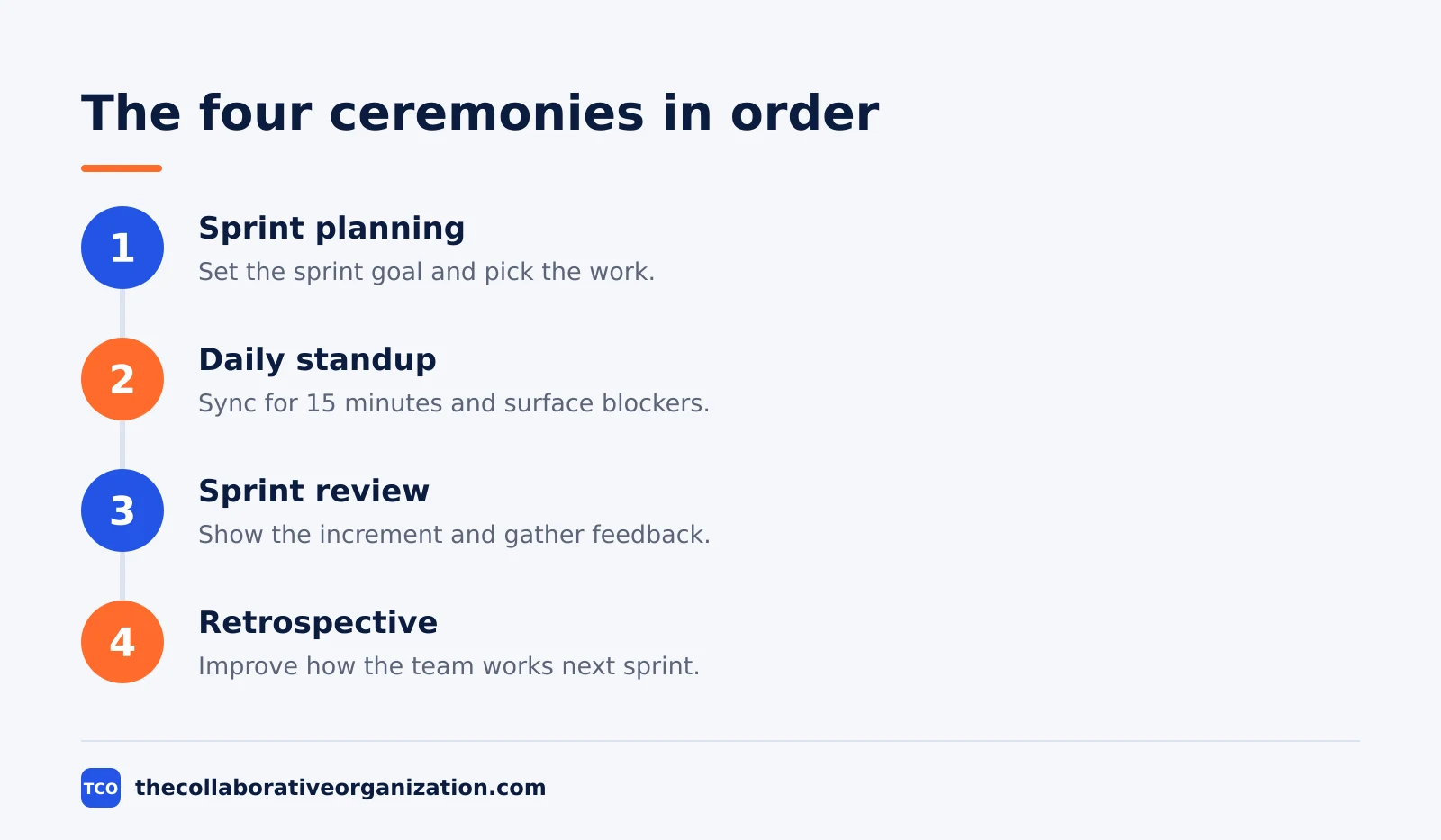
The four ceremonies at a glance
The table below shows all four ceremonies with their purpose, timing, timebox and output for a two-week sprint. Keep it next to the team calendar until the rhythm becomes habit.
| Ceremony | When | Timebox (2-week sprint) | Output |
|---|---|---|---|
| Sprint planning | Start of the sprint | Max 4 hours | Sprint goal and sprint backlog |
| Daily standup | Every working day | Max 15 minutes | Adapted plan for the next day |
| Sprint review | End of the sprint | Max 2 hours | Adjusted product backlog |
| Sprint retrospective | After the review | Max 1.5 hours | One or two improvements with an owner |
The timeboxes in the table are the usual caps for a two-week sprint, worked out from the Scrum Guide figures for a one-month sprint.
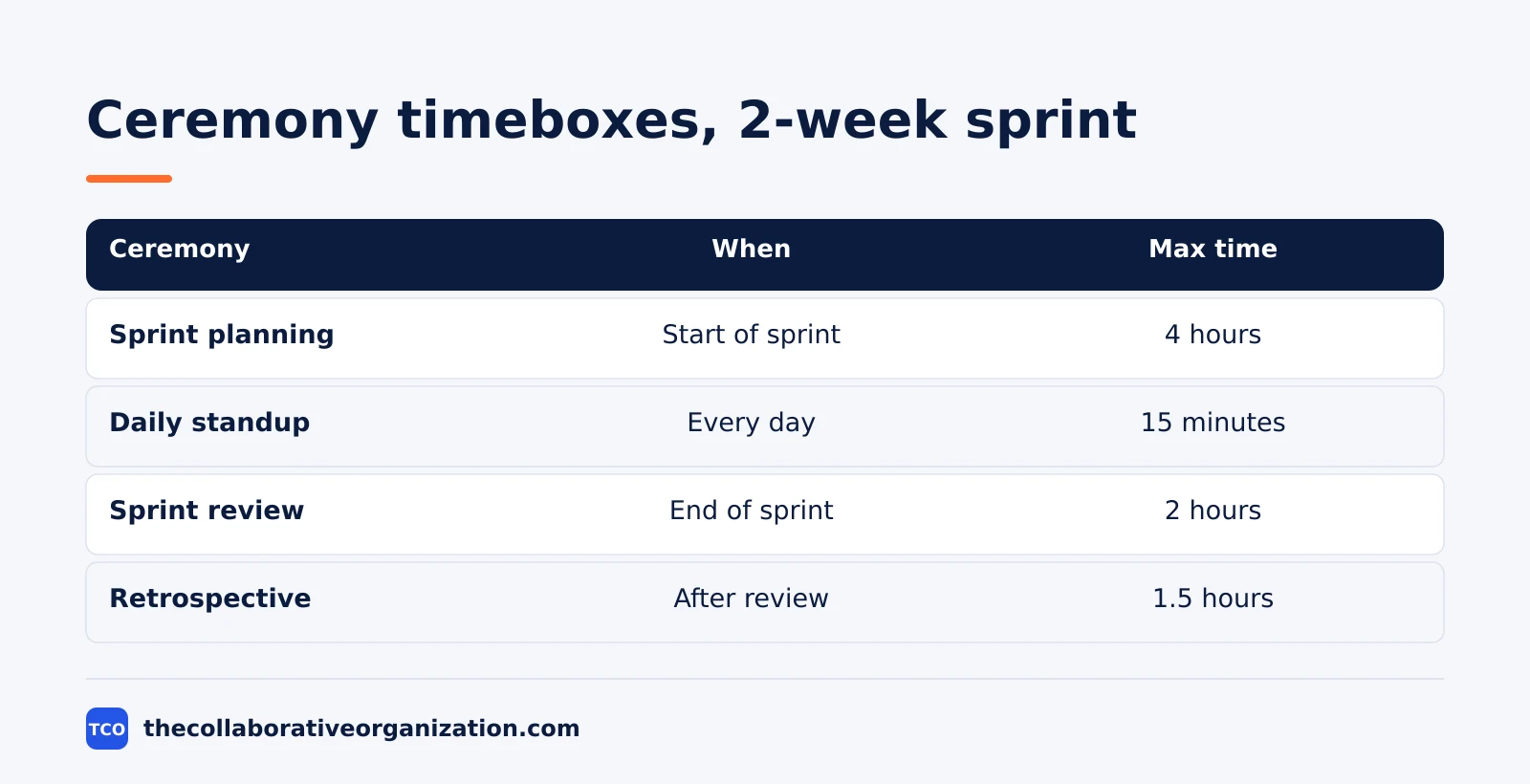
The Daily Scrum stays at 15 minutes whatever the sprint length, because it covers one day of work, not the whole sprint.
Sprint planning: set the goal and the work
Sprint planning opens every sprint, and the team leaves it with a sprint goal and a sprint backlog. The meeting answers two questions in order: what will we do this sprint, and how will we do it. Our guide on how to run a sprint planning meeting walks through the agenda step by step.
The Product Owner brings the top of the product backlog and explains the value of each item. The Developers select the items they can finish and say how they will do the work. The Scrum Master makes sure the meeting stays inside its timebox and that everyone has a voice.
Planning covers three topics in order. First, why the sprint is valuable, which produces the sprint goal. Second, what can be done, where the Developers select items with the Product Owner.
Third, how the work will be done, which turns the selection into a plan. A planning meeting that ends without a written sprint goal has not finished its job.
Daily standup: sync and surface blockers
The daily standup is a 15-minute sync where the Developers inspect progress toward the sprint goal and adapt the plan for the next day. It happens every working day, at the same time and place, and it is the shortest ceremony in the Scrum calendar.
The standup is not a status report to a manager. It is a team-to-team conversation about what changed since yesterday and what needs to change today. Daily standup meeting format shows the three-question format most teams use, and why the answers should lead to a plan, not a report.
A standup that produced no change to the plan was a status report, not a standup. The test is simple: after 15 minutes, does the team know who is blocked, who can help, and what moves today. If the answer is no, the meeting needs a firmer hand on the clock and on side discussions.
Sprint review: show the work and gather feedback
The sprint review happens at the end of the sprint, when the team shows the working increment to stakeholders and gathers feedback. It is not a polished slide deck. It is a live look at what was actually built, and stakeholders are expected to react, ask questions and redirect the work.
The review inspects the increment and adapts the product backlog. Feedback from the session goes back into the backlog, so the next sprint starts from what stakeholders actually want, not from what the team guessed. The Product Owner leads the discussion of what comes next, and the Developers show how the work behaves.
Keep the review honest. Showing only the finished parts and hiding the rough edges wastes the one meeting where outsiders can still change the plan. A review that produced no change to the backlog was a demo, not a review.
Sprint retrospective: improve how the team works
The sprint retrospective closes the sprint, and it looks at how the team worked, not at what it built. It follows the review, and the whole Scrum Team takes part. The team talks about its process, its collaboration and its tools, then picks one or two improvements to try next sprint.
The retrospective is the most useful ceremony for many teams, because it is the only one that changes the way the team works. A good retrospective ends with improvements that have owners and dates, not with a list nobody reads. One change per sprint beats five changes that never happen.
The Scrum Master usually facilitates, but the meeting belongs to the whole team. The Product Owner takes part too, because the way the team works affects what the product gets. What is said in the retrospective stays in the room, so people speak plainly about what slowed them down.
Agile ceremonies example: a two-week sprint
A seven-person team running two-week sprints shows how the four ceremonies fit into one cycle. The example below is an illustration, not a real team, and the timeboxes follow the Scrum Guide caps.
Monday morning opens with sprint planning, capped at 4 hours. The team agrees a sprint goal, “let guests check out in three steps”, and selects eight backlog items.
Each working day at 9:30, the team holds a 15-minute standup. On the second Friday, the team holds a 2-hour review with two stakeholders, who ask for a guest checkout option without an account. The backlog gains one item.
After the review, the team holds a 90-minute retrospective and agrees on one change: no more than two items in review at once.
The week holds about 2 hours and 15 minutes of standups, plus 7.5 hours of the other three ceremonies. That is under 10 hours of ceremony time in a two-week sprint, or about 12 percent of the working week for a full-time team.
Backlog refinement: the meeting that is not a ceremony
Backlog refinement is ongoing work in the Scrum Guide, not a named event, so it has no timebox and no fixed meeting. Most teams still schedule it as a recurring session, because the backlog needs steady care between planning meetings.
Refinement means breaking down and defining product backlog items into smaller, more precise items, adding detail such as description, order and size. A refined backlog makes planning faster, because the team is not discovering what an item means during the planning meeting itself.
A common shape is one hour a week, or two 30-minute sessions, with the Product Owner and two or three Developers. The output is a backlog whose top items are small enough to plan and clear enough to estimate. What is a product backlog explains how the backlog itself is ordered and kept ready.
Tools that keep ceremonies on track
A tool cannot run a ceremony, but it can hold the agenda, the board and the action items in one place. The sprint backlog lives in the tool, the review shows work from the tool, and the retrospective actions become cards in the next sprint. Compare the options on our project management software shortlist before you pick one.
| Tool | Best for | Free plan | Starting price (as of November 2026) | Notable limit |
|---|---|---|---|---|
| Jira | Scrum teams that want sprint boards, backlogs and reports | Free for up to 10 users | $9.70 per user per month (Standard), billed monthly for 1-100 users | Price falls only above 100 users |
| Asana | Teams that want ceremony agendas next to project timelines | Free for 2 people | $10.99 per user per month (Starter), billed annually | Free plan covers 2 people |
The Jira price comes from the Jira pricing page: Standard is $9.70 per user per month billed monthly for 1 to 100 users, after Atlassian raised list prices on 13 October 2026.
Asana lists Starter at $10.99 per user per month billed annually on its pricing page.
Common agile ceremony mistakes to avoid
Most ceremony problems come from the same five habits, and all five are easy to spot in one sprint. Run through the list below at the next retrospective.
- Planning without a sprint goal. A sprint that is only a list of items has no story to tell at the review. Write the goal first, then pick the items.
- Standups that become status reports. When people report to the Scrum Master instead of planning with each other, the meeting loses its purpose. Keep it to 15 minutes and end with a plan.
- Reviews that hide unfinished work. A demo of slides instead of working software gives stakeholders nothing real to react to. Show the increment, rough edges included.
- Retrospectives with no owner. An improvement without a named owner and a date is a wish. Give each change one owner and check it next sprint.
- Skipping the retrospective when busy. The busiest sprints are the ones that need it most. A short retrospective beats none at all.
Sources
- Scrumdemy - Scrum Events and Timeboxes Explained (2026)
- Rework - Agile Ceremonies: The 4 Scrum Events Explained (2026)
- Atlassian - A Guide to Agile Ceremonies and Scrum Meetings (2026)
- Vaiz - Agile Ceremonies: Scrum Meetings, Timeboxes, and Tips (2026)
- Teleretro - 4 Types of Agile Meetings (2026)
- Atlassian - Jira Pricing (2026)
- Asana - Pricing (2026)
Frequently asked questions
What are the four agile ceremonies?
The four are sprint planning, the daily standup (Daily Scrum), the sprint review and the sprint retrospective. The sprint itself is a fifth event in the Scrum Guide: a fixed-length container of one month or less that holds the other four.
How long should each agile ceremony last?
For a one-month sprint the Scrum Guide caps planning at 8 hours, the review at 4 hours and the retrospective at 3 hours, while the daily standup is 15 minutes. For a two-week sprint, plan on about half those caps: 4 hours, 2 hours and 1.5 hours.
Is backlog refinement an agile ceremony?
No. The Scrum Guide treats refinement as ongoing work, not a named event, so it has no timebox and no fixed meeting. Most teams still schedule it as a recurring session to keep the backlog ready for planning.
Who must attend the daily standup?
The Daily Scrum is for the Developers. The Scrum Master and Product Owner may attend, but the meeting belongs to the Developers, who inspect progress toward the sprint goal and adapt the plan for the next day.
What is the difference between a sprint review and a retrospective?
The review is about the product: the team shows the increment to stakeholders and gathers feedback. The retrospective is about the team: it looks at how the team worked together and picks one or two improvements to try next sprint.
Related articles
project management
How to Choose Project Management Software (2026)
Pick project management software in seven steps: define the work, count seats, price the real cost, and run a two-week pilot before you pay.
November 19, 2026 · 10 min read
project management
What Is a RACI Matrix? Definition, Roles and Examples (2026)
A RACI matrix maps who is Responsible, Accountable, Consulted and Informed for each task. Learn the four roles, how to build one, and see a worked example.
November 19, 2026 · 9 min read
project management
Daily Standup Meeting Format That Works (2026)
A daily standup is a 15-minute meeting where Developers inspect progress toward the Sprint Goal and plan the next day. Use this format to run one that ends on time.
November 19, 2026 · 10 min read